B-type natriuretic Peptide assay for the diagnosis and prognosis of patent ductus arteriosus in preterm infants
- PMID: 22493614
- PMCID: PMC3318091
- DOI: 10.4070/kcj.2012.42.3.192
B-type natriuretic Peptide assay for the diagnosis and prognosis of patent ductus arteriosus in preterm infants
Abstract
Background and objectives: Patent ductus arteriosus (PDA) is a significant cause of morbidity and mortality in preterm infants. Measurement of plasma B-type natriuretic peptide (BNP) has been reported to be a useful bedside screening tool for the presence of hemodynamically significant PDA (hsPDA) in neonates. This study was conducted to investigate the usefulness of a BNP assay as a biochemical marker for the diagnosis of hsPDA and predictive biomarker of the response to indomethacin in preterm infants.
Subjects and methods: Preterm infants born at <37 weeks' gestational age were prospectively enrolled within 24 hours of birth. Plasma BNP levels were measured on days 1, 4, and 7. Significant PDA was diagnosed by large ductal flow with left to right shunt on color Doppler echocardiography, along with clinical features of PDA. Following that, hsPDA was treated with indomethacin.
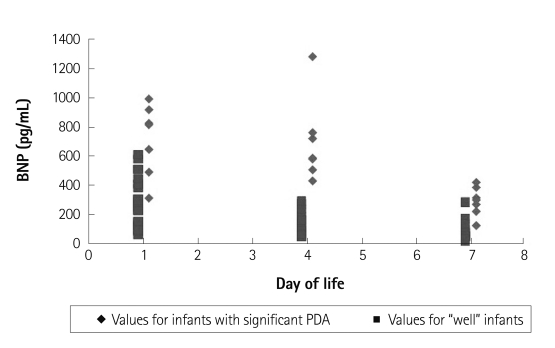
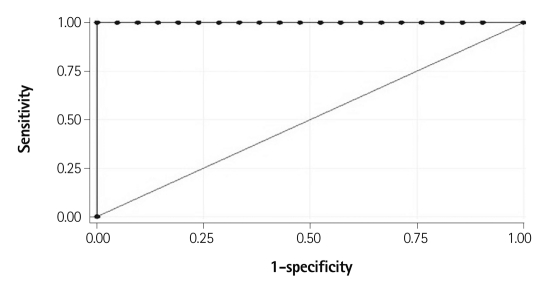
Results: A total of 28 preterm infants were prospectively enrolled in this study. Seven infants with PDA had higher on day 4 plasma BNP values (median 654.68 pg/mL; range 428.29-1280.00) compared to the control group (median 124.52 pg/mL; range 37.21-290.49). The area under the receiver operator characteristic curve for the detection of hsPDA was high: 0.998 (95% confidence interval: 0.995-1.002). The cutoff of BNP concentration for the diagnosis of hsPDA was determined to be 412 pg/mL (sensitivity: 100%; specificity: 95%).
Conclusion: B-type natriuretic peptide can be a useful biomarker for the screening and diagnosis of PDA in preterm infants. Serial BNP measurements are valuable for assessing the clinical course and indomethacin responsiveness of PDA.
Keywords: B-type natriuretic peptide; Echocardiography; Patent ductus arteriosus.
Conflict of interest statement
The authors have no financial conflicts of interest.
Figures
References
-
- Bancalari E, Claure N, Gonzalez A. Patent ductus arteriosus and respiratory outcome in premature infants. Biol Neonate. 2005;88:192–201. - PubMed
-
- Clyman RI. Ductus arteriosus: current theories of prenatal and postnatal regulation. Semin Perinatol. 1987;11:64–71. - PubMed
-
- Heymann MA, Rudolf AM. Control of the ductus arteriosus. Physiol Rev. 1975;55:62–78. - PubMed
-
- Clyman RI. Mechanisms regulating the ductus arteriosus. Biol Neonate. 2006;89:330–335. - PubMed
-
- Rojas MA, Gonzalez A, Bancalari E, Claure N, Poole C, Silva-Neto G. Changing trends in the epidemiology and pathogenesis of neonatal chronic lung disease. J Pediatr. 1995;126:605–610. - PubMed
LinkOut - more resources
Full Text Sources