


Novel associations for hypothyroidism include known autoimmune risk loci
- PMID: 22493691
- PMCID: PMC3321023
- DOI: 10.1371/journal.pone.0034442
Novel associations for hypothyroidism include known autoimmune risk loci
Abstract
Hypothyroidism is the most common thyroid disorder, affecting about 5% of the general population. Here we present the current largest genome-wide association study of hypothyroidism, in 3,736 cases and 35,546 controls. Hypothyroidism was assessed via web-based questionnaires. We identify five genome-wide significant associations, three of which are well known to be involved in a large spectrum of autoimmune diseases: rs6679677 near PTPN22, rs3184504 in SH2B3, and rs2517532 in the HLA class I region (p-values 2.8·10(-13), 2.6·10(-12), and 1.3·10(-8), respectively). We also report associations with rs4915077 near VAV3 (p-value 7.5·10(-10)) and rs925489 near FOXE1 (p value 2.4·10(-19)). VAV3 is involved in immune function, and FOXE1 and PTPN22 have previously been associated with hypothyroidism. Although the HLA class I region and SH2B3 have previously been linked with a number of autoimmune diseases, this is the first report of their association with thyroid disease. The VAV3 association is also novel. We also show suggestive evidence of association for hypothyroidism with a SNP in the HLA class II region (independent of the other HLA association) as well as SNPs in CAPZB, PDE8B, and CTLA4. CAPZB and PDE8B have been linked to TSH levels and CTLA4 to a variety of autoimmune diseases. These results suggest heterogeneity in the genetic etiology of hypothyroidism, implicating genes involved in both autoimmune disorders and thyroid function. Using a genetic risk profile score based on the top association from each of the five genome-wide significant regions in our study, the relative risk between the highest and lowest deciles of genetic risk is 2.0.
Conflict of interest statement
Figures
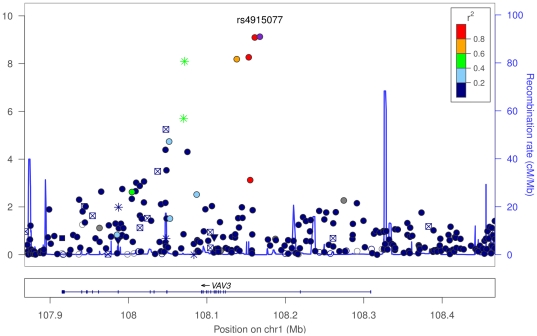
 ) of each SNP with the most associated SNP (i.e., rs4915077, shown in purple). Gray indicates SNPs for which
  information was missing. Plots were produced using the LocusZoom program .

References
-
- Cho JH, Gregersen PK. Genomics and the multifactorial nature of human autoimmune disease. N Engl J Med. 2011;365:1612–1623. - PubMed
MeSH terms
Substances
LinkOut - more resources
Full Text Sources
Other Literature Sources
Medical
Research Materials
