. 2012 Jun 15;590(12):2845-71.
doi: 10.1113/jphysiol.2012.228387. Epub 2012 Apr 10.

Quantitative measurement of mitochondrial membrane potential in cultured cells: calcium-induced de- and hyperpolarization of neuronal mitochondria

Affiliations

Quantitative measurement of mitochondrial membrane potential in cultured cells: calcium-induced de- and hyperpolarization of neuronal mitochondria

Akos A Gerencser et al. J Physiol. .

Abstract

Mitochondrial membrane potential (ΔΨM) is a central intermediate in oxidative energy metabolism. Although ΔΨM is routinely measured qualitatively or semi-quantitatively using fluorescent probes, its quantitative assay in intact cells has been limited mostly to slow, bulk-scale radioisotope distribution methods. Here we derive and verify a biophysical model of fluorescent potentiometric probe compartmentation and dynamics using a bis-oxonol-type indicator of plasma membrane potential (ΔΨP) and the ΔΨM probe tetramethylrhodamine methyl ester (TMRM) using fluorescence imaging and voltage clamp. Using this model we introduce a purely fluorescence-based quantitative assay to measure absolute values of ΔΨM in millivolts as they vary in time in individual cells in monolayer culture. The ΔΨP-dependent distribution of the probes is modelled by Eyring rate theory. Solutions of the model are used to deconvolute ΔΨP and ΔΨM in time from the probe fluorescence intensities, taking into account their slow, ΔΨP-dependent redistribution and Nernstian behaviour. The calibration accounts for matrix:cell volume ratio, high- and low-affinity binding, activity coefficients, background fluorescence and optical dilution, allowing comparisons of potentials in cells or cell types differing in these properties. In cultured rat cortical neurons, ΔΨM is −139 mV at rest, and is regulated between −108 mV and −158 mV by concerted increases in ATP demand and Ca2+-dependent metabolic activation. Sensitivity analysis showed that the standard error of the mean in the absolute calibrated values of resting ΔΨM including all biological and systematic measurement errors introduced by the calibration parameters is less than 11 mV. Between samples treated in different ways, the typical equivalent error is ∼5 mV.


Figures

Figure 1
Figure 1. Model for PMPI and TMRM redistribution across the plasma and mitochondrial membranes
A, the redistribution of the two lipophilic ions between the extracellular space and the cytosol was kinetically modelled. The potential-dependent uptake and efflux rate equations corresponding to eqn (1) are indicated above and below the arrows. TMRM was assumed to be in Nernstian equilibrium between the mitochondrial matrix and the cytosol. B, electrostatic or Eyring barrier in the plasma membrane, illustrating the simplified potentials (Ψ) that affect the diffusion of lipophilic probes across the membrane. s denotes the position of the peak of the potential barrier (Ψbarrier). s is between 0 and 1 and is 0.5 if the membrane behaves symmetrically.
Figure 2
Figure 2. Characterization of the behaviour of TMRM and PMPI at the plasma membrane by fluorescence imaging combined with electrophysiology
Aa–Da, cortical neurons were equilibrated for 30–60 min with TMRM (400 nm) in the presence of stigmatellin (1.25 μm), oligomycin (10 μg ml−1) and the uncoupler SF6847 (5 μm), to discharge ΔΨM. AbDb, cortical neurons were equilibrated with PMPI (1:200). A, fluorescence (black squares) recorded under voltage-clamp (red) in perforated mode of the whole-cell configuration. Green traces illustrate the fits performed for each decay or rise (eqn (5); see below). B, relationship of the equilibrium fluorescence intensities and the holding potentials (extrapolation of a single exponential function was used if no obvious equilibrium was reached). The red line is the best fit of eqn (4) for parameters f0, fX and b. C, relationship of the rate constants k1 (triangles) and k2 (squares) to the holding potential. Each pair of k1 and k2 values is the result of fits performed for each voltage step-triggered decay or rise (eqn (5); green traces in A). Functions fitting the k1 and k2 values were generated by first seeking the values of k and s using eqn (6), then plotting the functions of k1 (red) and k2 (green) according to eqn (3). See values of z, fX and k in Table 1. D, overlay of the fluorescence intensity calibrated in millivolts (black) and the holding potential (red). The calibration was performed by numeric solution of eqn (2) for the determined s values. Data are representative recordings from 8 cells in both conditions.
Figure 3
Figure 3. Complete calibration of plasma membrane potential in cortical neurons
Cortical neurons were equilibrated with TMRM (7.5 nm) and PMPI (1:200) in the presence of TPB (1 μm) for >90 min and imaged with wide-field fluorescence microscopy at 1 frame s−1. Only the PMPI data is shown here, for TMRM see Fig. 4. A, PMPI fluorescence micrographs after spectral unmixing from TMRM fluorescence bleed-through, depicting the first (a) and last (b) cropped frames of the experiment. Coloured, numbered shapes indicate the regions of interest (ROIs) used for averaging fluorescence intensity. The arrow shows the cell corresponding to the insets below. B, normalized PMPI fluorescence intensities, indicating mean ± SEM of fluorescence measured over n= 12 neurons in a representative experiment. The corresponding image recording is shown cropped in A. The anti-excitotoxicity cocktail (AEC), anti-swelling cocktail (ASC), mitochondrial depolarization cocktail (MDC) and complete depolarization cocktail (CDC; Table 2) were mixed into the experimental buffer as indicated. [K+]EC was incremented when indicated by fractional replacement of the experimental buffer with identical, but KCl-based, buffer containing all previously added drugs. The green fit curve and the red diamonds mark data ranges of analysis performed below. The red circle indicates the position of measuring fP0. C, calibrated ΔΨP showing mean ± SEM of the 12 neurons. Calibration was performed cell-by-cell using eqn (8). Top inset, example of the determination of fPX, [K+]C and ΔΨP,rest, by linear regression (eqns (10)–(12)) in a single neuron (marked by the arrow in A). Red diamonds correspond to the ones in B. Bottom inset, example of the determination of kP by linear regression (eqns (15)–(17)) in a single neuron (marked by the arrow in A). Data points were transformed from the equivalent of the segment of B marked by green. Main graphs show the average of 12 neurons in one representative experiment, while insets depict a single cell from the 12 neurons in this experiment (marked by the arrow in A). Table 3 summarizes the parameters and potentials determined in all similar experiments (n= 8).
Figure 4
Figure 4. Complete calibration of mitochondrial membrane potential in cortical neurons
Only the TMRM data are shown here; for PMPI see Fig. 3. A, TMRM fluorescence micrographs after spectral unmixing from PMPI fluorescence bleed-through, depicting the first (a) and last (b) frames of the experiment detailed in Fig. 3. B, TMRM fluorescence intensities, indicating mean ± SEM of fluorescence over n= 12 neurons in a representative experiment. The corresponding image recording is shown cropped in A. AEC, MDC and CDC (Table 2) were mixed into the experimental buffer as indicated. C, calibrated ΔΨM, showing mean ± SEM (n= 12). Calibration was performed cell-by-cell using eqn (22) and the time course of ΔΨP determined in Fig. 3C. Inset, example of the determination of fTX, fTE, kP and ΔΨM,rest by linear regression (eqns (24)–(26)) in a single neuron (marked by the arrow in A). Data points were transformed from the equivalent of the segment of B marked by green. Main graphs show the average of 12 neurons in one representative experiment, while the inset depicts a single cell from the 12 neurons in this experiment. The following constants were used for the calculations: RAV= 1.179, zP=−0.55, zTM= 0.71, zT= 0.8, sT= 0.41. Table 3 summarizes the parameters and potentials determined in all similar experiments (n= 8).
Figure 5
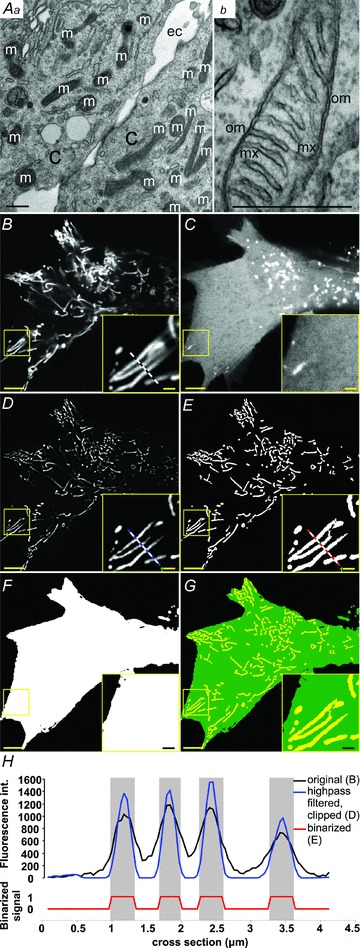
Figure 5. Measurement of mitochondria:cell and matrix:mitochondrion volume fractions in INS-1E cells with electron microscopy and laser scanning confocal microscopy
A, electron microscopic stereology was performed in uniform random sectioned samples of INS-1E cells imaged at 20,500× (a) to determine the mitochondria (m) to cell (c) volume fraction; within these sections mitochondria with well-outlined cristae were imaged at 105,000× (b) to measure the matrix:mitochondrion volume fraction. Scale bars, 500 nm; ec, extracellular space; mx, matrix; om, outer mitochondrial membrane. BH, confocal microscopic determination of the mitochondria to cytosol volume fraction was performed by imaging MitoTracker Red (B) and calcein fluorescence (C). D and E, MitoTracker Red images were highpass filtered (D) and binarized (E) by locally adaptive thresholding. F, calcein images were binarized by globally adaptive thresholding. G, composite image showing mitochondrial profiles in yellow and cellular profile in green. BG, scale bars, 5 μm. Insets show magnifications of the boxed areas; scale bars in insets, 1 μm. H, effect of highpass filtering on local background fluorescence intensities. The black trace corresponds to the unfiltered fluorescence intensity profile measured across the line in B. Inset, blue and red traces depict pixel values corresponding to the same line in the highpass filtered (D) and binarized (E) images, respectively.
Figure 6
Figure 6. Measurements of volume and activity coefficient ratios in cortical neurons
Confocal microscopic determination of mitochondria:cell volume fraction was performed by imaging MitoTracker Red (A) and calcein fluorescence (B). C, composite image showing mitochondrial profiles in yellow and cellular profile in green obtained as in Fig. 5BG. Processes and astroglia surrounding the neuronal soma were masked manually. D, cortical neurons loaded with TMRM (50 nm; without TPB) were time-lapse imaged immediately after complete mitochondrial depolarization using MDC. White outlines indicate the regions in which nuclear fluorescence intensity was measured. E, TMRM fluorescence intensity image (from D) masked by a copy of the same image binarized for the mitochondrial pattern, performed as in C. The areas indicated by the white outlines were used to determine mitochondrial fluorescence intensities. F, relationship of mitochondrial and nuclear fluorescence intensities measured in D and E, respectively, shown normalized to the initial mitochondrial fluorescence. Note that as TMRM leaks out of the cell over time, the two fluorescence intensities decrease proportionally. This proportionality provides aR′. Scale bars, 5 μm. The regression was done cell-by-cell and aR′ (0.410 ± 0.007) is expressed as the mean ± SEM of experiments (n= 5; 5–12 neurons were observed per experiment; from 3 independent cultures).
Figure 7
Figure 7. Sensitivity analysis using error propagation
The errors in single-cell ΔΨM calibration caused by the error of the indicated parameter(s) are shown as a function of ΔΨM and ΔΨP. Values associated with contours are given as SEM in mV. A, error caused by typical error in MDC-triggered decay parameters (slope = 0.035 ± 0.0016 and intercept = 0.0021 ± 0.00009 mean ± mean of parameter ± mean of SEMs of the regressions performed on single cells). B, error caused by typical fluorescence signal to noise ratio (mean/SD = 80 for PMPI and 110 for TMRM), without errors propagating through fPX and fTX. C, error caused by the determination of PMPI to TMRM crossbleed correction coefficient (0.379 ± 0.003 mean ± SEM; n= 3). D, error caused by the SEM of aR′= 0.410 ± 0.007 (n= 5). E, error caused by the SEM of VF= 7.53 ± 0.08% (n= 4). F, error caused by 10% deviation in the assumed value VFM= 0.8. Errors were calculated for parameters given in Table 3 column 2 with a Savitzky–Golay kernel width of 21.
Figure 8
Figure 8. Sensitivity analysis using simulation
AaHa and Ab–Hb, PMPI and TMRM fluorescence was simulated during swelling (or contraction) of the whole cell volume (VT) with constant mitochondrial volume fraction (AaHa), and during swelling (or contraction) of mitochondria (Ab–Hb) (a change of VF with constant total cellular volume). A, the model experiment simulated a transient depolarization of ΔΨP (green) followed by calibration K+ steps, stable ΔΨM (red) during the ΔΨP transient, a hyperpolarization and a depolarization followed by mitochondrial (MDC) and complete (CDC) depolarization. Numbered discs correspond to Table 4. B, time course of modelled volume change, simulating swelling during the stimulation, and during the calibration. C and D, PMPI (C) and TMRM (D) fluorescence traces were calculated from the potential time courses (A) assuming that VT (originally 1) or VF (originally 7.53%) changes as shown in B. Trace colours correspond to the modelled volume changes in (B). The inset in C shows the linear regression performed on the K+ steps (eqn (10)–(12)). The inset in D shows the linear regression performed on the complete mitochondrial depolarization-induced decay curve (marked by the bracket; for eqns (24)–(26)). E, ΔΨP was calculated from C by assuming unchanged volumes. F, ΔΨM was calculated from D and E by performing the calibration protocol shown in Fig. 4 and assuming unchanged volumes. E and F, black traces (mostly overlaid by the light blue) correspond to the modelled potentials (A). The insets in E and F plot the obtained resting potentials as functions of the maximal alteration of the volume term. G and H, calibrated potentials as in E and F but assuming a 25-fold binding of TMRM to mitochondrial and 5-fold binding of PMPI to cellular membranes. Simulations were performed using parameter values as shown in Table 4, with the exception that PN= 5 was used to provide a hyperpolarization of ΔΨP upon modelled MDC addition.
Figure 9
Figure 9. Measurement of ΔΨP and ΔΨM in cortical neurons during K+-evoked plasma membrane depolarization
A and B, PMPI (A) and TMRM (B) fluorescence intensities after background correction and spectral unmixing. Data points are means ± SEM of n= 3–5 experiments. Only time points preceding the calibration steps (MDC and CDC addition) are shown. Insets show the complete time lapse for a representative experiment (mean ± SEM of n= 11, 8 and 15 cells for a, b and c, respectively). The bracketed parts of the insets correspond to the main graphs. C, ΔΨP was calibrated as in Fig. 3, in single cells using fPi measured after each K+ step and fP0 measured after CDC addition. D, ΔΨM was calibrated as in Fig. 4 using C and the MDC-triggered decay curve (marked by the arrowhead in B inset) and fT0 measured after CDC addition. AaDa, the effect of isosmotic application 40 mm KCl to the cultures using rapid exchange of the superfusion medium (n= 5). In AbDb, KCl was added in the presence of oligomycin (2 μg ml−1) as indicated on the top (n= 5). In AcDc, cultures were pretreated (∼15 min) and all media were supplemented with oligomycin (2 μg ml−1) and AEC in the (nominal) absence of Ca2+ (n= 3).
Figure 10
Figure 10. Calcium-dependent mitochondrial hyperpolarization in firing neurons
Cortical neurons were field stimulated at 100 Hz, 20 mA, 1 ms pulse width in 10 s trains (indicated by the bars on the top), while cultures were superfused with fresh medium. A and B, PMPI (A) and TMRM (B) fluorescence intensities after background correction and spectral unmixing. See the description of the insets in Fig. 9 legend. C, ΔΨP was calibrated as in Fig. 3, in single cells using fPi measured after each K+ step and fP0 measured after CDC addition. D, ΔΨM was calibrated as in Fig. 4 using C and the MDC-triggered decay curve (marked by the arrowhead in B inset) and fT0 measured after CDC addition. Aa–Da were performed in normal medium (mean ± SEM of n= 5 experiments), and Ab–Db in the (nominal) absence of Ca2+ (n= 9). Note that the transients in C and D are slightly smeared in time as compared to the recorded fluorescence (A and B) because of the application of smoothing and differential kernels (width = 15), and that the ΔΨM hyperpolarizations followed the ΔΨP depolarizations.

References

    1. Ainscow EK, Brand MD. Internal regulation of ATP turnover, glycolysis and oxidative phosphorylation in rat hepatocytes. Eur J Biochem. 1999;266:737–749. - PubMed
    1. Andersen PS, Fuchs M. Potential energy barriers to ion transport within lipid bilayers. Studies with tetraphenylborate. Biophys J. 1975;15:795–830. - PMC - PubMed
    1. Bakeeva LE, Grinius LL, Jasaitis AA, Kuliene VV, Levitsky DO, Liberman EA, Severina II, Skulachev VP. Conversion of biomembrane-produced energy into electric form. II. Intact mitochondria. Biochim Biophys Acta. 1970;216:13–21. - PubMed
    1. Birket MJ, Orr AL, Gerencser AA, Madden DT, Vitelli C, Swistowski A, Brand MD, Zeng X. A reduction in ATP demand and mitochondrial activity with neural differentiation of human embryonic stem cells. J Cell Sci. 2011;124:348–358. - PMC - PubMed
    1. Boork J, Wennerstrom H. The influence of membrane potentials on reaction rates. Control in free-energy-transducing systems. Biochim Biophys Acta. 1984;767:314–320. - PubMed

Publication types

LinkOut - more resources