


Predictors of overall perceived health in patients with heart failure
- PMID: 22495800
- PMCID: PMC3396769
- DOI: 10.1097/JCN.0b013e31824987a8
Predictors of overall perceived health in patients with heart failure
Abstract
Background: Overall perceived health (OPH) is a powerful and independent predictor of negative health outcomes and low health-related quality of life. Overall perceived health is conspicuously low in patients with heart failure (HF).
Objective: The purpose of this study was to determine the key predictors of OPH in persons with HF and explore possible mediating relationships.
Methods: This cross-sectional predictive correlational study was a secondary analysis of an existing data set. Individual characteristics, biophysiological variables, physical symptoms, psychological symptoms, and physical and social functioning were identified from the Wilson and Cleary Model and tested as predictors of OPH in a 5-step hierarchical regression analysis.
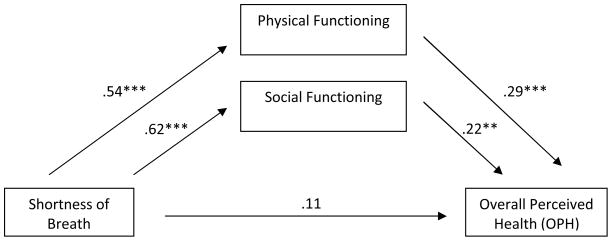
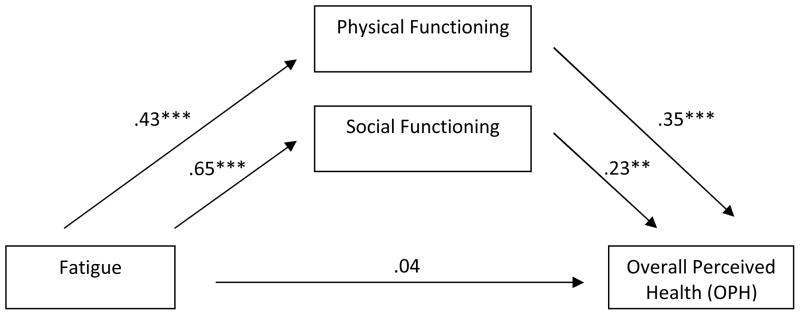
Results: The sample (n = 265) was primarily male (64.2%) and white (61.9%), with a mean age of 62 years, and had at least a high school education and a household income enough or more than enough to meet needs. Most (69.1%) had systolic dysfunction, and 78.5% were New York Heart Association class III or IV. The final model containing 15 predictors explained 39.2% of the variance in OPH. Six variables were significant independent predictors of OPH: perceived sufficiency of income, social functioning, comorbid burden, symptom stability, race, and the interaction of gender and social functioning, the last indicating social functioning as a stronger predictor for men than for women. In a multiple mediation analysis, the effects of shortness of breath and fatigue on OPH were mediated by physical and social functioning. Gender moderated the effect of fatigue through social functioning.
Conclusions: These variables explained a significant portion of the variance in OPH and can be used to target individuals at risk for low OPH and to tailor interventions. If OPH is low, a focus on patient symptoms and ability to participate in life activities is appropriate, with particular attention to social functioning in men.
Figures
References
-
- Roger VL, Go AS, Lloyd-Jones DM, Adams RJ, Berry JD, Brown TM. Heart disease and stroke statistics—2011 update: A report from the American Heart Association. Circulation. 123:e18–e209. Retrieved January 30, 2011, from http://www.circ.ahajournals.org. - PMC - PubMed
-
- Roger VL, Weston SA, Redfield MM, Hellermann-Homan JP, Killian J, Yawn BP, et al. Trends in heart failure incidence and survival in a community-based population. JAMA. 2004;292(3):344–350. - PubMed
-
- Hunt SA, Abraham WT, Chin MH, Feldman AM, Francis GS, Ganiats TG, et al. 2009 Focused update incorporated into the ACC/AHA 2005 guidelines for the diagnosis and management of heart failure in adults: a report of the American College of Cardiology Foundation/American Heart Association Task Force on Practice Guidelines. Circulation. 2009;119:e391–e479. Retrieved on August 21, 2009 from http://circ.ahajournals.org/cgi/content/full/119/14/e391. - PubMed
-
- Calvert MJ, Freemantle N, Cleland JG. The impact of chronic heart failure on health-related quality of life data acquired in the baseline phase of the CARE-HF study. Eur J Heart Fail. 2005;7(2):243–251. - PubMed
-
- Bailis DS, Segall A, Chipperfield JG. Two views of self-rated general health status. Soc Sci Med. 2003;56(2):203–217. - PubMed
Publication types
MeSH terms
Grants and funding
LinkOut - more resources
Full Text Sources
Other Literature Sources
Medical
Research Materials
Miscellaneous
