. 2012 May 25;287(22):18854-62.
doi: 10.1074/jbc.M112.352815. Epub 2012 Apr 11.

Identification of a conserved interface between PUF and CPEB proteins

Affiliations

Identification of a conserved interface between PUF and CPEB proteins

Zachary T Campbell et al. J Biol Chem. .

Abstract

Members of the PUF (Pumilio and FBF) and CPEB (cytoplasmic polyadenylation element-binding) protein families collaborate to regulate mRNA expression throughout eukaryotes. Here, we focus on the physical interactions between members of these two families, concentrating on Caenorhabditis elegans FBF-2 and CPB-1. To localize the site of interaction on FBF-2, we identified conserved amino acids within C. elegans PUF proteins. Deletion of an extended loop containing several conserved residues abolished binding to CPB-1. We analyzed alanine substitutions at 13 individual amino acids in FBF-2, each identified via its conservation. Multiple single point mutations disrupted binding to CPB-1 but not to RNA. Position Tyr-479 was particularly critical as multiple substitutions to other amino acids at this position did not restore binding. The complex of FBF-2 and CPB-1 repressed translation of an mRNA containing an FBF binding element. Repression required both proteins and was disrupted by FBF-2 alleles that failed to bind CPB-1 or RNA. The equivalent loop in human PUM2 is required for binding to human CPEB3 in vitro, although the primary sequences of the human and C. elegans PUF proteins have diverged in that region. Our findings define a key region in PUF/CPEB interactions and imply a conserved platform through which PUF proteins interact with their protein partners.


Figures
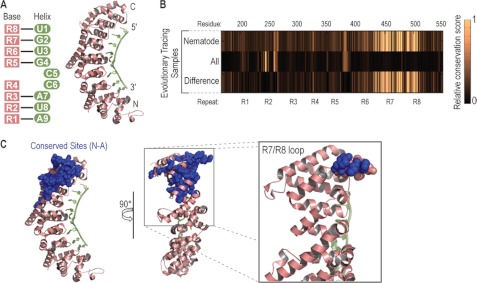
FIGURE 1.
FIGURE 1.
Identification of conserved sites in FBF-2. A, recognition of RNA by PUFs is highly modular; a schematic and the structure of FBF-2 (28) are shown. PUF repeats (pink) specify recognition of RNA bases (green). B, identification of conserved residues in nematode PUFs, all PUFs, and a subtraction of the two sets. Conservation was calculated using Evolutionary Tracing (46). C, an extended loop along one side of the PUF repeats contains conserved sites. Inset, the R7/R8 loop residues (479–485) are shown as spheres; two of residues in this region were identified as conserved sites using Evolutionary Tracing (blue spheres).
FIGURE 2.
FIGURE 2.
Analysis of a mutant in FBF-2 that lacks the R7/R8 loop. A, schematic of the yeast two-hybrid assay. Binding assays of a wild-type and a mutant form of FBF-2 and wild-type CPB-1 are shown. The YBZ-1 cell line was transformed with plasmids expressing the indicated GAL4 activation domain (AD) or DNA binding domain (LexA) fusions indicated. B, RNA binding assayed in the yeast three-hybrid system. Interactions between a high affinity binding site from the gld-1 FBEa and wild-type or mutant version of FBF-2 are shown. Error bars in A and B indicate S.D. C, an affinity chromatography-based assay of FBF-2 binding to CPB-1. CPB-1 was immobilized on resin and incubated with FBF-2. Unbound FBF-2 was washed away using a series of wash steps, and the specifically bound protein eluted at high concentrations of imidazole. Ni-NTA, nickel-nitrilotriacetic acid. D, FBF-2 eluted at high concentrations of imidazole. In the absence of CPB-1, FBF-2 is weakly associated with the resin. However, in the presence of CPB-1, FBF-2 is eluted at high concentrations of imidazole. The deletion mutant behaves in an identical fashion to FBF-2 in the absence of CPB-1.
FIGURE 3.
FIGURE 3.
Identification of interaction-defective mutants in FBF-2 using targeted screen. A, logic of the experiment. B and C, measurements of CPB-1 binding in a yeast two-hybrid assay (B) and RNA binding in a yeast three-hybrid assay (C). D, the ratio of LacZ values obtained from the assays in B and C was used to identify mutations that specifically disrupted binding to CPB-1 but not to RNA (black bars). Error bars in B–D indicate S.D.
FIGURE 4.
FIGURE 4.
Clustered interaction-defective alleles and biochemical analysis of key residue, Tyr-479. A, neutral mutations (gray), interaction-defective mutants (purple), and the most defective point mutant (blue) are shown as spheres in the structure of FBF-2 (28). Inset, the single largest loss of interaction point mutant, Y479A, is adjacent to the other loss of interaction mutants. B, additional mutations at position 479 fail to interact with CPB-1 in yeast two-hybrid assays. C, however, RNA binding is uncompromised in yeast three-hybrid assays. Error bars in B and C indicate S.D.
FIGURE 5.
FIGURE 5.
CPB-1 is required for translational repression of FBE-containing reporter by FBF-2. A, schematic of the cell-free repression assay of translation. Two rounds of translation were conducted. In the first, CPB-1 and FBF-2 proteins were in vitro translated from 50 ng of mRNA. In the second round, newly synthesized proteins were incubated with two reporter RNAs. The firefly luciferase reported contained a 3′-UTR PUF binding element derived from the 3′-UTR of SSP-10. The second Renilla reporter was used as a control. These were incubated for 90 min, and activities of both reporters were quantified. B, the translation of the firefly reporter is repressed only in the presence of FBF-2 and CPB-1. As controls, CPB-1 binding-defective (CPBdef) (Y479A), an RNA binding-defective (RNAdef) (H326A) form of FBF-2, and an FBF-2 binding defective mutant of CPB-1 (FBFdef, L40A) were assayed. FBFdef, FBF-binding defective. FF/Ren, firefly/Renilla. C, the mechanism utilized by FBF-2 in the presence of CPB-1 is not dependent on deadenylation as similar results are obtained on a reporter lacking a poly(A) tail. D, schematic of a modified yeast three-hybrid assay. CPB-1 is expressed with an SV40 nuclear localization sequence (NLS). The effects on FBF-2 binding to RNA are assayed using Lac-Z expression. E, expression of CPB-1 alters binding of FBF-2 to the ssp-10 RNA but not an empty vector or high affinity gld-1a site. Error bars in B, C, and E indicate S.D.
FIGURE 6.
FIGURE 6.
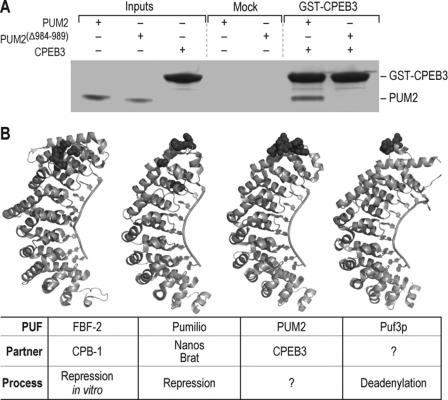
Identification of a conserved site of interaction between PUFs and CPEBs. A, affinity chromatography of human CPEB3 was conducted with either wild-type PUM2 or mutant PUM2Δ984–989. Wild-type PUM2 specifically associates with CPEB3 and not a mock GST alone control. However, PUM2Δ984–989 failed to interact with either. B, a broadly conserved interface mediates protein-protein interactions throughout PUF proteins. The sites of mutations that disrupt specific interactions are shown as spheres (40, 55).

References

    1. Valencia-Sanchez M. A., Liu J., Hannon G. J., Parker R. (2006) Control of translation and mRNA degradation by miRNAs and siRNAs. Genes Dev. 20, 515–524 - PubMed
    1. Gebauer F., Hentze M. W. (2004) Molecular mechanisms of translational control. Nat. Rev. Mol. Cell Biol. 5, 827–835 - PMC - PubMed
    1. Besse F., Ephrussi A. (2008) Translational control of localized mRNAs: restricting protein synthesis in space and time. Nat. Rev. Mol. Cell Biol. 9, 971–980 - PubMed
    1. Osborne H. B., Richter J. D. (1997) Translational control by polyadenylation during early development. Prog. Mol. Subcell. Biol. 18, 173–198 - PubMed
    1. Wickens M., Kimble J., Strickland S. (1996) Translational control of developmental decisions in Translational Control (Hershey J., Mathews M., Sonenberg N., eds) pp. 411–450, Cold Spring Harbor Laboratory Press, Plainview, NY

Publication types

MeSH terms

Substances