The impact of age and gender on papillary thyroid cancer survival
- PMID: 22496497
- PMCID: PMC3387425
- DOI: 10.1210/jc.2011-2864
The impact of age and gender on papillary thyroid cancer survival
Abstract
Context: Thyroid cancer predominately affects women, carries a worse prognosis in older age, and may have higher mortality in men. Superimposed on these observations is the fact that most women have attained menopause by age 55 yr.
Objective: The objective of the study was to determine whether men contribute disproportionately to papillary thyroid cancer (PTC) mortality or whether menopause affects PTC prognosis.
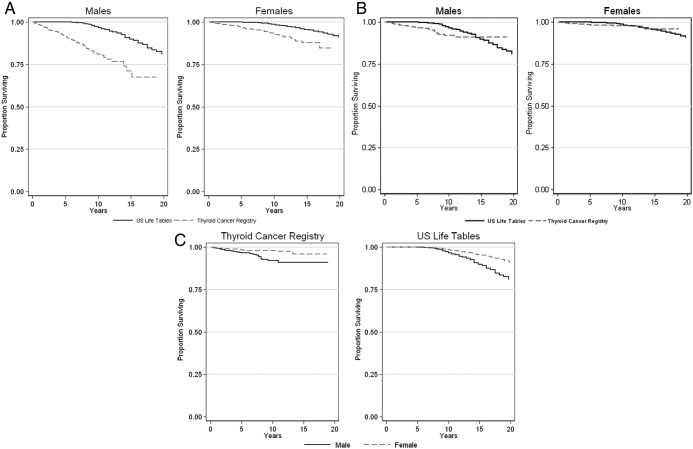
Design: Gender-specific mortality was normalized using age-matched subjects from the U.S. population. Multivariate Cox proportional hazard regression models incorporating gender, age, and National Thyroid Cancer Treatment Cooperative Study Group stage were used to model disease-specific survival (DSS).
Participants and setting: Patients were followed in a prospective registry.
Main outcome measure: The relationships between gender, age, and PTC outcomes were analyzed.
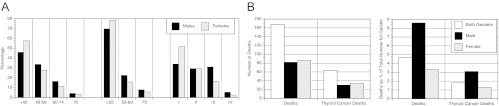
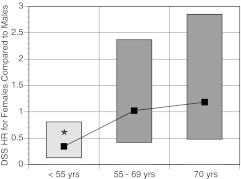
Results: The unadjusted hazard ratio (HR) for DSS for women was 0.40 [confidence interval (CI) 0.24-0.65]. This female advantage diminished when DSS was adjusted for age at diagnosis and stage with a HR encompassing unity (HR 0.72, CI 0.44-1.19). Additional multivariate models of DSS considering gender, disease stage, and various age groupings showed that the DSS for women diagnosed at under 55 yr was improved over men (HR 0.33, CI 0.13-0.81). However, the HR for DSS increased to become similar to men for women diagnosed at 55-69 yr (HR 1.01, CI 0.42-2.37) and at 70 yr or greater (HR 1.17, CI 0.48-2.85).
Conclusions: Although the overall outcome of women with PTC is similar to men, subgroup analysis showed that this composite outcome is composed of two periods with different outcomes. The first period is a period with better outcomes for women than men when the diagnosis occurs at younger than 55 yr; the second is a period with similar outcomes for both women and men diagnosed at ages greater than 55 yr. These data raise the question of whether an older age cutoff would improve current staging systems. We hypothesize that older age modifies the effect of gender on outcomes due to menopause-associated hormonal alterations.
Figures
References
-
- Akslen LA, Haldorsen T, Thoresen SO, Glattre E. 1991. Survival and causes of death in thyroid cancer: a population-based study of 2479 cases from Norway. Cancer Res 51:1234–1241 - PubMed
-
- Cunningham MP, Duda RB, Recant W, Chmiel JS, Sylvester JA, Fremgen A. 1990. Survival discriminants for differentiated thyroid cancer. Am J Surg 160:344–347 - PubMed
-
- Micheli A, Ciampichini R, Oberaigner W, Ciccolallo L, de Vries E, Izarzugaza I, Zambon P, Gatta G, De Angelis R. 2009. The advantage of women in cancer survival: an analysis of EUROCARE-4 data. Eur J Cancer 45:1017–1027 - PubMed
-
- Tubiana M, Schlumberger M, Rougier P, Laplanche A, Benhamou E, Gardet P, Caillou B, Travagli JP, Parmentier C. 1985. Long-term results and prognostic factors in patients with differentiated thyroid carcinoma. Cancer 55:794–804 - PubMed
-
- Carcangiu ML, Zampi G, Pupi A, Castagnoli A, Rosai J. 1985. Papillary carcinoma of the thyroid. A clinicopathologic study of 241 cases treated at the University of Florence, Italy. Cancer 55:805–828 - PubMed
Publication types
MeSH terms
Grants and funding
LinkOut - more resources
Full Text Sources
Medical