. 2012;8(4):e1002463.
doi: 10.1371/journal.pcbi.1002463. Epub 2012 Apr 5.

Energetic selection of topology in ferredoxins

Affiliations

Energetic selection of topology in ferredoxins

J Dongun Kim et al. PLoS Comput Biol. 2012.

Abstract

Models of early protein evolution posit the existence of short peptides that bound metals and ions and served as transporters, membranes or catalysts. The Cys-X-X-Cys-X-X-Cys heptapeptide located within bacterial ferredoxins, enclosing an Fe₄S₄ metal center, is an attractive candidate for such an early peptide. Ferredoxins are ancient proteins and the simple α+β fold is found alone or as a domain in larger proteins throughout all three kingdoms of life. Previous analyses of the heptapeptide conformation in experimentally determined ferredoxin structures revealed a pervasive right-handed topology, despite the fact that the Fe₄S₄ cluster is achiral. Conformational enumeration of a model CGGCGGC heptapeptide bound to a cubane iron-sulfur cluster indicates both left-handed and right-handed folds could exist and have comparable stabilities. However, only the natural ferredoxin topology provides a significant network of backbone-to-cluster hydrogen bonds that would stabilize the metal-peptide complex. The optimal peptide configuration (alternating α(L),α(R)) is that of an α-sheet, providing an additional mechanism where oligomerization could stabilize the peptide and facilitate iron-sulfur cluster binding.


Conflict of interest statement

The authors have declared that no competing interests exist.

Figures
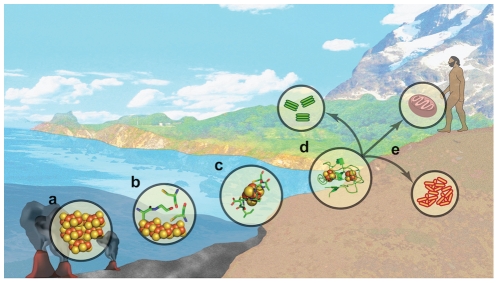
Figure 1
Figure 1. Hypothesized progression of iron-sulfur clusters from hydrothermal vents to life.
Figure 2
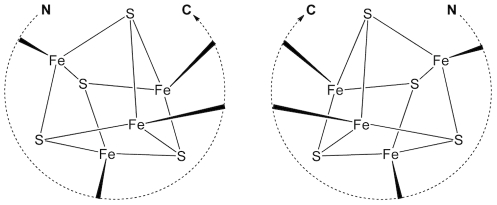
Figure 2. Two topological states of peptide-Fe4S4 cluster.
Figure 3
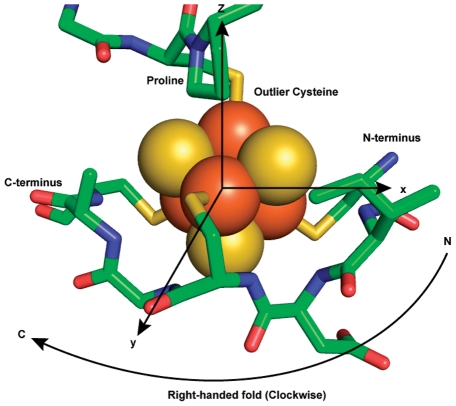
Figure 3. Fold topology in a ferredoxin fold.
Right/Left fold configuration can be defined with an outlier, by orienting the outlier cysteine along the z-axis and iron-sulfur cluster being at the origin. A ferredoxin fold, with a conserved sequence CxxCxxC with an outlier cysteine, can create either right or left topological configuration. Right-handed fold is shown.
Figure 4
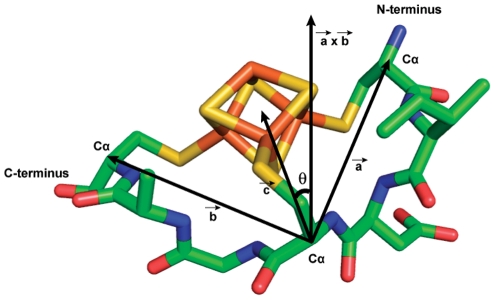
Figure 4. Topology angle in a ferredoxin fold for database analysis.
An arbitrary plane was defined with three cysteine carbon alpha coordinates. Three dimensional vector calculations were done to determine the topology angle of the protein fold.
Figure 5
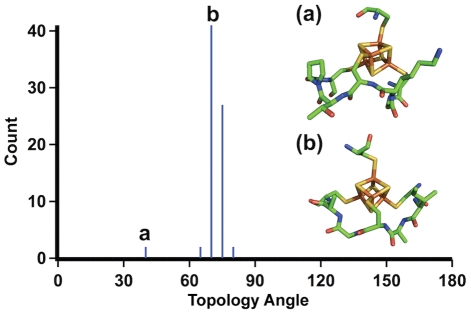
Figure 5. Topology of experimentally determined protein structures (Protein Data Bank).
The absence of peaks between 90 to 180 degrees suggests that the left-handed fold conformation does not exist in the known structures archived in the PDB.
Figure 6
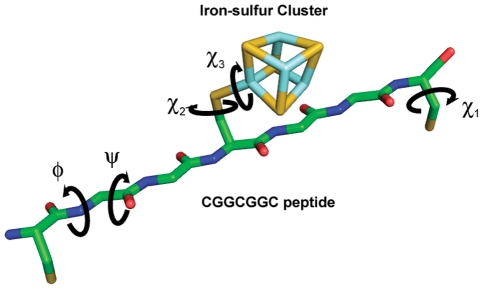
Figure 6. Protein ensemble generated by modifying psi, phi and chi dihedral angles.
For a model heptapeptide-cluster complex, CGGCGGC fused to an iron-sulfur cluster, there are total 6 ψ angles, 6 Φ angles, 3 χ1 angles, and one each for χ2 and χ3 angles. The permutations are carried out by 60 degrees step size for Φ and ψ and 120 degrees step size for χ angles.
Figure 7
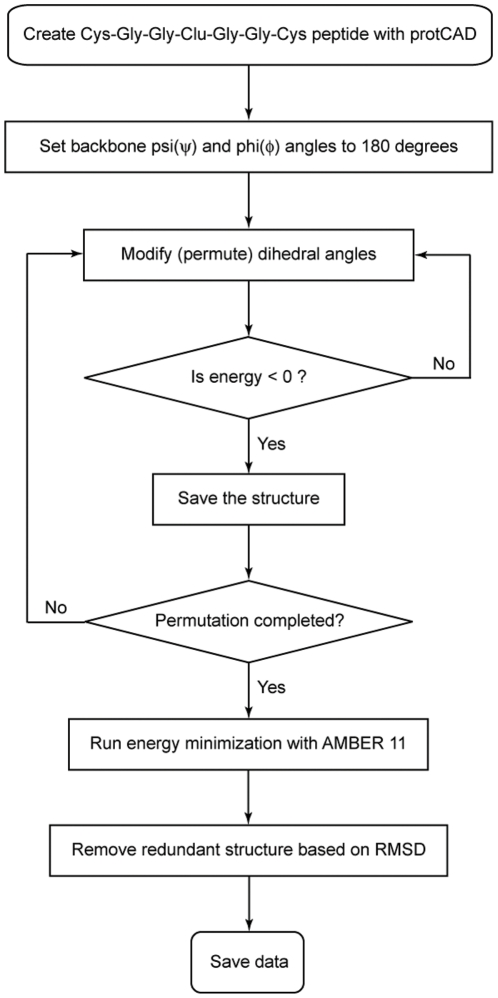
Figure 7. Cys-Gly-Gly-Clu-Gly-Gly-Cys peptide created with protCAD.
All possible structures are explored by permuting 17 rotatable dihedral angles of the peptide from −180 to 180 with a step size of 60 degrees.
Figure 8
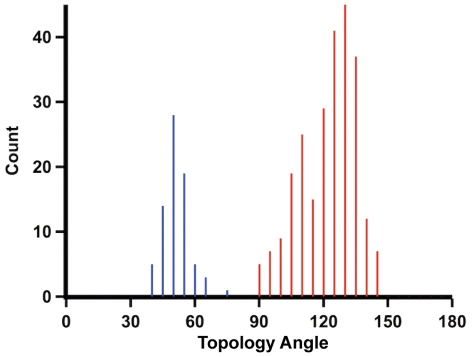
Figure 8. Topology angles of entactic structural states.
Cys-Gly-Gly-Clu-Gly-Gly-Cys hepeptide model has 232 structural entactic states, either right-handed (blue, 75 out of 232) or left-handed (red, 157 out of 232). Despite the inexistence of left-handed topological state in nature, model peptide suggests that left-handed structure can also properly interact with an iron-sulfur cluster.
Figure 9
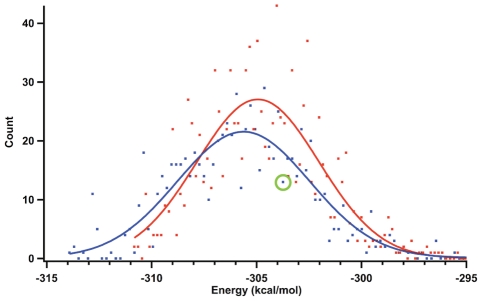
Figure 9. The energy distributions of right (blue) and left-handed (red) structures.
The gaussian fits are very similar, which suggests that the natural selection was not influenced by the energetic stability alone. The energy corresponding to the ensemble that has the lowest RMSD to the experimentally determined ferredoxin structure (PDB: 2FDN)- green circle.
Figure 10
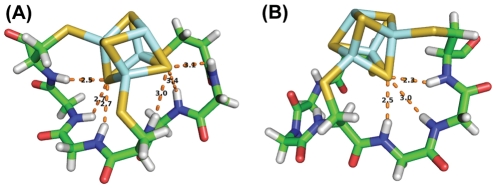
Figure 10. Computationally generated entactic states of the model heptapeptide with optimal peptide-cluster interaction energies.
(A) Right-handed fold can form six hydrogen bonds, whereas (B) left-handed fold can only contribute three hydrogen bonds.
Figure 11
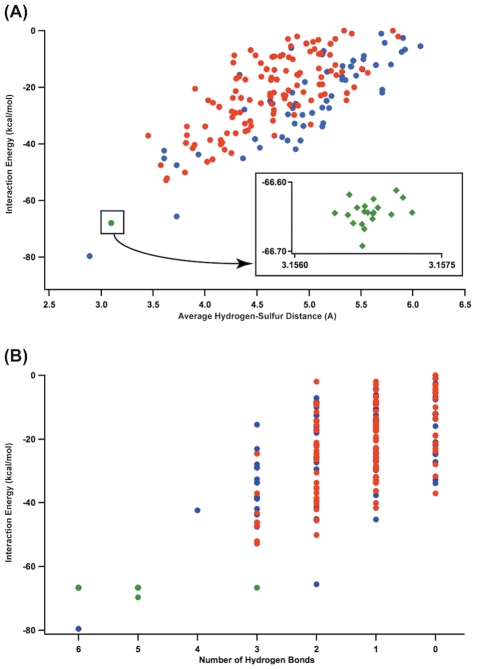
Figure 11. Hydrogen bonding environment of the 232 left- and right-handed heptapeptide-cluster conformations.
(A) Interaction energy vs. average H-S distance of left (red), right-handed (blue) complexes. Experimentally determined ferredoxin structures (green) and non-ferredoxin redox active proteins (purple) show nearly identical bond geometries and calculated interaction energies. (B). The same dataset presented as the number of hydrogen bonds versus interaction energy. Only one simulated peptide in the ensemble contributes six hydrogen bonds, corresponding to the best interaction energy. This is equivalent to the natural right-handed fold.

References

    1. Dupont CL, Yang S, Palenik B, Bourne PE. Modern proteomes contain putative imprints of ancient shifts in trace metal geochemistry. Proc Natl Acad Sci U S A. 2006;103:17822–17827. - PMC - PubMed
    1. Caetano-Anolles G, Caetano-Anolles D, Kim KM, Mittenthal JE. Proteome Evolution and the Metabolic Origins of Translation and Cellular Life. J Mol Evol. 2011;72:14–33. - PubMed
    1. Caetano-Anolles G, Kim HS, Mittenthal JE. The origin of modern metabolic networks inferred from phylogenomic analysis of protein architecture. Proc Natl Acad Sci U S A. 2007;104:9358–9363. - PMC - PubMed
    1. Falkowski PG, Fenchel T, Delong EF. The microbial engines that drive Earth's biogeochemical cycles. Science. 2008;320:1034–1039. - PubMed
    1. Eck RV, Dayhoff MO. Evolution of the structure of ferredoxin based on living relics of primitive amino acid sequences. Science. 1966;152:363–366. - PubMed

Publication types