


The impact of imputation on meta-analysis of genome-wide association studies
- PMID: 22496814
- PMCID: PMC3320624
- DOI: 10.1371/journal.pone.0034486
The impact of imputation on meta-analysis of genome-wide association studies
Abstract
Genotype imputation is often used in the meta-analysis of genome-wide association studies (GWAS), for combining data from different studies and/or genotyping platforms, in order to improve the ability for detecting disease variants with small to moderate effects. However, how genotype imputation affects the performance of the meta-analysis of GWAS is largely unknown. In this study, we investigated the effects of genotype imputation on the performance of meta-analysis through simulations based on empirical data from the Framingham Heart Study. We found that when fix-effects models were used, considerable between-study heterogeneity was detected when causal variants were typed in only some but not all individual studies, resulting in up to ∼25% reduction of detection power. For certain situations, the power of the meta-analysis can be even less than that of individual studies. Additional analyses showed that the detection power was slightly improved when between-study heterogeneity was partially controlled through the random-effects model, relative to that of the fixed-effects model. Our study may aid in the planning, data analysis, and interpretation of GWAS meta-analysis results when genotype imputation is necessary.
Conflict of interest statement
Figures
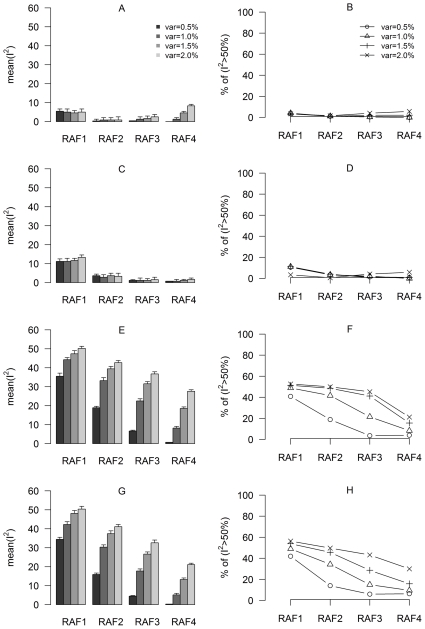
 , and those in the right column (B, D, F, H) show the average percentage of simulations with
  (large between-study heterogeneity). The plots in rows 1–4 are for scenarios 1–4, respectively. Descriptions of scenarios and RAF's are given in Table 2, and “var” values indicate the simulated QTL variance.
References
-
- McCarthy MI, Abecasis GR, Cardon LR, Goldstein DB, Little J, et al. Genome-wide association studies for complex traits: consensus, uncertainty and challenges. Nature Reviews Genetics. 2008;9:356–369. - PubMed
Publication types
MeSH terms
Grants and funding
- N01-HC-25195/HC/NHLBI NIH HHS/United States
- R01AR050496/AR/NIAMS NIH HHS/United States
- R01AR057049/AR/NIAMS NIH HHS/United States
- RC2 DE020756/DE/NIDCR NIH HHS/United States
- R01 AG026564/AG/NIA NIH HHS/United States
- P50AR055081/AR/NIAMS NIH HHS/United States
- RC2DE020756/DE/NIDCR NIH HHS/United States
- P50 AR055081/AR/NIAMS NIH HHS/United States
- R03 TW008221/TW/FIC NIH HHS/United States
- R01 AR050496/AR/NIAMS NIH HHS/United States
- R01AG026564/AG/NIA NIH HHS/United States
- R03TW008221/TW/FIC NIH HHS/United States
- R01 AR057049/AR/NIAMS NIH HHS/United States
- N01 HC025195/HL/NHLBI NIH HHS/United States
LinkOut - more resources
Full Text Sources
