


Expression Profiles in Stage II Colon Cancer According to APC Gene Status
- PMID: 22496922
- PMCID: PMC3323927
- DOI: 10.1593/tlo.11325
Expression Profiles in Stage II Colon Cancer According to APC Gene Status
Abstract
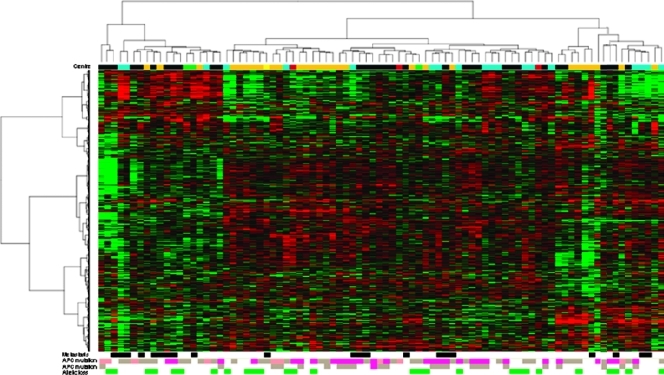
Colorectal cancer is one of the most common cancers in the world. Histoclinical staging is efficient, but combination with molecular markers may improve the classification of stage II cancers. Several tumor-suppressor genes have been associated with colorectal cancer, and the most frequent allelic losses have been extensively studied for their prognosis effect, but the results remain controversial. In a previous study, we found a possible influence of the chromosome 5 status in the development of liver metastases in stage II colon cancers. We have here investigated the role of the APC gene, located in chromosome arm 5q, in a series of 183 colon adenocarcinomas through a combined analysis of gene expression, mutation, allelic loss and promoter methylation, and metastasis occurrence. Point mutations were found in 73% of cases and allelic losses were found in 39%; 59% of tumors presented with a biallelic inactivation, with a very strong interdependence of the two APC hits (P = 2.1 x 10(-9)). No association was found between expression, number and type of APC alterations, and metastatic evolution. Our results show that the determination of APC status cannot help in the prediction of metastasis and cannot be used to subclassify stage II colon cancers.
Figures
References
-
- Ilyas M, Straub J, Tomlinson IPM, Bodmer WF. Genetic pathways in colorectal and other cancers. Eur J Cancer. 1999;35:335–351. - PubMed
-
- Miyoshi Y, Nagase H, Ando H, Horii A, Ichii S, Nakatsuru S, Aoki T, Miki Y, Mori T, Nakamura Y. Somatic mutations of the APC gene in colorectal tumors: mutation cluster region in the APC gene. Hum Mol Genet. 1992;1:229–233. - PubMed
-
- Powell SM, Petersen GM, Krush AJ, Booker S, Jen J, Giardiello FM, Hamilton SR, Vogelstein B, Kinzler KW. APC mutations occur early during colorectal tumorigenesis. Nature. 1192;359:235–237. - PubMed
-
- Segditsas S, Sieber OM, Rowan A, Setien F, Neale K, Phillips RK, Ward R, Esteller M, Tomlinson IP. Promoter hypermethylation leads to decreased APC mRNA expression in familial polyposis and sporadic colorectal tumours, but does not substitute for truncating mutations. Exp Mol Pathol. 2008;85:201–206. - PubMed
LinkOut - more resources
Full Text Sources
Other Literature Sources
Molecular Biology Databases