Review
. 2012 May;84(4):595-607.
doi: 10.1111/j.1365-2958.2012.08049.x. Epub 2012 Apr 13.

Proteolytic regulation of alginate overproduction in Pseudomonas aeruginosa

Affiliations
Review

Proteolytic regulation of alginate overproduction in Pseudomonas aeruginosa

F Heath Damron et al. Mol Microbiol. 2012 May.

Abstract

Pseudomonas aeruginosa, a Gram-negative bacterium, is a significant opportunistic pathogen associated with skin and soft tissue infections, nosocomial pneumonia and sepsis. In addition, it can chronically colonize the lungs of cystic fibrosis (CF) patients. Overproduction of the exopolysaccharide called alginate provides P. aeruginosa with a selective advantage and facilitates survival in the CF lung. The in vitro phenotype of alginate overproduction observed on solid culture media is referred to as mucoid. Expression of the alginate machinery and biosynthetic enzymes are controlled by the extracytoplasmic sigma factor, σ(22) (AlgU/T). The key negative regulator of both σ(22) activity and the mucoid phenotype is the cognate anti-sigma factor MucA. MucA sequesters σ(22) to the inner membrane inhibiting the sigma factor's transcriptional activity. The well-studied mechanism for transition to the mucoid phenotype is mutation of mucA, leading to loss of MucA function and therefore activation of σ(22) . Recently, regulated intramembrane proteolysis (RIP) has been recognized as a mechanism whereby proteolysis of the anti-sigma factor MucA leads to active σ(22) allowing P. aeruginosa to respond to environmental stress conditions by overproduction of alginate. The goal of this review is to illuminate the pathways leading to RIP that have been identified and proposed.


Figures

Figure 1
Figure 1. P. aeruginosa mucoid and nonmucoid phenotypes
Representative strains of the wild-type nonmucoid and mucoid phenotypes are shown. Mucoid strains overproduce the exopolysaccharide known as alginate. Strains were grown on Pseudomonas isolation agar (PIA) for 24 hours at 37°C, and then 24 hours at 25°C.
Figure 2
Figure 2. P. aeruginosa wild-type and mutant MucA and associated protease complexes
Proteolytic activities of proteins are indicated by scissors. A. Full length MucA protein sequestering σ22 is shown with MucB binding the C-termius of MucA. AlgW is indicated as a trimer as previously demonstrated (Cezairliyan & Sauer, 2009). The relative positions where AlgW cleaves are indicated with the major cleavage site. MucP is shown localized to the inner membrane. PDZ domains of each protease are indicated in red and it should be noted that all RIP proteases identified thus far harbor one or two of these domains. Cytoplasmic ClpXP cleaves residual MucA from σ22 in the final step of activation of the σ22 (Qiu et al., 2008b). B. Mutant MucA22 is shown localized to the inner membrane. Prc is a protease that facilitates degradation of mutant MucA proteins. In this review, it is proposed that MucP may play a role in degradation of mutant MucA; however this has not been established. RIP of MucA leads to activation of σ22 and expression of the σ22 regulon. RIP of MucA is accomplished by the proteases AlgW, MucP, ClpXP, and Prc.
Figure 3
Figure 3. Domains of the proteases involved in regulation of alginate overproduction
The known proteases which are involved in regulating σ22 are shown with their respective domains as indicated by the SMART protein database (Letunic et al., 2009). PDZ domains (red octagons) are protein-protein interaction domains and are found in all of the alginate regulatory envelope proteases. Envelope proteases AlgW and MucD both also have trypsin protease domains (black rectangle). TSPc (purple octagon) indicates the tail-specific protease domain on Prc. Prc also has a C-terminal domain of unknown function, which has yet to be characterized known as DUF3340. The ClpX protein has an AAA (ATPase Associated Activities) domain (gray oval). ClpX and ClpP are both required for the activation of σ22 (Qiu et al., 2008b) which suggests they likely work in concert. ClpX also has a ClpB domain that plays a role in protein recognition and is similar to a PDZ domain. Red blocks in the N-terminus indicate a signal sequence has been identified.
Figure 4
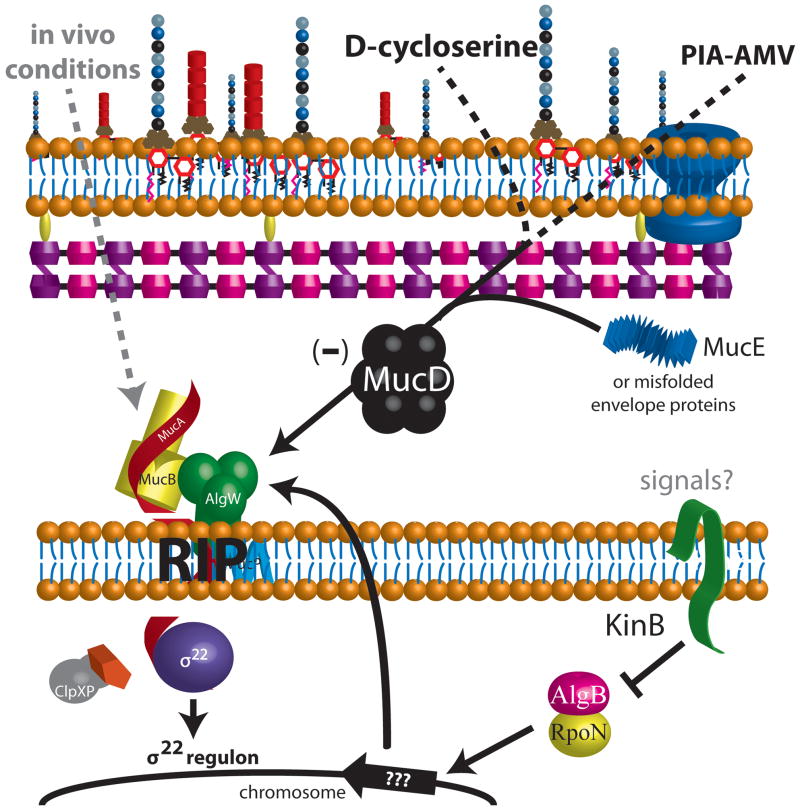
Figure 4. Pathways leading to regulated intramembrane proteolysis (RIP) of MucA
A composite model of the various pathways in P. aeruginosa, that lead to RIP of MucA and activation of σ22 are shown. Cell wall stress agents such as D-cycloserine can inhibit peptidoglycan synthesis and activate RIP of MucA (Wood et al., 2006, Wood & Ohman, 2009). When the envelope protein MucE is overexpressed, RIP of MucA occurs due to activation of AlgW and MucP proteases (Qiu et al., 2007). Growth on PIA-AMV medium causes RIP of MucA by AlgW and MucP protease, presumably due to misfolded proteins in the envelope (Damron et al., 2011). MucD is a chaperone-protease that is in the periplasm. The protease activity of MucD is required for repression of alginate overproduction. Likely, MucD degrades proteins that accumulate in the periplasm. If the function of MucD is lost then RIP of MucA will occur. MucD overexpression can suppress the MucE signal (Qiu et al., 2007) and is upregulated during growth on PIA-AMV (Damron et al., 2011). However, in the absence of MucD, RIP of MucA and activation of σ22 only requires MucP and not AlgW(Damron & Yu, 2011). When the histidine kinase KinB is inactivated or deleted, AlgW-RIP of MucA occurs and is dependent upon response regulator AlgB and sigma factor RpoN (σ54) (Damron et al., 2009). It is hypothesized that AlgB/RpoN controls expression of genes that influence RIP. It is also not known what signals activate KinB. In vivo conditions are indicated in gray dashed line since a study does indicate alginate production can occur during infection (Bragonzi et al., 2005), but the specifics of this pathway have not been elucidated. Based on the convergence to RIP by multiple pathways, future therapeutics inhibiting the RIP proteases may provide novel treatment options against P. aeruginosa.

References

    1. Ades SE. Regulation by destruction: design of the sigmaE envelope stress response. Curr Opin Microbiol. 2008;11:535–540. - PubMed
    1. Akiyama Y, Kanehara K, Ito K. RseP (YaeL), an Escherichia coli RIP protease, cleaves transmembrane sequences. EMBO J. 2004;23:4434–4442. - PMC - PubMed
    1. Alba BM, Leeds JA, Onufryk C, Lu CZ, Gross CA. DegS and YaeL participate sequentially in the cleavage of RseA to activate the sigma(E)-dependent extracytoplasmic stress response. Genes Dev. 2002;16:2156–2168. - PMC - PubMed
    1. Anastassiou ED, Mintzas AC, Kounavis C, Dimitracopoulos G. Alginate production by clinical nonmucoid Pseudomonas aeruginosa strains. J Clin Microbiol. 1987;25:656–659. - PMC - PubMed
    1. Armstrong D, Bell S, Robinson M, Bye P, Rose B, Harbour C, Lee C, Service H, Nissen M, Syrmis M, Wainwright C. Evidence for spread of a clonal strain of Pseudomonas aeruginosa among cystic fibrosis clinics. J Clin Microbiol. 2003;41:2266–2267. - PMC - PubMed

Publication types

MeSH terms