


The obesity paradox in men versus women with systolic heart failure
- PMID: 22497678
- PMCID: PMC3377856
- DOI: 10.1016/j.amjcard.2012.02.050
The obesity paradox in men versus women with systolic heart failure
Abstract
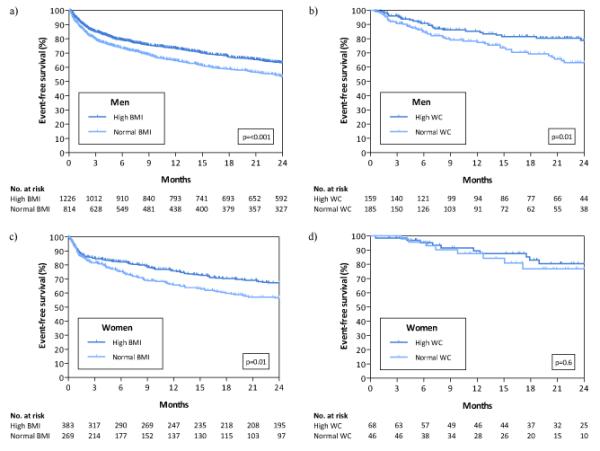
Obesity is common in heart failure (HF) and is associated with improved outcomes, a finding often termed the "obesity paradox." Although fat distribution varies by gender, the role of obesity in the outcomes of women compared to men with HF has not been well studied. In a cohort of patients with advanced systolic HF followed at a single university center, 2,718 patients had body mass indexes (BMIs) measured at baseline, and 469 patients with HF had waist circumferences (WCs) measured at baseline. Elevated BMI was defined as ≥25 kg/m(2). High WC was defined as ≥88 cm in women and ≥102 cm in men. The primary outcome was death, urgent heart transplantation, or ventricular assist device placement. The mean age was 53.0 ± 12.4 years, 25% of subjects were women, and the mean left ventricular ejection fraction was 22.9 ± 7.19%. In men, 2-year event-free survival was better for high versus normal BMI (63.2% vs 53.5%, p <0.001) and for high versus normal WC (78.8% vs 63.1%, p = 0.01). In women, 2-year event-free survival was better for elevated versus normal BMI (67.1% vs 56.6%, p = 0.01) but similar in the 2 WC groups. In multivariate analyses, normal BMI and normal WC were associated with higher relative risk for the primary outcome in men (BMI 1.34, WC 2.02) and women (BMI 1.38, WC 2.99). In conclusion, in patients with advanced HF, high BMI and WC were associated with improved outcomes in both genders. Further investigation of the interaction between body composition and gender in HF outcomes is warranted.
Copyright © 2012 Elsevier Inc. All rights reserved.
Figures
References
-
- Lloyd-Jones D, Adams RJ, Brown TM, Carnethon M, Dai S, De Simone G, Ferguson TB, Ford E, Furie K, Gillespie C, Go A, Greenlund K, Haase N, Hailpern S, Ho PM, Howard V, Kissela B, Kittner S, Lackland D, Lisabeth L, Marelli A, McDermott MM, Meigs J, Mozaffarian D, Mussolino M, Nichol G, Roger VL, Rosamond W, Sacco R, Sorlie P, Thom T, Wasserthiel-Smoller S, Wong ND, Wylie-Rosett J. Heart disease and stroke statistics--2010 update: a report from the American Heart Association. Circulation. 2010;121:e46–e215. - PubMed
-
- Clark AL, Fonarow GC, Horwich TB. Waist circumference, body mass index, and survival in systolic heart failure: the obesity paradox revisited. J Card Fail. 2011;17:374–380. - PubMed
-
- Oreopoulos A, Padwal R, Kalantar-Zadeh K, Fonarow G, Norris C, McAlister F. Body mass index and mortality in heart failure: a meta-analysis. Am Heart J. 2008;156:13–22. - PubMed
-
- Horwich T, Fonarow G, Hamilton M, MacLellan W, Woo M, Tillisch J. The relationship between obesity and mortality in patients with heart failure. J Am Coll Cardiol. 2001;38:789–795. - PubMed
-
- Curtis J, Selter J, Wang Y, Rathore S, Jovin I, Jadbabaie F, Kosiborod M, Portnay E, Sokol S, Bader F, Krumholz H. The obesity paradox: body mass index and outcomes in patients with heart failure. Arch Intern Med. 2005;165:55–61. - PubMed
Publication types
MeSH terms
Grants and funding
LinkOut - more resources
Full Text Sources
Medical
Research Materials
Miscellaneous
