. 2012 Aug;11(4):599-606.
doi: 10.1111/j.1474-9726.2012.00821.x. Epub 2012 May 17.

Molecular phenotyping of aging in single yeast cells using a novel microfluidic device

Affiliations

Molecular phenotyping of aging in single yeast cells using a novel microfluidic device

Zhengwei Xie et al. Aging Cell. 2012 Aug.

Abstract

Budding yeast has served as an important model organism for aging research, and previous genetic studies have led to the discovery of conserved genes/pathways that regulate lifespan across species. However, the molecular causes of aging and death remain elusive, because it is very difficult to directly observe the cellular and molecular events accompanying aging in single yeast cells by the traditional approach based on micromanipulation. We have developed a microfluidic system to track individual mother cells throughout their lifespan, allowing automated lifespan measurement and direct observation of cell cycle dynamics, cell/organelle morphologies, and various molecular markers. We found that aging of the wild-type cells is characterized by an increased general stress and a progressive lengthening of the cell cycle for the last few cell divisions; these features are much less apparent in the long-lived FOB1 deletion mutant. Following the fate of individual cells revealed that there are different forms of cell death that are characterized by different terminal cell morphologies, and associated with different levels of stress and lifespan. We have identified a molecular marker - the level of the expression of Hsp104, as a good predictor for the lifespan of individual cells. Our approach allows detailed molecular phenotyping of single cells in the process of aging and thus provides new insight into its mechanism.


Conflict of interest statement

The authors declare no conflict of interest.

Figures
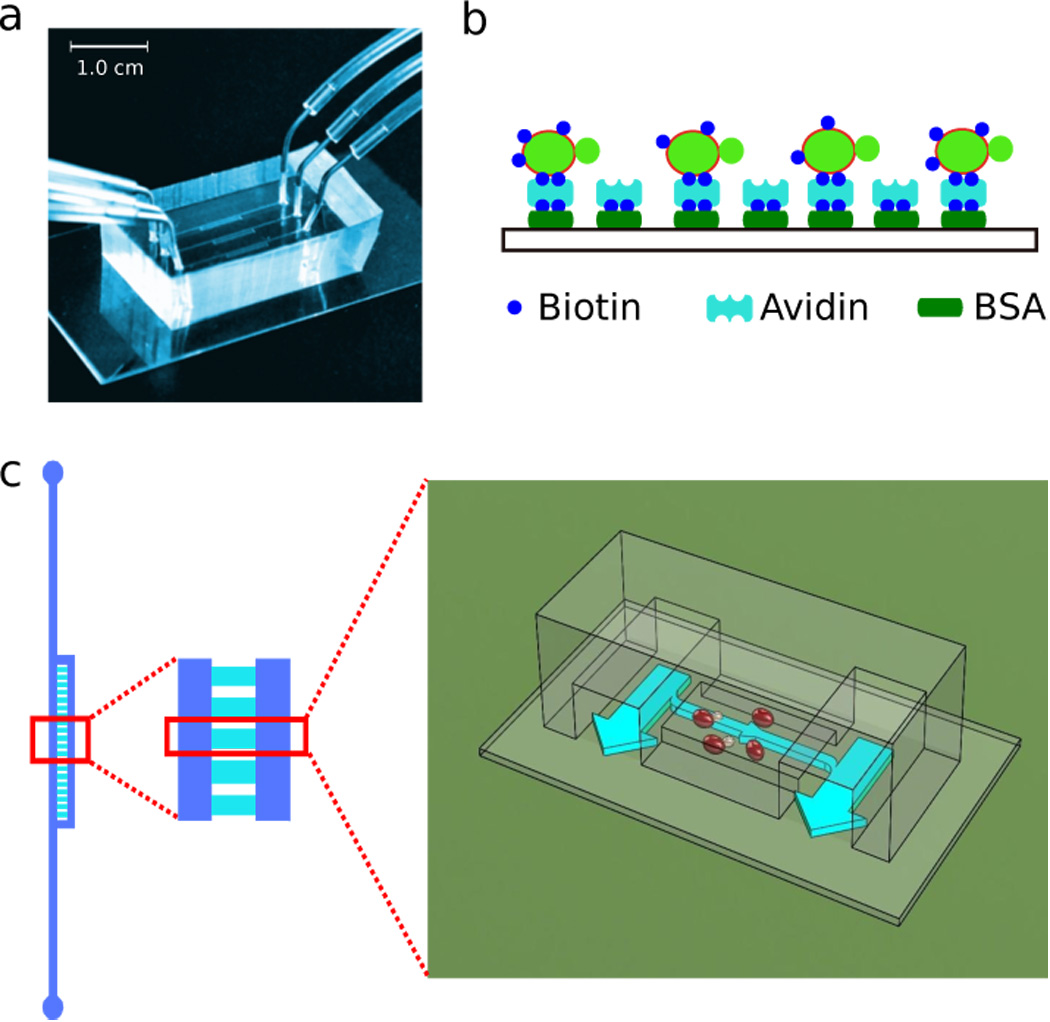
Figure 1
Figure 1
An example of chip design. a) A photograph of a chip with three independent channels. A soft PDMS with micro-channels (top) is sealed on a thin glass slide (bottom). The size of the device is indicated by the scale bar. b) A schematic of mother cell surface labeling and glass modification. c) Geometries of the channels (blue) and chambers (cyan). Arrows show the directions of fluid flow, with broader arrow indicating bigger flux. Cells (red ellipsoids) are loaded inside the chambers.
Figure 2
Figure 2
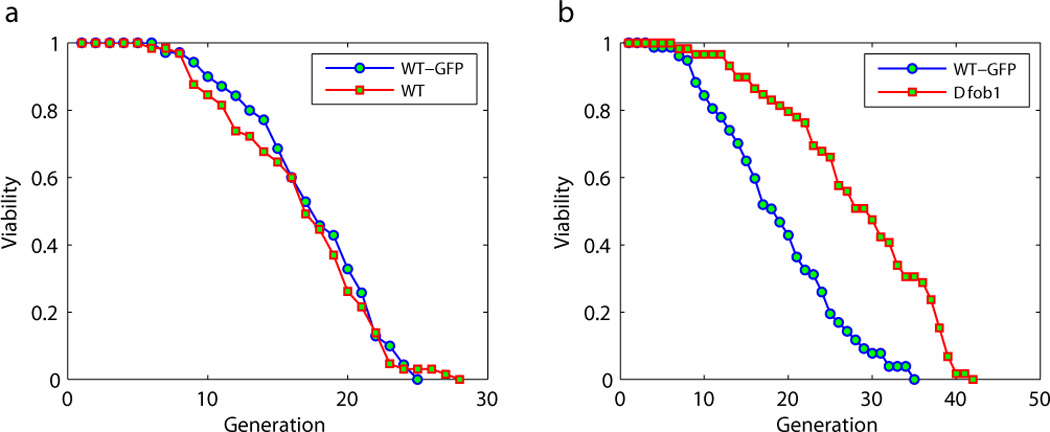
Survival curves of the wild type strain (a) and the FOB1 deletion mutant (b) measured by using the microfluidic device. Shown is the percent of cells still dividing after a given number of generations. A wild type strain with a GFP tag is loaded to the some channel as a control (blue curves). The number of cells measured to generate the survival curves: (a) WT-GFP 70, WT 65; (b) WT-GFP 77, Δfob1 59.
Figure 3
Figure 3
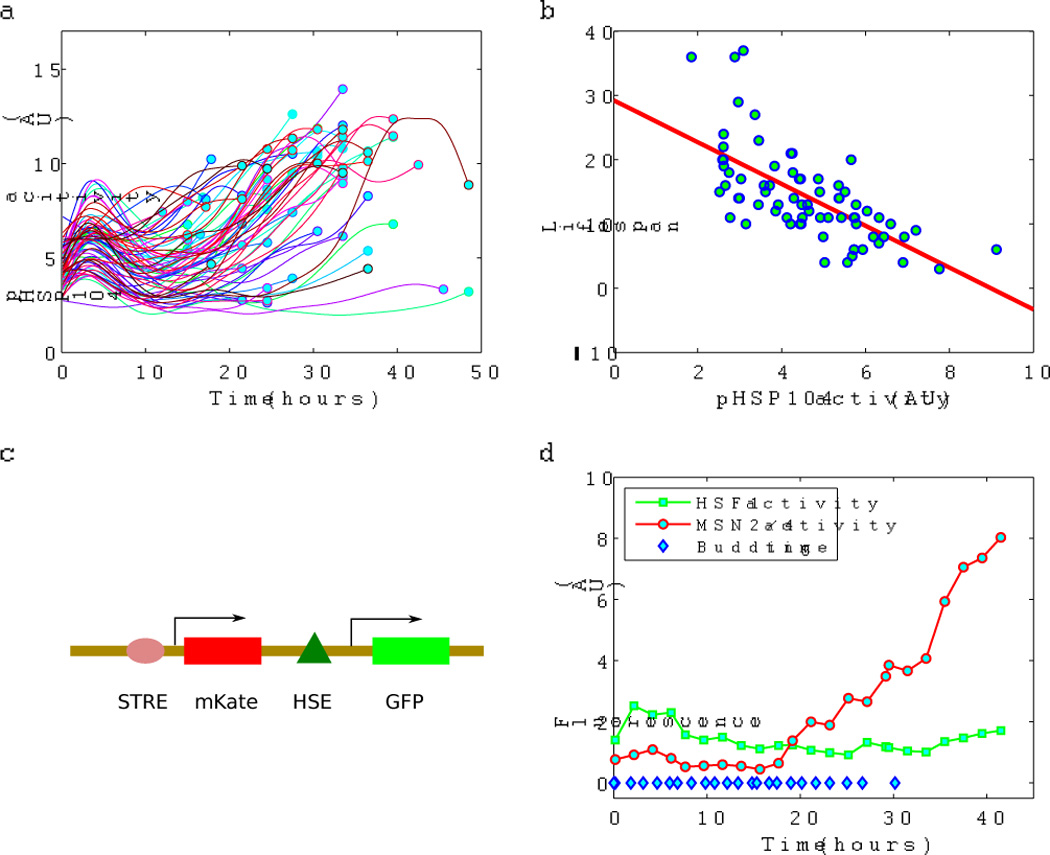
Monitoring the lifespan and fluorescence reporters simultaneously identified a lifespan marker. a) The activity of HSP104 promoter (reported by a GFP driven by the HSP104 promoter) as a function of time in individual cells. Fluorescence was measured once every two hours. Curves are spline fits to guide the eyes. Each curve corresponds to an individual cell. Circles indicate the last budding event. b) Lifespan of individual cells negatively correlates with HSP104 promoter activity (measured at 8 hours after the cell loading). Number of cells = 71. c) A schematic of the dual reporter construct, with the binding site of Msn2/4 (STRE) upstream of mKate and the binding site of Hsf1 (HSE) upstream of GFP, both in the context of a crippled CYC1 promoter. d) A typical example of the age dependence of Msn2/4 and Hsf1 activities in a single cell, as reported by the dual reporter. Budding time (blue diamond) was tracked simultaneously.
Figure 4
Figure 4
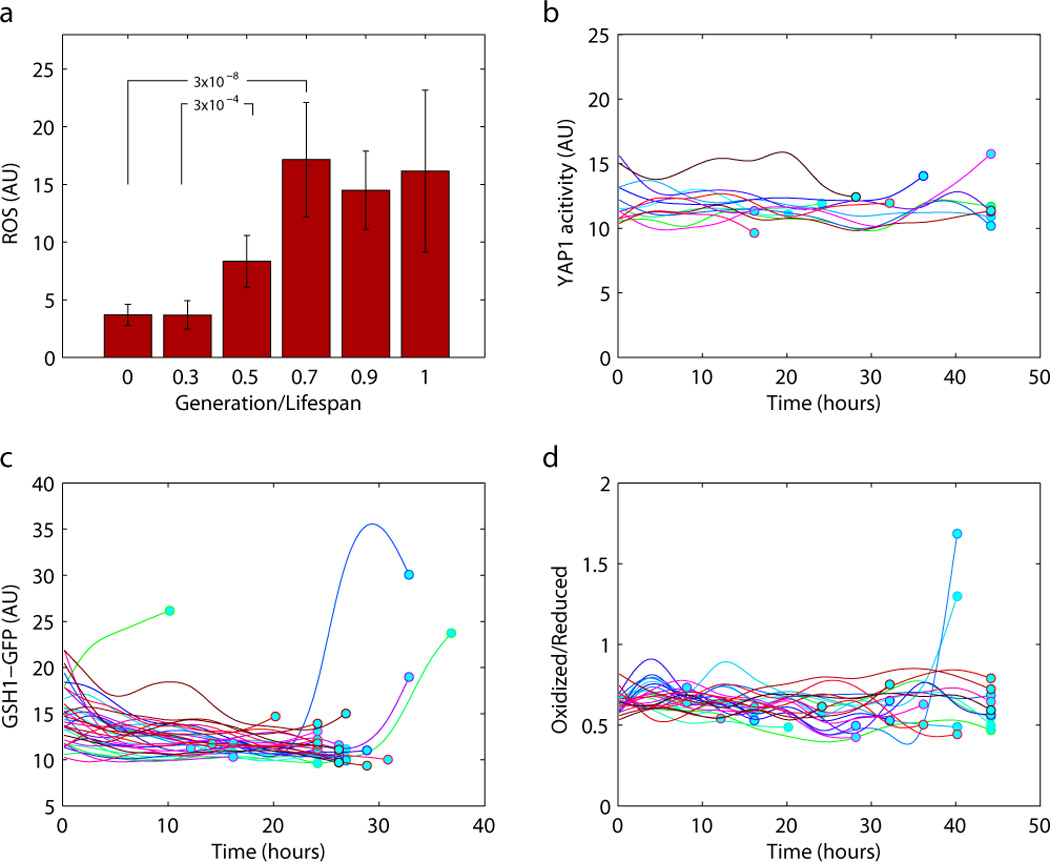
Oxidative stress as a function of age in individual cells. a) DCFH-DA staining showed increased ROS level in the aged cell populations. Staining was performed at 0, 11, 22, and 33 hours after cell loading in separate channels. Cells were grouped by their relative lifespan (generation normalized by the total lifespan) at the time of staining. b) Yap1 activity as a function of age remains the same throughout the lifespan. Yap1 activity is reported by a YFP driven by a crippled CYC1 promoter containing a Yap1 binding site. c) The protein level of Gsh1 (a transcriptional target of Yap1) as reported by a 3’ GFP fusion does not increase with age. d) Redox potential reported by the roGFP. The ratio of the oxidized to the reduced forms of the roGFP (arbitrary unit) was calculated from the fluorescence signals from the two different forms, as excited by two different wavelengths.
Figure 5
Figure 5
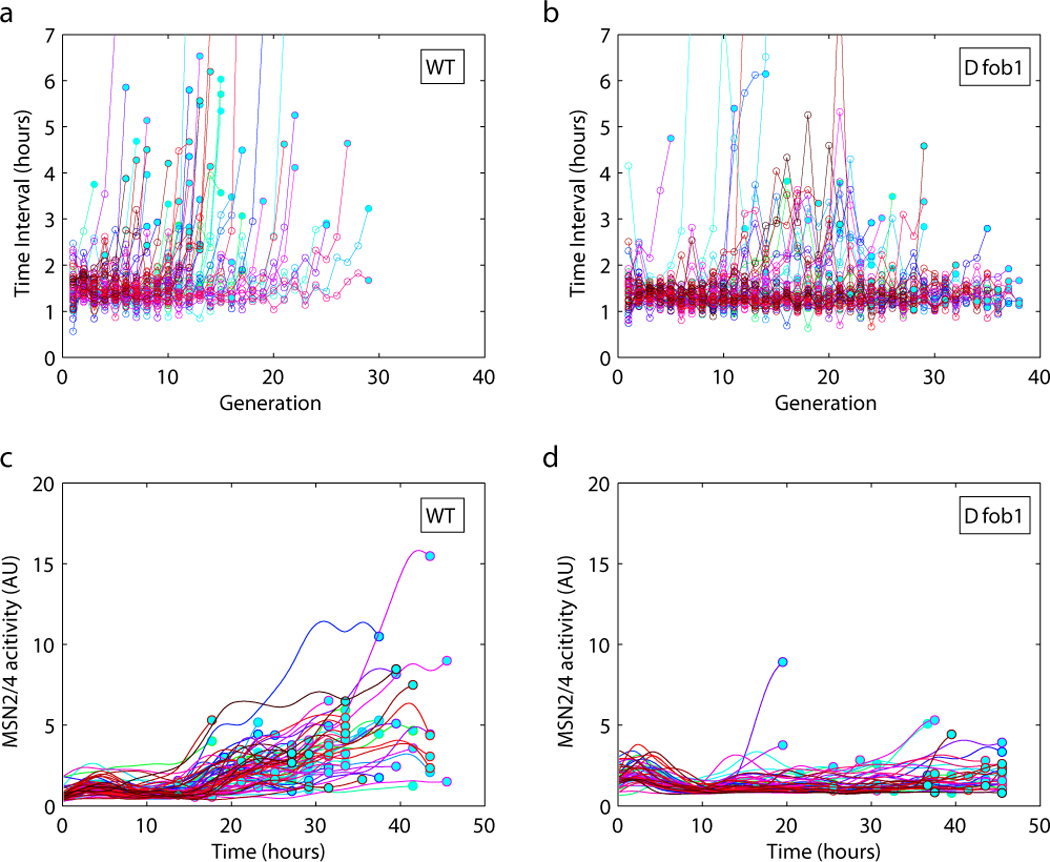
Budding time interval (a & b) and stress response (c & d) profiles of the wild type and the FOB1 deletion mutant. Budding time interval, defined as the time between two successive budding events, is plotted against the replicative age of the cell. Each curve corresponds to a single cell. Data points are connected by straight lines (a & b) and spline fitted (c & d) to guide the eyes. The filled circles indicate the last budding event. Stress response is measured by the activity of Msn2/4, reported by a GFP driven by a crippled CYC1 promoter containing a STRE. Number of cells: a 59, b 59, c 93, d 59.
Figure 6
Figure 6
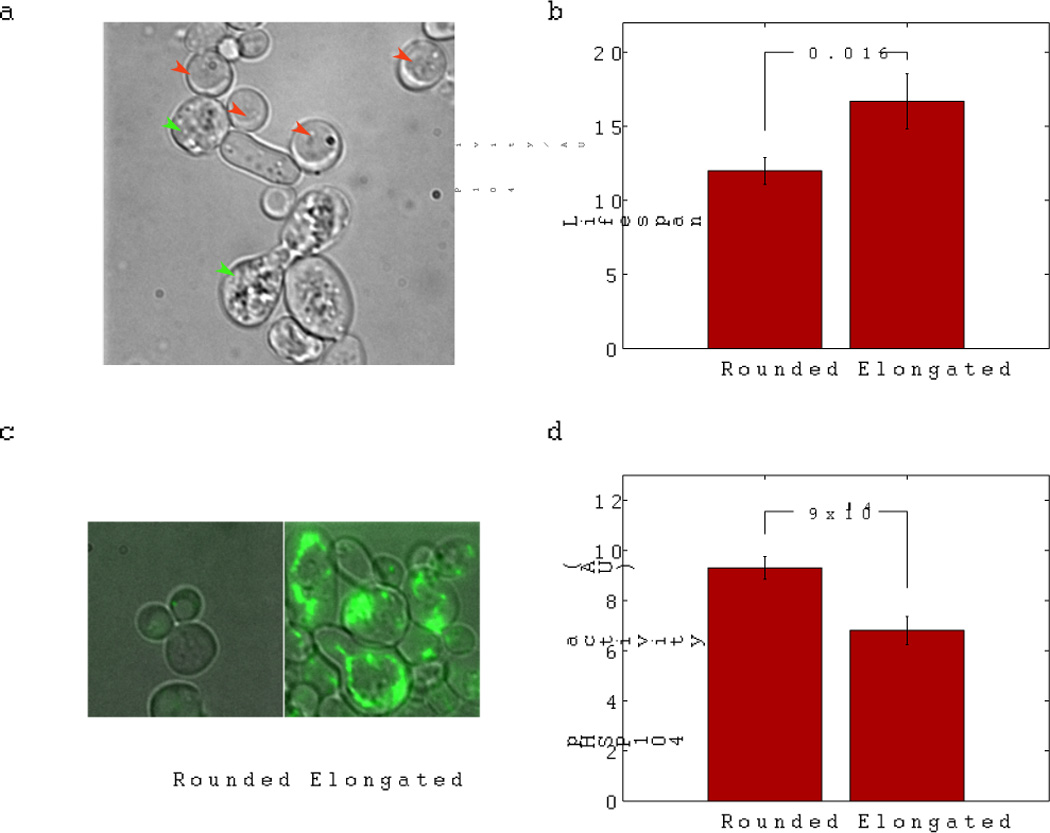
Characterization of the different forms of cell death. a) Different forms of cell death as defined by different terminal cell morphologies. Two predominant forms are type I (rounded shape, red arrows) and type II (elongated shape, green arrows). Type I-rounded cells have shorter lifespan (b), more severely damaged mitochondria (as reported by the Leu4-GFP marker) (c), and higher stress levels (reported by the HSP104 promoter activity) (d), relative to type II-elongated cells.

References

    1. Balaban RS, Nemoto S, Finkel T. Mitochondria, oxidants, and aging. Cell. 2005;120:483–495. - PubMed
    1. Bilski P, Belanger AG, Chignell CF. Photosensitized oxidation of 2’,7’-dichlorofluorescin: singlet oxygen does not contribute to the formation of fluorescent oxidation product 2’,7’-dichlorofluorescein. Free Radic. Biol. Med. 2002;33:938–946. - PubMed
    1. Bishop NA, Guarente L. Genetic links between diet and lifespan: shared mechanisms from yeast to humans. Nat. Rev. Genet. 2007;8:835–844. - PubMed
    1. Bonini MG, Rota C, Tomasi A, Mason RP. The oxidation of 2’,7’-dichlorofluorescin to reactive oxygen species: a self-fulfilling prophesy? Free Radic. Biol. Med. 2006;40:968–975. - PubMed
    1. Boy-Marcotte E, Lagniel G, Perrot M, Bussereau F, Boudsocq A, Jacquet M, Labarre J. The heat shock response in yeast: differential regulations and contributions of the Msn2p/Msn4p and Hsf1p regulons. Mol. Microbiol. 1999;33:274–283. - PubMed

Publication types

MeSH terms

Substances