


Real-time moment-to-moment emotional responses to narrative and informational breast cancer videos in African American women
- PMID: 22498923
- PMCID: PMC3337426
- DOI: 10.1093/her/cys047
Real-time moment-to-moment emotional responses to narrative and informational breast cancer videos in African American women
Abstract
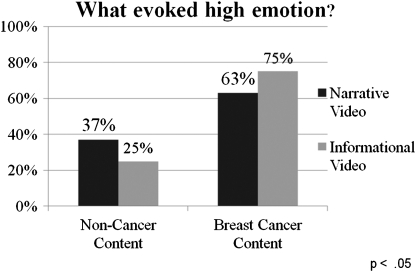
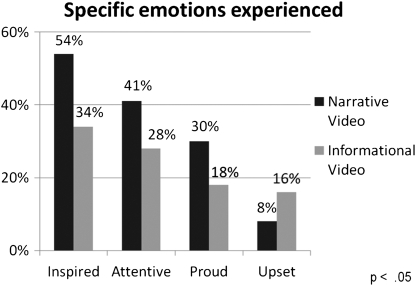
In a randomized experiment using moment-to-moment audience analysis methods, we compared women's emotional responses with a narrative versus informational breast cancer video. Both videos communicated three key messages about breast cancer: (i) understand your breast cancer risk, (ii) talk openly about breast cancer and (iii) get regular mammograms. A community-based convenience sample of African American women (n = 59) used a hand-held audience response device to report the intensity of their emotional reaction while watching one of the two videos. Strong emotions were more likely to correspond to contextual information about characters in the video and less likely to correspond to health content among women who watched the narrative video compared with those who watched the informational video (P < 0.05). Women who watched the narrative video were more likely to report feeling attentive (41 versus 28%, respectively), inspired (54 versus 34%) and proud (30 versus 18%) and less likely to feel upset (8 versus 16%) (all P < 0.05). Women in the narrative group were more likely to mention women's personal stories than health information in open-ended recall questions, but this did not detract from obtaining health information. Findings suggest that stories can be used to communicate health information without distracting from core health content.
Figures
References
-
- Petraglia J. Narrative intervention in behavior and public health. J Health Commun. 2007;12:493–505. - PubMed
-
- Gunaratnam Y, Oliviere D. Narrative and Stories in Health Care: Illness, Dying, and Bereavement. New York, NY: Oxford University Press; 2009.
-
- Houston TK, Allison JJ, Sussman M, et al. Culturally appropriate storytelling to improve blood pressure: a randomized trial. Ann Intern Med. 2011;154:77–84. - PubMed
-
- Kreuter MW, Green MC, Cappella JN, et al. Narrative communication in cancer prevention and control: a framework to guide research and application. Ann Behav Med. 2007;33:221–35. - PubMed
