


End-of-life quality-of-care measures for nursing homes: place of death and hospice
- PMID: 22500481
- PMCID: PMC3322517
- DOI: 10.1089/jpm.2011.0345
End-of-life quality-of-care measures for nursing homes: place of death and hospice
Abstract
Objective: The Centers for Medicare and Medicaid Services (CMS) publishes a web-based quality report card for nursing homes. The quality measures (QMs) do not assess quality of end-of-life (EOL) care, which affects a large proportion of residents. This study developed prototype EOL QMs that can be calculated from data sources available for all nursing homes nationally.
Methods: The study included approximately 1.5 million decedents residing in 16,000 nursing homes during 2003-2007, nationally. Minimum Data Set (MDS) data were linked to Medicare enrollment files, hospital claims, and hospice claims. Random effect logistic models were estimated to develop risk-adjustment models predicting two outcome measures (place of death [POD] and hospice enrollment), which were then used to construct two EOL QMs. The distributional properties of the QMs were investigated.
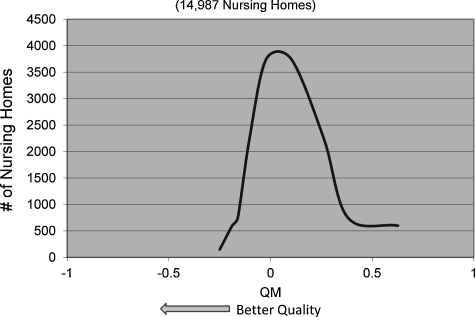
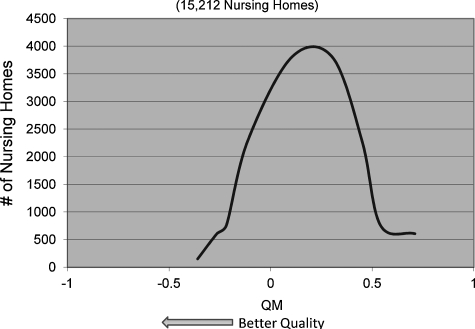
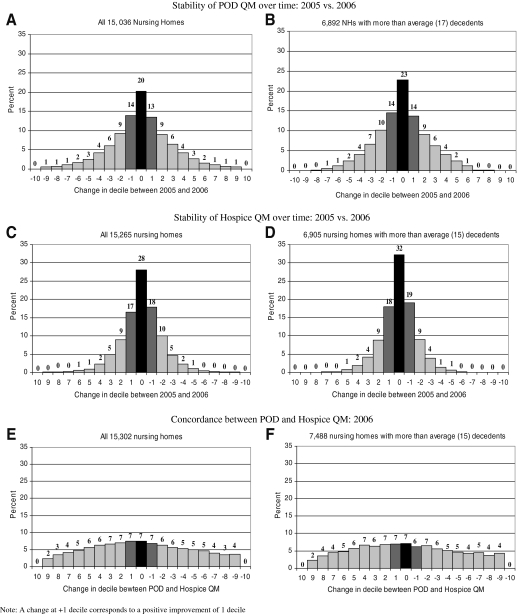
Results: The QMs exhibited moderate stability over time. They were more stable in identifying quality outliers among the larger nursing homes and in identifying poor-quality outliers than high-quality outliers.
Conclusions: This study offers two QMs specialized to EOL care in nursing homes that can be calculated from data that are readily available and could be incorporated in the Nursing Home Compare (NHC) report card. Further work to validate the QMs is required.
Figures
References
-
- Lynn J. Measuring Quality of Care at the End-of-Life: A Statement of Principles. Washington, DC: The American Geriatrics Society; 1996. AGS Ethics and Clinical Practice Committees. - PubMed
-
- Field MJ. Cassel CK. Improving Care at the End of Life. Washington, D.C.: Institute of Medicine, National Academy Press; 1997. Approaching Death. - PubMed
-
- The National Academies Press. Describing Death in America: What We Need To Know. Washington, D.C.: 2003. - PubMed
-
- National Consensus Project for Quality PalliativeCare: Clinical Practice Guidelines for Quality Pallative Care. 2006. http://nationalconsensusproject.org/ [Jun 10;2011 ]. http://nationalconsensusproject.org/
-
- Bell CL. Somogyi-Zalud E. Masaki KH. Methodological review: Measured and reported congruence between preferred and actual place of death. Palliat Med. 2009;23:482–490. - PubMed
Publication types
MeSH terms
Grants and funding
LinkOut - more resources
Full Text Sources
Medical
Research Materials
Miscellaneous
