. 2012 Jul 20;7(7):1190-7.
doi: 10.1021/cb2004884. Epub 2012 Apr 25.

A high-throughput screen to identify inhibitors of ATP homeostasis in non-replicating Mycobacterium tuberculosis

Affiliations
Free PMC article

A high-throughput screen to identify inhibitors of ATP homeostasis in non-replicating Mycobacterium tuberculosis

Puiying A Mak et al. ACS Chem Biol. .
Free PMC article

Abstract

Growing evidence suggests that the presence of a subpopulation of hypoxic non-replicating, phenotypically drug-tolerant mycobacteria is responsible for the prolonged duration of tuberculosis treatment. The discovery of new antitubercular agents active against this subpopulation may help in developing new strategies to shorten the time of tuberculosis therapy. Recently, the maintenance of a low level of bacterial respiration was shown to be a point of metabolic vulnerability in Mycobacterium tuberculosis. Here, we describe the development of a hypoxic model to identify compounds targeting mycobacterial respiratory functions and ATP homeostasis in whole mycobacteria. The model was adapted to 1,536-well plate format and successfully used to screen over 600,000 compounds. Approximately 800 compounds were confirmed to reduce intracellular ATP levels in a dose-dependent manner in Mycobacterium bovis BCG. One hundred and forty non-cytotoxic compounds with activity against hypoxic non-replicating M. tuberculosis were further validated. The resulting collection of compounds that disrupt ATP homeostasis in M. tuberculosis represents a valuable resource to decipher the biology of persistent mycobacteria.


Figures
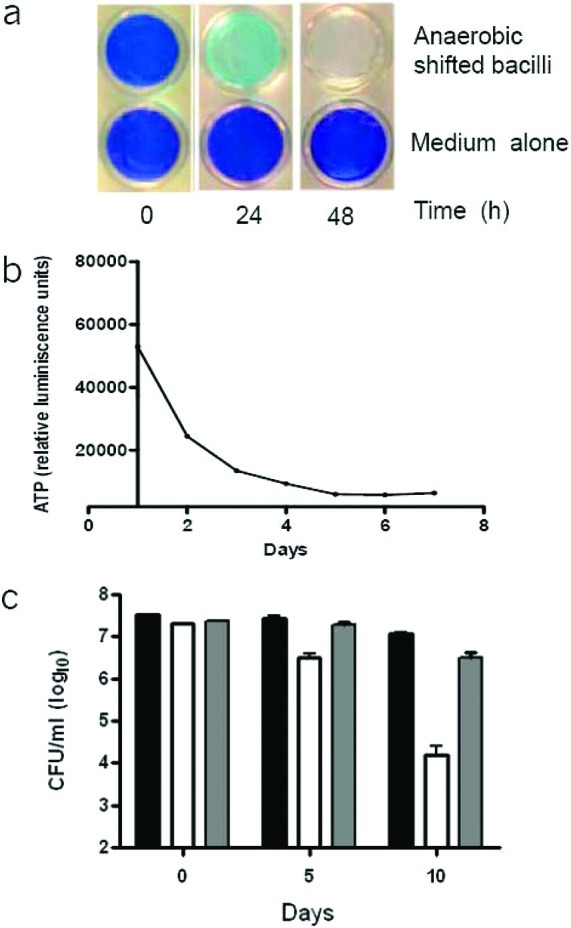
Figure 1
Figure 1
Viability and intracellular ATP levels of M. bovis BCG during the hypoxic shift down assay. (a) Upper row: A hypoxic M. bovis culture was inoculated at an OD600 of 0.2 in a 24-well plate and shifted into a hypoxic atmosphere. The presence of oxygen left in the culture was monitored by decolorization of methylene blue. Methylene blue decolorized after 2 days. Lower row: Control wells with methylene blue, but without bacilli, in a hypoxic atmosphere. (b) ATP levels (RLU, relative luminescence units) were monitored daily for a period of 7 days. (c) Survival of M. bovis BCG and M. bovis BCG:ΔdosR in the hypoxic shift down model. Viability (CFU/mL) of M. bovis BCG parental (black bar), M. bovis BCG:ΔdosR (white bar), and complemented mutant (gray bar) was determined at each time point in the hypoxic shift down model. The experiment was carried out three times in triplicate, and results are given as means ± SD.
Figure 2
Figure 2
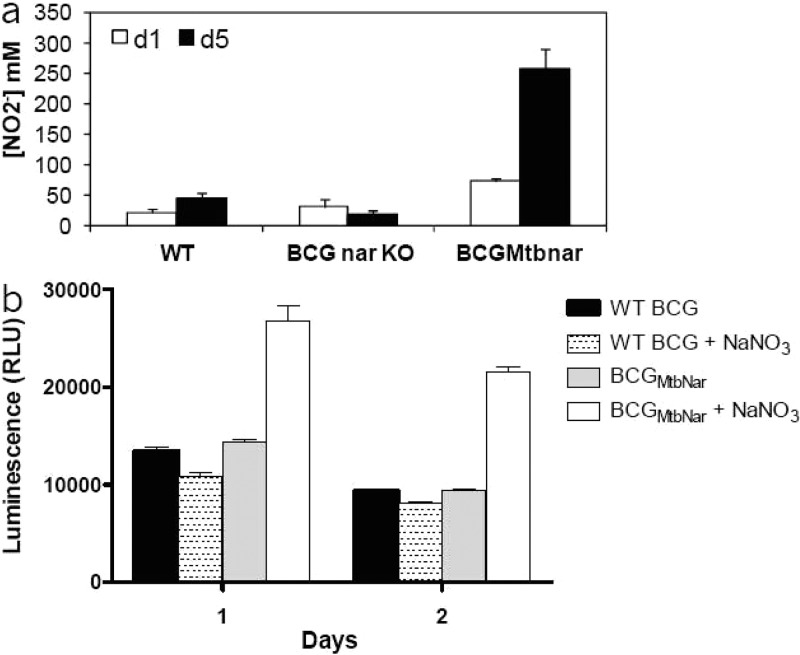
Complementation of M. bovis BCG with narGHJI cluster gene from M. tuberculosis enhanced nitrate reductase activity and ATP levels in the hypoxic shift down model. (a) Production of nitrite in culture by M. bovis BCG wild type (WT), M. bovis BCG narGHJI KO strain (BCGnar-KO), and M. bovis BCG complemented with M. tuberculosis narGHJI (BCGMtbNar) at days 1 and 5. (b) Intracellular ATP production measured for M. bovis BCG WT and M. bovis BCGMtbNar complemented strains at day 1 and 2 upon methylene blue decolorization in the absence or presence of 20 mM sodium nitrate (NaNO3). Results are expressed as the means ± SD of triplicates.
Figure 3
Figure 3
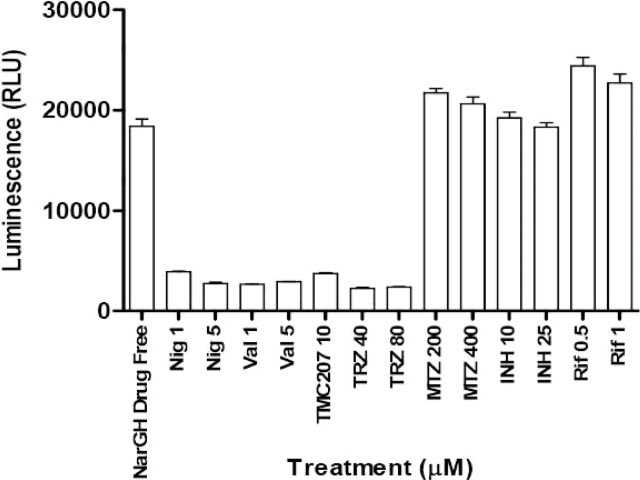
Effect of proton motive force inhibitors, phenothiazines, and standard anti-TB drugs on ATP levels of hypoxic shifted M. bovis BCGMtbNar. Reference compounds at indicated concentrations were tested on hypoxic adapted M. bovis BCGMtbNar complemented strain in 384-well microwell plates (40 μL/well). Hypoxic shift down bacilli were added together with nitrate upon methylene blue decolorization in control plates. After 2 days of drug exposure plates were treated with 40 μL of BTG reagent. ATP levels (RLU) were quantified 10 min after incubation. The experiment was carried out three times in triplicates and results are given as means ± SD. Nig: nigericine; Val: valinomycin; TRZ: thioridazine; MTZ: metronidazole; INH: isoniazid; Rif: rifampicin.
Figure 4
Figure 4
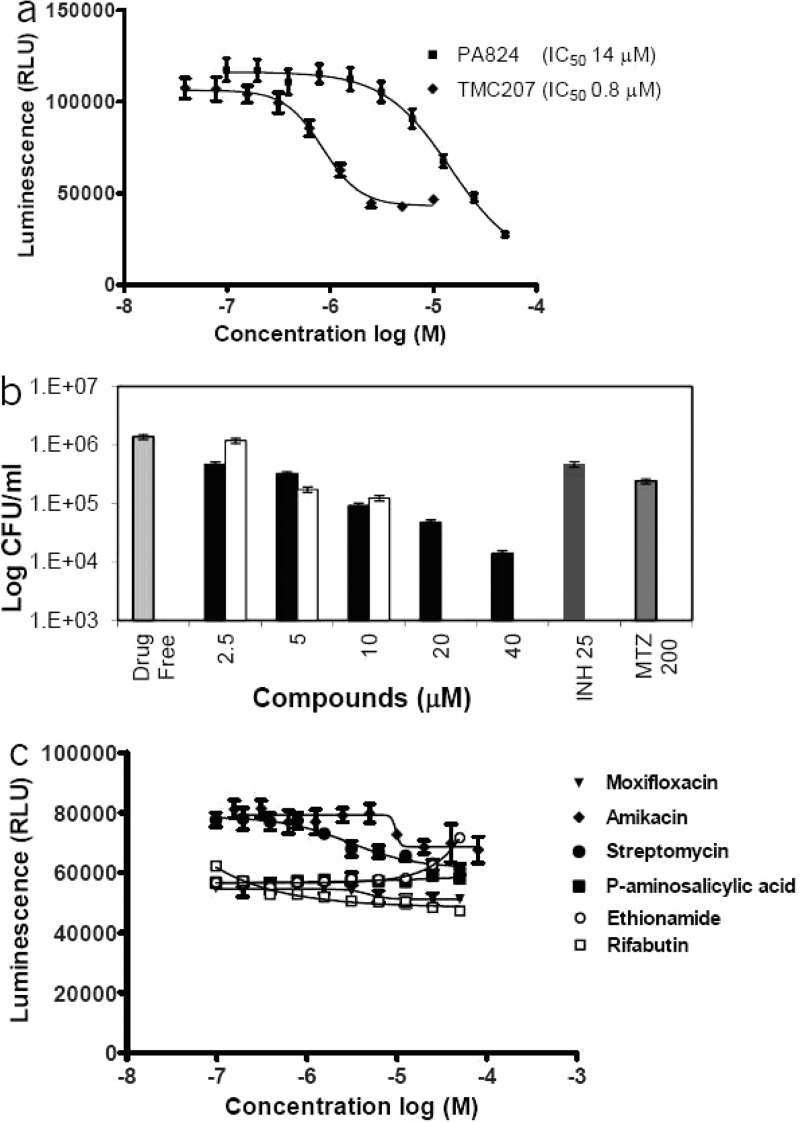
Effects of various anti-mycobacterials on ATP levels and viability of hypoxic shift down M. tuberculosis. (a) TMC207 and PA-824 compounds at indicated concentrations were tested on hypoxic shift down M. tuberculosis. ATP levels (RLU) were quantified by using the BTG Assay Kit. (b) The number of viable cells after treatment with different concentrations of PA-824 (black bars) and TMC207 (white bars) over a period of 5 days was determined by CFU counts on 7H11 agar. Results are expressed as the means ± SD of triplicates. (c) Moxifloxacin, amikacin, streptomycin, p-amino salicylic acid, ethionamide, and rifabutin ranging from 40 to 0.02 μM were tested on hypoxic shift down M. tuberculosis. After 2 days of drug exposure plates were treated with 40 μL of BTG reagent. Luminescence was recorded 10 min after incubation. Values reported are average of duplicate measurements.
Figure 5
Figure 5
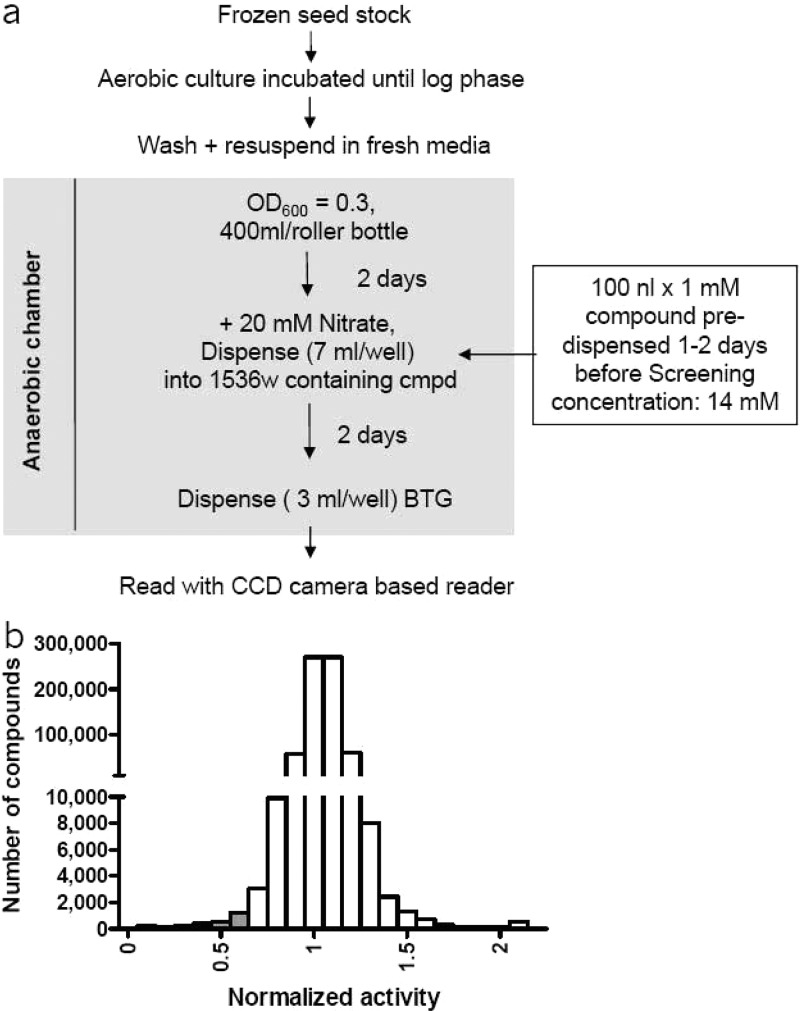
High-throughput screening of the chemical compound library on hypoxic M. bovis BCGMtbNar. (a) Schematic representation of the M. bovis BCGMtbNar hypoxic shift down HTS process. (b) Histogram showing the distribution of compounds versus activity for the HTS. Plate median activity was normalized to an arbitrary value of 1, and the putative hits were identified from those of activity <0.7 (gray bars).
Figure 6
Figure 6
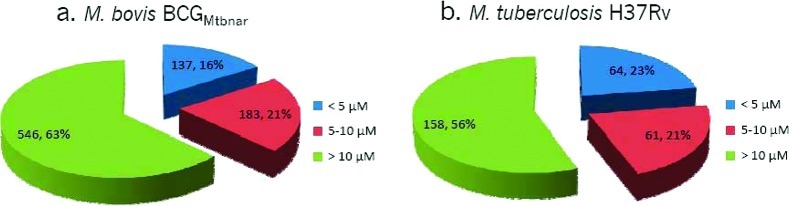
Reconfirmation of hypoxic ATP IC50 activity of HTS hits in hypoxic non-replicating mycobacteria. Ability to reduce the intracellular ATP levels of HTS hits was evaluated using various concentrations of compounds. A total of 866 hits showed activity against hypoxic M. bovis BCGMtbNar (a), and 283 hits showed activity against M. tuberculosis (b). The notation >10 μM in panel a corresponds to compounds that showed at least 20% ATP reduction at 14.1 μM, and >10 μM in panel b corresponds to compounds that showed at least 20% ATP reduction at 10 μM. The number of compounds belonging to each group and percentage of hits are depicted on the pieces in the pie chart.
Figure 7
Figure 7
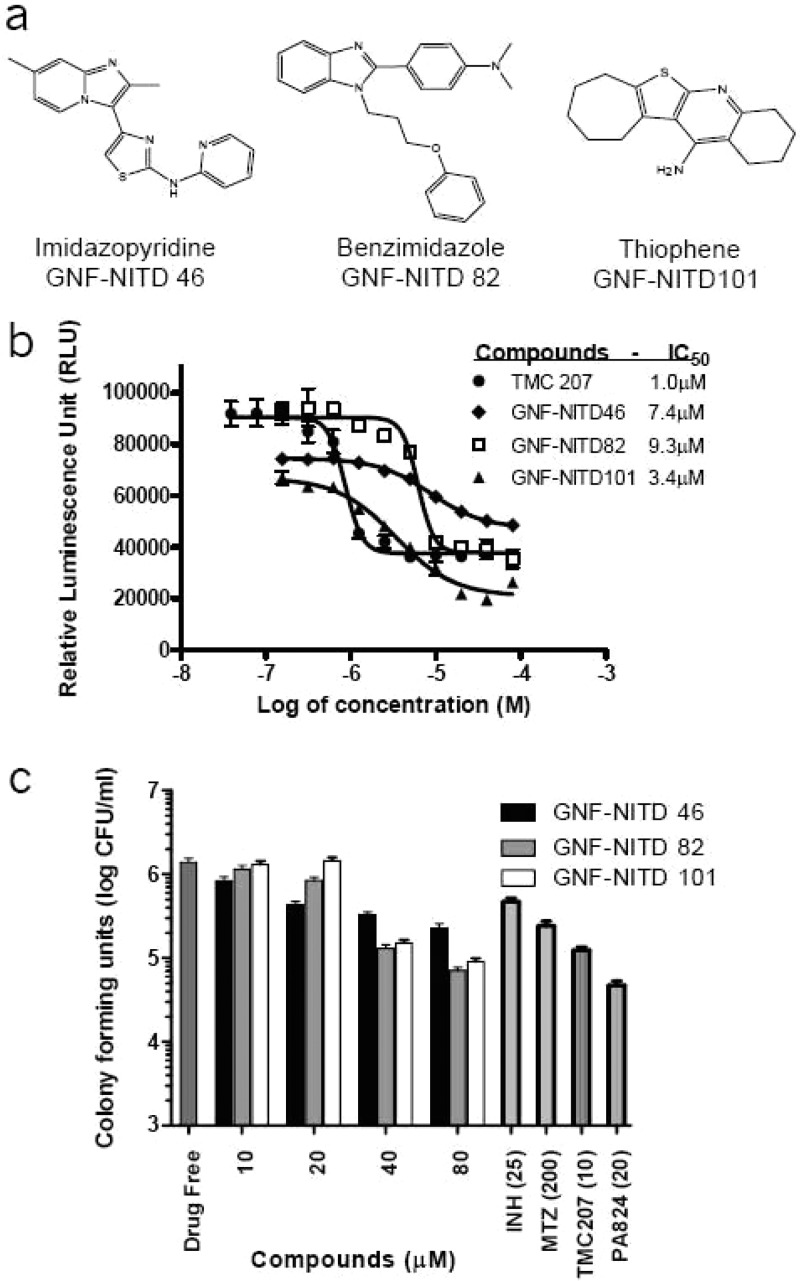
Comparative efficacy of selected hypoxic hits against M. tuberculosis. (a) Structure of benzimidazole (BZ), imidazopyridines (IPs), and thiophene compound class. (b) Compounds were obtained as pure solids and tested against hypoxic shift down M. tuberculosis for ATP activity (ATP IC50). (c) Hypoxic cidal activity (HCC90).

References

    1. Dye C.; Scheele S.; Dolin P.; Pathania V.; Raviglione M. C. (1999) Consensus statement. Global burden of tuberculosis: estimated incidence, prevalence, and mortality by country. WHO Global Surveillance and Monitoring Project. J. Am. Med. Assoc. 282, 677–686. - PubMed
    1. Mahmoudi A.; Iseman M. D. (1993) Pitfalls in the care of patients with tuberculosis. Common errors and their association with the acquisition of drug resistance. J. Am. Med. Assoc. 270, 65–68. - PubMed
    1. Duncan K.; Barry C. E. III (2004) Prospects for new antitubercular drugs. Curr. Opin. Microbiol. 7, 460–465. - PubMed
    1. Young D. B.; Perkins M. D.; Duncan K.; Barry C. E. III (2008) Confronting the scientific obstacles to global control of tuberculosis. J. Clin. Invest. 118, 1255–1265. - PMC - PubMed
    1. Gomez J. E.; McKinney J. D. M. (2004) Tuberculosis persistence, latency, and drug tolerance. Tuberculosis (Edinburgh) 84, 29–44. - PubMed

Publication types

MeSH terms

Substances

LinkOut - more resources