


Direct upstream motility in Escherichia coli
- PMID: 22500751
- PMCID: PMC3318139
- DOI: 10.1016/j.bpj.2012.03.001
Direct upstream motility in Escherichia coli
Abstract
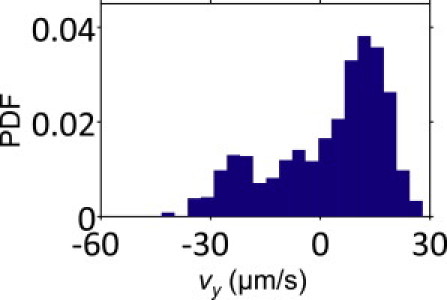
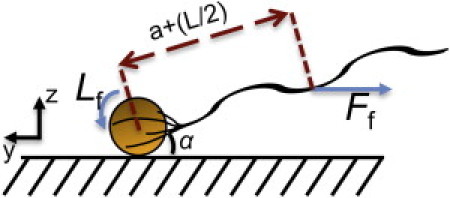
We provide an experimental demonstration of positive rheotaxis (rapid and continuous upstream motility) in wild-type Escherichia coli freely swimming over a surface. This hydrodynamic phenomenon is dominant below a critical shear rate and robust against Brownian motion and cell tumbling. We deduce that individual bacteria entering a flow system can rapidly migrate upstream (>20 μm/s) much faster than a gradually advancing biofilm. Given a bacterial population with a distribution of sizes and swim speeds, local shear rate near the surface determines the dominant hydrodynamic mode for motility, i.e., circular or random trajectories for low shear rates, positive rheotaxis for moderate flow, and sideways swimming at higher shear rates. Faster swimmers can move upstream more rapidly and at higher shear rates, as expected. Interestingly, we also find on average that both swim speed and upstream motility are independent of cell aspect ratio.
Copyright © 2012 Biophysical Society. Published by Elsevier Inc. All rights reserved.
Figures
References
-
- Berg H.C. Motile behavior of bacteria. Phys. Today. 2000;53:24–30.
-
- Alexandre G., Greer-Phillips S., Zhulin I.B. Ecological role of energy taxis in microorganisms. FEMS Microbiol. Rev. 2004;28:113–126. - PubMed
-
- Gest H. Phototaxis and other sensory phenomena in purple photosynthetic bacteria. FEMS Microbiol. Rev. 1995;16:287–294.
-
- Dunin-Borkowski R.E., McCartney M.R., Buseck P.R. Magnetic microstructure of magnetotactic bacteria by electron holography. Science. 1998;282:1868–1870. - PubMed
MeSH terms
LinkOut - more resources
Full Text Sources
Other Literature Sources
