. 2012 Jul;143(1):223-233.e9.
doi: 10.1053/j.gastro.2012.04.006. Epub 2012 Apr 10.

Mutations that alter use of hepatitis C virus cell entry factors mediate escape from neutralizing antibodies

Affiliations

Mutations that alter use of hepatitis C virus cell entry factors mediate escape from neutralizing antibodies

Isabel Fofana et al. Gastroenterology. 2012 Jul.

Abstract

Background & aims: The development of vaccines and other strategies to prevent hepatitis C virus (HCV) infection is limited by rapid viral evasion. HCV entry is the first step of infection; this process involves several viral and host factors and is targeted by host-neutralizing responses. Although the roles of host factors in HCV entry have been well characterized, their involvement in evasion of immune responses is poorly understood. We used acute infection of liver graft as a model to investigate the molecular mechanisms of viral evasion.

Methods: We studied factors that contribute to evasion of host immune responses using patient-derived antibodies, HCV pseudoparticles, and cell culture-derived HCV that express viral envelopes from patients who have undergone liver transplantation. These viruses were used to infect hepatoma cell lines that express different levels of HCV entry factors.

Results: By using reverse genetic analyses, we identified altered use of host-cell entry factors as a mechanism by which HCV evades host immune responses. Mutations that alter use of the CD81 receptor also allowed the virus to escape neutralizing antibodies. Kinetic studies showed that these mutations affect virus-antibody interactions during postbinding steps of the HCV entry process. Functional studies with a large panel of patient-derived antibodies showed that this mechanism mediates viral escape, leading to persistent infection in general.

Conclusions: We identified a mechanism by which HCV evades host immune responses, in which use of cell entry factors evolves with escape from neutralizing antibodies. These findings advance our understanding of the pathogenesis of HCV infection and might be used to develop antiviral strategies and vaccines.


Figures

Figure 1
Figure 1
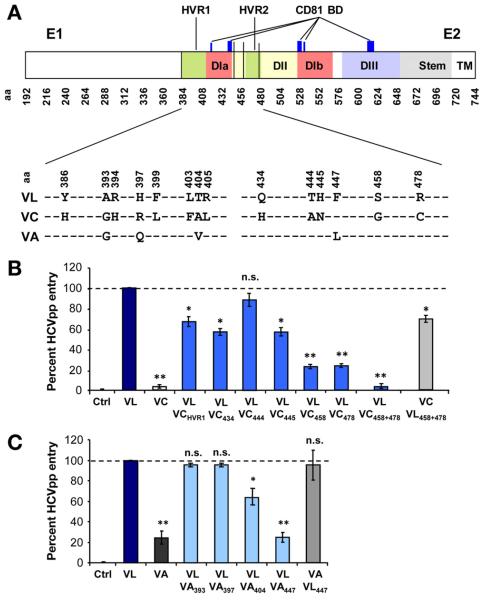
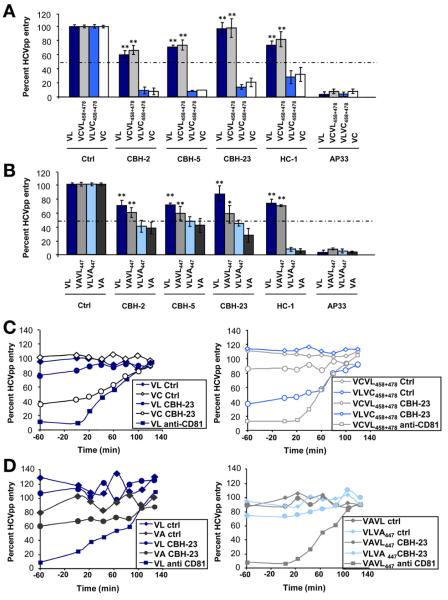
Positions 447, 458, and 478 confer enhanced viral entry of a high-infectivity variant reinfecting the liver graft. (A) Genomic organization and mutations of envelope glycoproteins of escape variant VL and nonselected variants VC and VA. HVR1 and HVR2 are depicted in green; E2 domains are depicted in red (DI), yellow (DII), and blue (DIII); and CD81 binding domains are depicted in dark blue.,, Positions 447, 458, and 478 are highlighted in black vertical lines. Differences between VL, VC, and VA in region E1E2384–483 are displayed. (B and C) Viral entry in Huh7.5.1 cells of the escape variant VL, the nonselected variants VC and VA, as well as chimeric variants containing defined mutations of VC and VA in VL or vice versa (Supplementary Figure 1). HCVpp infection was analyzed by luciferase reporter gene expression. Results are expressed as the percentage of viral entry compared with VL. Means ± standard deviation from at least 4 independent experiments performed in triplicate are shown. Significant differences in HCVpp entry between variants are indicated (*P ≤ .05; **P < .001). aa, amino acid; BD, binding domain.
Figure 2
Figure 2
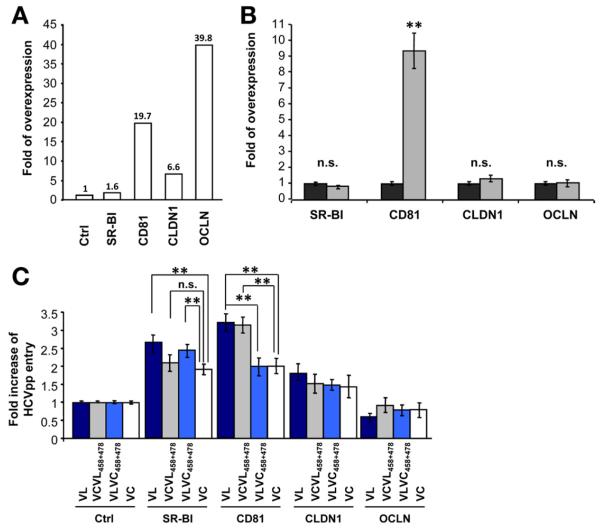
Altered use of CD81 is responsible for enhanced viral entry of the escape variant. (A) Entry factor expression in clones of SR-BI-, CD81-, CLDN1-, or OCLN-transduced Huh7.5.1 cells. The relative overexpression of each entry factor was determined by flow cytometry and is indicated as fold expression compared with parental Huh7.5.1 cells. (B) Entry factor expression in pools of CD81-overex-pressing Huh7.5.1 cells (grey bars). The relative entry factor expression was determined as described in panel A. (C) Receptor dependency of patient-derived HCVpp entry. Parental and transduced Huh7.5.1 cells were incubated with parental or chimeric HCVpp and viral entry was determined as described in Figure 1. Viral entry is expressed as the fold-change of viral entry compared with parental cells. Means ± standard deviation from 3 independent experiments performed in triplicate are shown. Significant differences in HCVpp entry between variants are indicated (**P < .001).
Figure 3
Figure 3
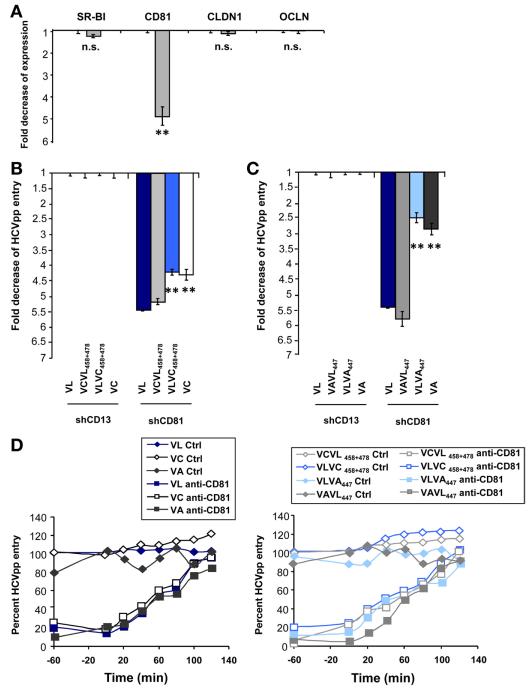
Different CD81 use of viral variants in Huh7.5 cells with silenced CD81 expression. (A) Entry factor expression in Huh7.5 cells with silenced CD81 (grey bars) or CD13 (black bars) expression. CD81 expression was determined by flow cytometry and is indicated as fold expression compared with control shCD13-Huh7.5 cells. (B and C) Entry of patient-derived HCVpp VL, VC, and VA. Huh7.5 cells with silenced CD81 or CD13 expression were incubated with parental or chimeric HCVpp and viral entry was determined as described in Figure 1. Viral entry is expressed as the fold-change of viral entry compared with shCD13-Huh7.5 control cells. Means ± standard deviation from 3 independent experiments performed in triplicate are shown. Significant differences in HCVpp entry between wild-type and chimeric variants are indicated (**P < .001). (D) Entry kinetics of patient-derived variants. Kinetics of HCVpp entry was performed using anti-CD81 or isotype control antibody (5 μg/mL). HCV entry was determined as described in Figure 1. One representative experiment of 4 is shown.
Figure 4
Figure 4
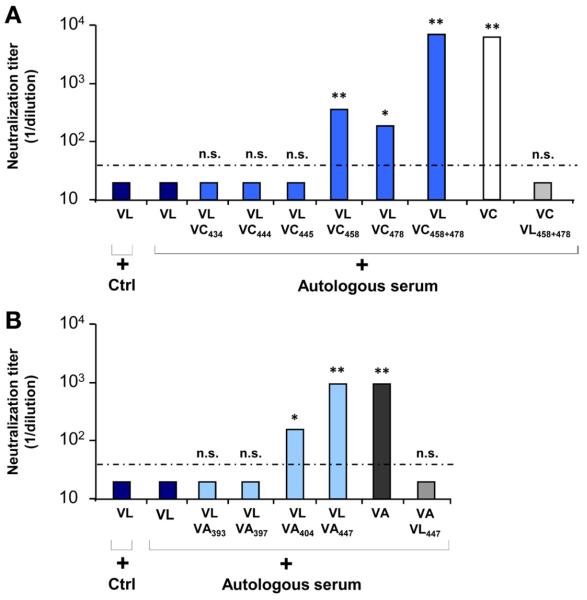
Positions 447, 458, and 478 mediate viral escape from neutralization by autologous transplant serum. Neutralization of the escape variant VL, variants VC and VA, and the chimeric strains. HCVpp were incubated with autologous anti-HCV–positive or control serum in serial dilutions for 1 hour at 37°C before incubation with Huh7.5.1 cells. Neutralization titers obtained by end point dilution are indicated. Dotted line indicates the threshold for a positive neutralization titer (1/40). Means ± standard deviation from at least 4 experiments performed in triplicate are shown. (A) Neutralization of variants VL, VL containing individual or combined mutations of VC, and VC with double substitutions of VL by autologous anti–HCV-positive pretransplant serum. (B) Neutralization of variants VL, VL containing individual mutations of VA, and VA with single substitution of VL by autologous anti-HCV–positive pretransplant serum. Significant differences in neutralization between variants are indicated (*P ≤ .05; **P < .001).
Figure 5
Figure 5
Mechanisms of viral evasion from neutralizing antibodies. (A and B) Escape from neutralization by HMAbs directed against conformational and linear epitopes. HCVpp produced from isolates shown in Figure 1 were incubated with HMAbs (Supplementary Table 1) or control Ab (10 μg/mL) for 1 hour at 37°C before incubation with Huh7.5.1 cells. Results are expressed as the percentage of viral entry relative to HCVpp incubated with control mAb. Means ± standard deviation from at least 4 experiments performed in triplicate are shown. Significant differences in HCVpp entry between variants are indicated (**P < .001). (C and D) Escape from neutralization of anti-E2 antibody CBH-23 in kinetic assays. Kinetics were performed as described in Figure 3 (HMAb, 10 μg/mL; JS-81, 5 μg/mL). One representative experiment of 4 is shown.
Figure 6
Figure 6
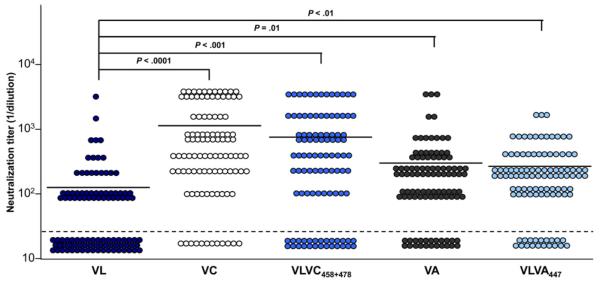
The HCV VL strain is poorly neutralized by antibodies present in sera from a large panel of nonrelated patients with chronic HCV infection. Parental HCVpp (VL, VC, and VA) and chimeric HCVpp (VLVC458+478 and VLVA447) strains, adjusted for p24 antigen expression, were preincubated for 1 hour with serial dilutions of anti-HCV–positive sera from randomly selected patients with chronic hepatitis C before incubation with Huh7.5.1 target cells. Patient number, sex, HCV genotype, and viral load are indicated in Supplementary Tables 2 and 3. Neutralization was determined as in Figure 4. Mean neutralization titers are marked by lines. Means from at least 3 independent experiments performed in triplicate are shown. Significant differences in neutralization are indicated.
Figure 7
Figure 7
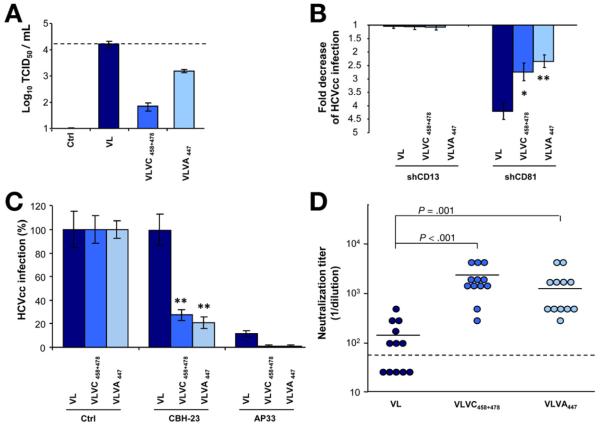
Viral entry and escape from neutralization of chimeric HCVcc expressing patient-derived viral envelopes. (A) Infectivity of HCVcc expressing envelopes of variant VL and functional residues of VA and VC is indicated by TCID50. Means ± standard deviation from 1 representative experiment are shown. (B) Relative infectivity of chimeric HCVcc expressing patient-derived viral envelopes in Huh7.5 cells with silenced CD81 or CD13 expression. Means ± standard deviation from 3 independent experiments performed in triplicate are shown. (C) Escape from neutralization by HMAb CBH-23. Neutralization was performed as described in Figure 5. Results are expressed as the percentage of viral infectivity relative to HCVcc incubated with control mAb. Means ± standard deviation (SD) from at least 3 experiments performed in triplicate are shown. (D) Inhibition of HCVcc infection by anti-HCV–positive sera described in Supplementary Table 3. Neutralization was performed as described in Figure 6. Means from 1 representative experiment performed in triplicate are shown. Significant differences in HCVcc infection between wild-type and chimeric variants are indicated (*P ≤ .05; **P < .001).

References

    1. Alter H. Viral hepatitis. Hepatology. 2006;43:S230–S234. - PubMed
    1. Hofmann WP, Zeuzem S. A new standard of care for the treatment of chronic HCV infection. Nat Rev Gastroenterol Hepatol. 2011;8:257–264. - PubMed
    1. Watt K, Veldt B, Charlton M. A practical guide to the management of HCV infection following liver transplantation. Am J Transplant. 2009;9:1707–1713. - PubMed
    1. Zeisel MB, Cosset FL, Baumert TF. Host neutralizing responses and pathogenesis of hepatitis C virus infection. Hepatology. 2008;48:299–307. - PubMed
    1. Zeisel MB, Fofana I, Fafi-Kremer S, et al. HCV entry into hepato-cytes: mechanism and potential therapeutic implications. J Hepatol. 2011;54:566–576. - PubMed

Publication types

Substances