


Recruiting underrepresented groups into the Carbohydrates and Related Biomarkers (CARB) cancer prevention feeding study
- PMID: 22504222
- PMCID: PMC3516589
- DOI: 10.1016/j.cct.2012.03.017
Recruiting underrepresented groups into the Carbohydrates and Related Biomarkers (CARB) cancer prevention feeding study
Abstract
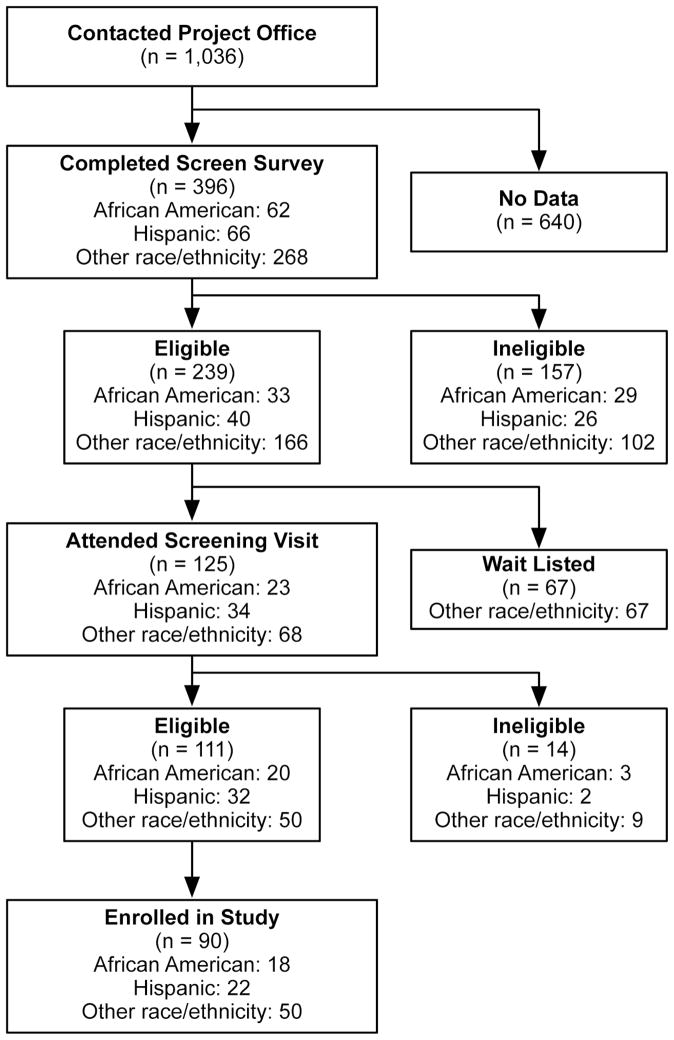
Using data from a randomized, controlled feeding study, which aimed to recruit 88 participants (including 22 Hispanics and 22 African Americans), we examined strategies for recruiting individuals from underrepresented groups into research trials. Study eligibility criteria included participants who 1) were 18-45 years old; 2) had a body mass index (BMI) >18<24.9 or BMI>28.0 <40.0; 3); had no preexisting health conditions; 4) were non-smoking; 5) had normal fasting blood glucose level (<100 mg/dL); and 6) spoke English. Participants were recruited using two overarching methods: media-based strategies (flyers and posters, email announcements, announcements in local and campus newspapers, and the Internet) and in-person strategies (presentations in university classes and community events). Participants were enrolled March 2006-March 2009. We present the numbers of individuals requesting study information, completing pre-enrollment screening questionnaires, and enrolling in the study. A total of 1036 individuals requested study information, and 396 completed a pre-enrollment screening questionnaire; 90 enrolled in the study (22 Hispanics and 18 African Americans). Among enrolled participants, in-person recruitment strategies were reported by 39% of African Americans, 73% of Hispanics, and 30% of non-Hispanic Whites (P<0.001). In-person recruitment strategies were successful among Hispanics. Mass media recruitment strategies were successful among non-Hispanic Whites but enlisted relatively few Hispanic participants. Both strategies recruited nearly equal percentages of African Americans. These data suggest that different strategies are needed to effectively recruit racial/ethnic population subgroups into intervention studies.
Copyright © 2012 Elsevier Inc. All rights reserved.
Conflict of interest statement
No conflicts of interest are reported.
References
-
- Burchard EG, Ziv E, Coyle N, Gomez SL, Tang H, Karter AJ, et al. The importance of race and ethnic background in biomedical research and clinical practice. The New England journal of medicine. 2003;348:1170–5. - PubMed
-
- Bolen S, Tilburt J, Baffi C, Gary TL, Powe N, Howerton M, et al. Defining “success” in recruitment of underrepresented populations to cancer clinical trials: moving toward a more consistent approach. Cancer. 2006;106:1197–204. - PubMed
-
- National Institutes of Health. Monitoring adherence to the NIH policy on the inclusion of women and minorities as subjects in clinical research. 2007 Available from: URL: http://orwh.od.nih.gov/inclusion/FinalAnnualReport2006.pdf.
-
- US Census Bureau. Race and Hispanic Origin 2005. US Census Bureau; 2009. Available from: URL: http://www.census.gov/population/www/pop-profile/files/dynamic/RACEHO.pdf.
-
- Murthy VH, Krumholz HM, Gross CP. Participation in cancer clinical trials: race-, sex-, and age-based disparities. JAMA. 2004;291:2720–6. - PubMed
Publication types
MeSH terms
Grants and funding
LinkOut - more resources
Full Text Sources
