


Brain correlates of phasic autonomic response to acupuncture stimulation: an event-related fMRI study
- PMID: 22504841
- PMCID: PMC3646924
- DOI: 10.1002/hbm.22091
Brain correlates of phasic autonomic response to acupuncture stimulation: an event-related fMRI study
Abstract
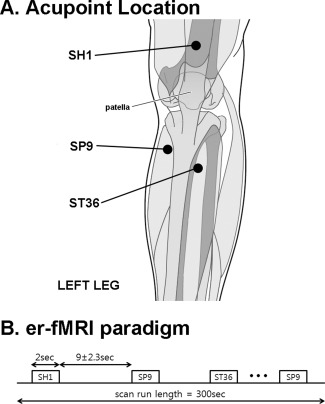
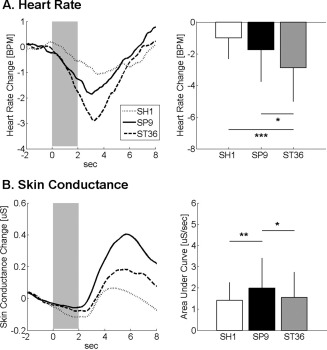
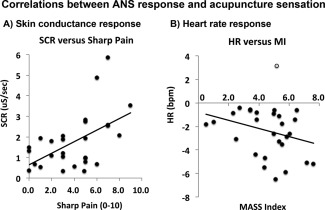
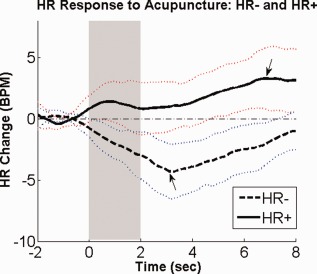
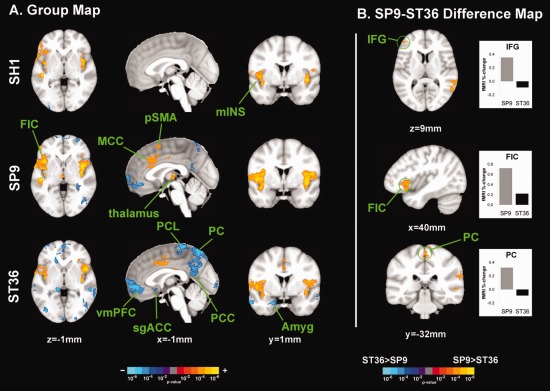
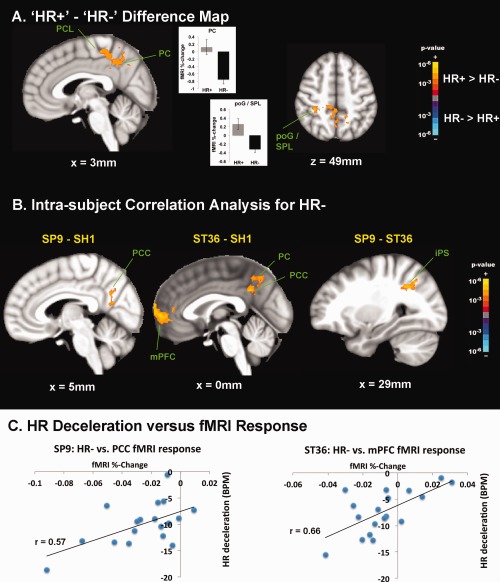
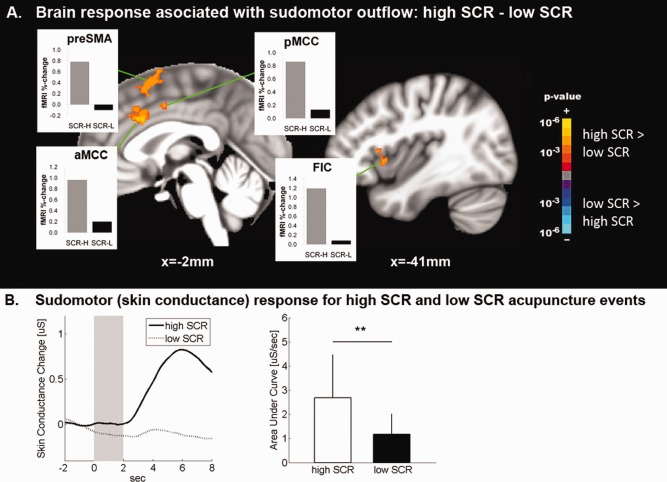
Autonomic nervous system (ANS) response to acupuncture has been investigated by multiple studies; however, the brain circuitry underlying this response is not well understood. We applied event-related fMRI (er-fMRI) in conjunction with ANS recording (heart rate, HR; skin conductance response, SCR). Brief manual acupuncture stimuli were delivered at acupoints ST36 and SP9, while sham stimuli were delivered at control location, SH1. Acupuncture produced activation in S2, insula, and mid-cingulate cortex, and deactivation in default mode network (DMN) areas. On average, HR deceleration (HR-) and SCR were noted following both real and sham acupuncture, though magnitude of response was greater following real acupuncture and inter-subject magnitude of response correlated with evoked sensation intensity. Acupuncture events with strong SCR also produced greater anterior insula activation than without SCR. Moreover, acupuncture at SP9, which produced greater SCR, also produced stronger sharp pain sensation, and greater anterior insula activation. Conversely, acupuncture-induced HR- was associated with greater DMN deactivation. Between-event correlation demonstrated that this association was strongest for ST36, which also produced more robust HR-. In fact, DMN deactivation was significantly more pronounced across acupuncture stimuli producing HR-, versus those events characterized by acceleration (HR+). Thus, differential brain response underlying acupuncture stimuli may be related to differential autonomic outflows and may result from heterogeneity in evoked sensations. Our er-fMRI approach suggests that ANS response to acupuncture, consistent with previously characterized orienting and startle/defense responses, arises from activity within distinct subregions of the more general brain circuitry responding to acupuncture stimuli.
Keywords: acupoint; defense response; heart rate; orienting response; skin conductance response.
Copyright © 2012 Wiley Periodicals, Inc.
Figures
References
-
- Abad‐Alegria F, Pomaron C, et al. (2001): Objective assessment of the sympatholytic action of the Nei‐Kuan acupoint. Am J Chin Med 29:201–210. - PubMed
-
- Andersson S, Lundeberg T (1995): Acupuncture—From empiricism to science: Functional background to acupuncture effects in pain and disease. Med Hypotheses 45:271–281. - PubMed
-
- Backer M, Hammes MG, et al. (2002): Different modes of manual acupuncture stimulation differentially modulate cerebral blood flow velocity, arterial blood pressure and heart rate in human subjects. Neurosci Lett 333:203–206. - PubMed
-
- Bajaj P, Madsen H, et al. (2003): Endometriosis is associated with central sensitization: A psychophysical controlled study. J. Pain 4:372–380. - PubMed
Publication types
MeSH terms
Grants and funding
- P41-RR14075/RR/NCRR NIH HHS/United States
- UL1-RR025758/RR/NCRR NIH HHS/United States
- P41 RR014075/RR/NCRR NIH HHS/United States
- R01 HL084502/HL/NHLBI NIH HHS/United States
- R01 AT004714/AT/NCCIH NIH HHS/United States
- P01 AT006663/AT/NCCIH NIH HHS/United States
- UL1 RR025758/RR/NCRR NIH HHS/United States
- R01 AT005280/AT/NCCIH NIH HHS/United States
- K01-AT002166/AT/NCCIH NIH HHS/United States
- P01-AT002048/AT/NCCIH NIH HHS/United States
- K01 AT002166/AT/NCCIH NIH HHS/United States
- P01 AT002048/AT/NCCIH NIH HHS/United States
- R01-AT004714/AT/NCCIH NIH HHS/United States
- F05-AT003770/AT/NCCIH NIH HHS/United States
