. 2012 Jun;194(12):3128-36.
doi: 10.1128/JB.06178-11. Epub 2012 Apr 13.

The biofilm-specific antibiotic resistance gene ndvB is important for expression of ethanol oxidation genes in Pseudomonas aeruginosa biofilms

Affiliations

The biofilm-specific antibiotic resistance gene ndvB is important for expression of ethanol oxidation genes in Pseudomonas aeruginosa biofilms

Trevor Beaudoin et al. J Bacteriol. 2012 Jun.

Abstract

Bacteria growing in biofilms are responsible for a large number of persistent infections and are often more resistant to antibiotics than are free-floating bacteria. In a previous study, we identified a Pseudomonas aeruginosa gene, ndvB, which is important for the formation of periplasmic glucans. We established that these glucans function in biofilm-specific antibiotic resistance by sequestering antibiotic molecules away from their cellular targets. In this study, we investigate another function of ndvB in biofilm-specific antibiotic resistance. DNA microarray analysis identified 24 genes that were responsive to the presence of ndvB. A subset of 20 genes, including 8 ethanol oxidation genes (ercS', erbR, exaA, exaB, eraR, pqqB, pqqC, and pqqE), was highly expressed in wild-type biofilm cells but not in ΔndvB biofilms, while 4 genes displayed the reciprocal expression pattern. Using quantitative real-time PCR, we confirmed the ndvB-dependent expression of the ethanol oxidation genes and additionally demonstrated that these genes were more highly expressed in biofilms than in planktonic cultures. Expression of erbR in ΔndvB biofilms was restored after the treatment of the biofilm with periplasmic extracts derived from wild-type biofilm cells. Inactivation of ethanol oxidation genes increased the sensitivity of biofilms to tobramycin. Together, these results reveal that ndvB affects the expression of multiple genes in biofilms and that ethanol oxidation genes are linked to biofilm-specific antibiotic resistance.


Figures
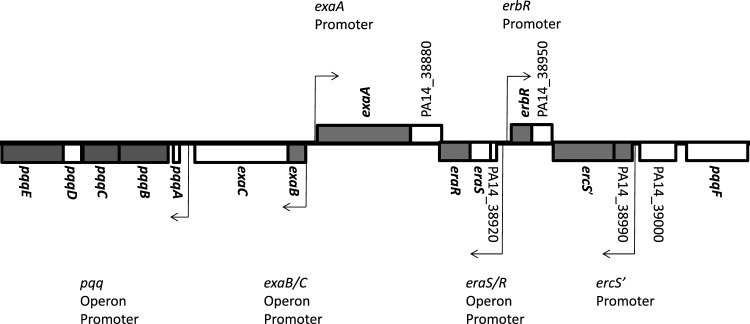
Fig 1
Fig 1
Chromosomal arrangement of ethanol oxidation genes in P. aeruginosa strain PA14. ndvB-responsive genes identified by microarray analysis are shown in gray. Genes previously reported to be involved in ethanol oxidation are in bold (14, 22). The confirmed promoters for several operons of ethanol oxidation genes are indicated by arrows (12, 13, 22).
Fig 2
Fig 2
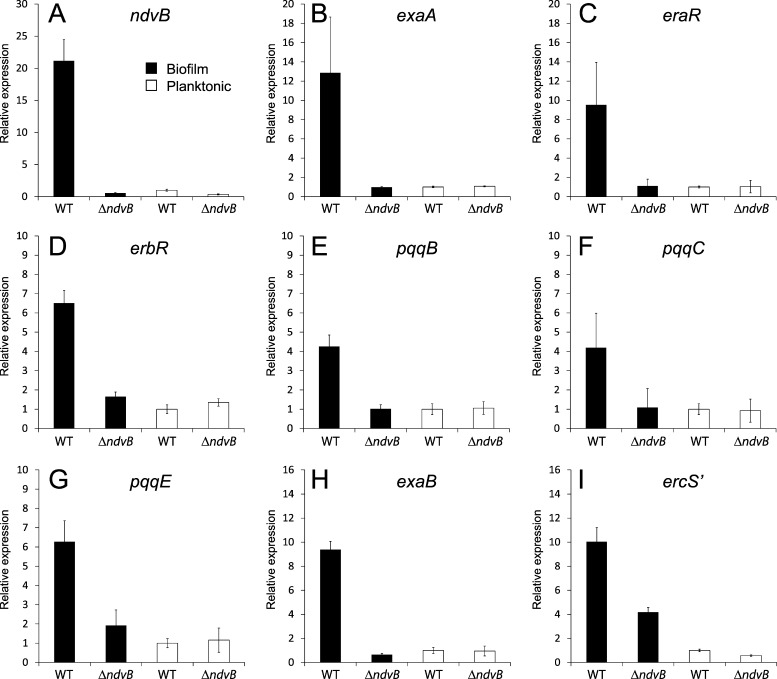
qPCR analysis of ethanol oxidation genes in biofilms and planktonic cultures of wild-type and ΔndvB strains. RNA was extracted from drip-fed biofilms grown in M63-arginine and planktonic cultures grown in LB (A to G) or from colony biofilms and planktonic cultures that were both grown in M63-arginine (H and I). Gene expression of the wild type and the ΔndvB mutant under each condition is given relative to that of the wild-type planktonic cultures. The error bars indicate standard deviations for two biological replicates tested in triplicate qPCRs. Tested genes include ndvB (A), exaA (B), eraR (C), erbR (D), pqqB (E), pqqC (F), pqqE (G), exaB (H), and ercS′ (I). All of the genes showed a statistically significant (P < 0.05) increase in expression in wild-type biofilms compared to that in ΔndvB biofilms. WT, wild type.
Fig 3
Fig 3
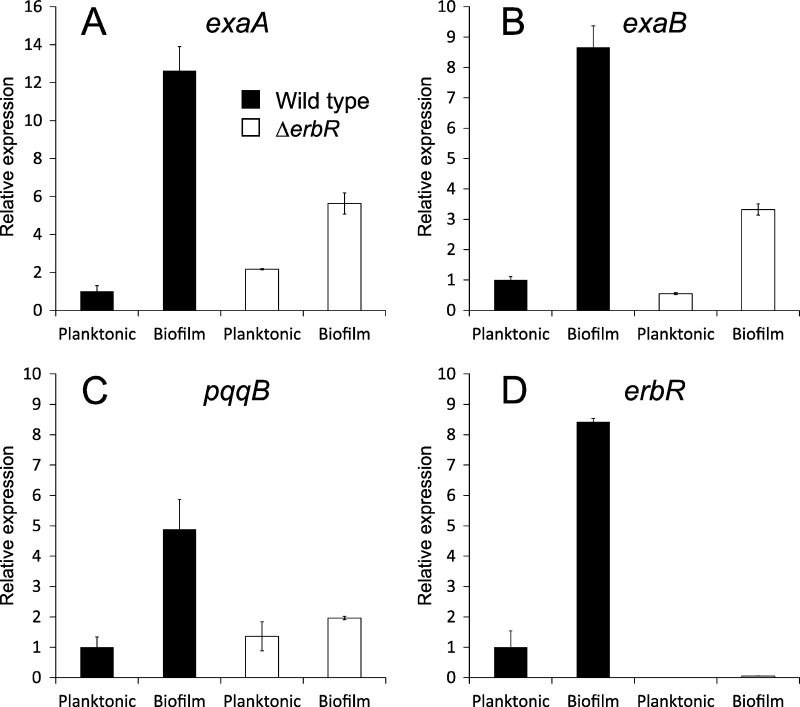
Induction of exaA, exaB, and pqqB in biofilms involves the response regulator ErbR. Colony biofilms and planktonic cultures of wild-type and ΔerbR strains were grown in M63-arginine. RNA was assayed by qPCR for expression of exaA (A), exaB (B), pqqB (C), and erbR (D). Gene expression is given relative to that of the wild-type planktonic cultures. For each condition, two biological replicate samples were tested in triplicate qPCRs.
Fig 4
Fig 4
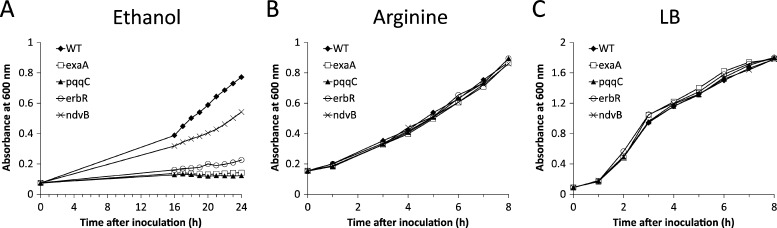
Inactivation of ndvB compromises planktonic growth on ethanol. The PA14 wild-type strain (WT), the ΔndvB mutant, and three ethanol oxidation gene mutants (ΔexaA, ΔpqqC, and ΔerbR) were grown in M63 containing ethanol (A) or arginine (B) as the sole carbon source or in LB medium (C). Growth was monitored by measuring absorbance at 600 nm. The growth curves are representative of at least two replicate experiments. Statistically significant differences in growth between the wild-type and mutant strains (P < 0.05) were observed for ethanol but not for the other conditions.
Fig 5
Fig 5
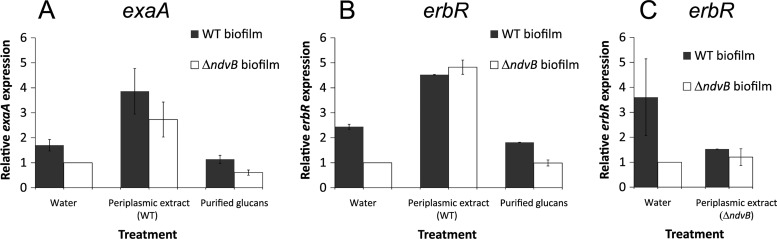
Expression of erbR and exaA in biofilms treated with periplasmic extract or purified glucans. Preformed wild-type and ΔndvB biofilms were treated for 8 h with water (negative control), wild-type periplasmic extract, ΔndvB periplasmic extract, or purified glucans. Expression of exaA (A) and erbR (B and C) was measured by qPCR and is given relative to that of the untreated ΔndvB biofilms. Each panel shows the results of two or three biological replicates tested in triplicate qPCRs.

References

    1. Blatny JM, Brautaset T, Winther-Larsen HC, Karunakaran P, Valla S. 1997. Improved broad-host-range RK2 vectors useful for high and low regulated gene expression levels in Gram-negative bacteria. Plasmid 38:35–51 - PubMed
    1. Breedveld MW, Miller KJ. 1994. Cyclic β-glucans of members of the family Rhizobiaceae. Microbiol. Rev. 58:145–161 - PMC - PubMed
    1. CLSI 2009. Methods for dilution antimicrobial susceptibility tests for bacteria that grow aerobically. Approved standard—eighth edition. CLSI document M07-A8Clinical and Laboratory Standards Institute, Wayne, PA
    1. Costerton JW, Stewart PS, Greenberg EP. 1999. Bacterial biofilms: a common cause of persistent infections. Science 284:1318–1322 - PubMed
    1. Development Core Team R 2006. R: a language and environment for statistical computing. R Foundation for Statistical Computing, Vienna, Austria: http://www.R-project.org

Publication types

MeSH terms