. 2012 May;11(5):148-59.
doi: 10.1074/mcp.M111.016857. Epub 2012 Apr 14.

Methods for quantification of in vivo changes in protein ubiquitination following proteasome and deubiquitinase inhibition

Affiliations

Methods for quantification of in vivo changes in protein ubiquitination following proteasome and deubiquitinase inhibition

Namrata D Udeshi et al. Mol Cell Proteomics. 2012 May.

Abstract

Ubiquitination plays a key role in protein degradation and signal transduction. Ubiquitin is a small protein modifier that is adducted to lysine residues by the combined function of E1, E2, and E3 enzymes and is removed by deubiquitinating enzymes. Characterization of ubiquitination sites is important for understanding the role of this modification in cellular processes and disease. However, until recently, large-scale characterization of endogenous ubiquitination sites has been hampered by the lack of efficient enrichment techniques. The introduction of antibodies that specifically recognize peptides with lysine residues that harbor a di-glycine remnant (K-ε-GG) following tryptic digestion has dramatically improved the ability to enrich and identify ubiquitination sites from cellular lysates. We used this enrichment technique to study the effects of proteasome inhibition by MG-132 and deubiquitinase inhibition by PR-619 on ubiquitination sites in human Jurkat cells by quantitative high performance mass spectrometry. Minimal fractionation of digested lysates prior to immunoaffinity enrichment increased the yield of K-ε-GG peptides three- to fourfold resulting in detection of up to ~3300 distinct K-GG peptides in SILAC triple encoded experiments starting from 5 mg of protein per label state. In total, we identify 5533 distinct K-ε-GG peptides of which 4907 were quantified in this study, demonstrating that the strategy presented is a practical approach to perturbational studies in cell systems. We found that proteasome inhibition by MG-132 and deubiquitinase inhibition by PR-619 induces significant changes to the ubiquitin landscape, but that not all ubiquitination sites regulated by MG-132 and PR-619 are likely substrates for the ubiquitin-proteasome system. Additionally, we find that the proteasome and deubiquitinase inhibitors studied induced only minor changes in protein expression levels regardless of the extent of regulation induced at the ubiquitin site level. We attribute this finding to the low stoichiometry of the majority ubiquitination sites identified in this study.


Figures
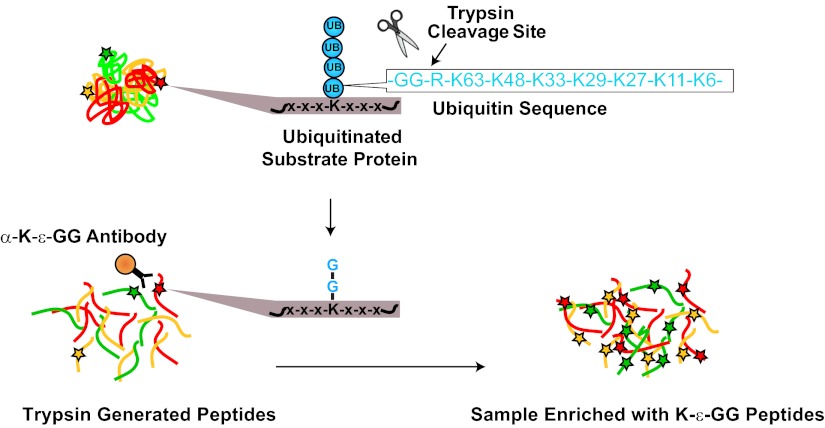
Fig. 1.
Fig. 1.
Schematic of the enrichment of K-ε-GG peptides with an anti- K-ε-GG antibody. Following tryptic digestion two glycine residues from the C terminus of ubiquitin remain linked to the epsilon amino group of a modified lysine residue. An anti-K-ε-GG antibody is used to efficiently enrich these peptides away from non- K-ε-GG peptides.
Fig. 2.
Fig. 2.
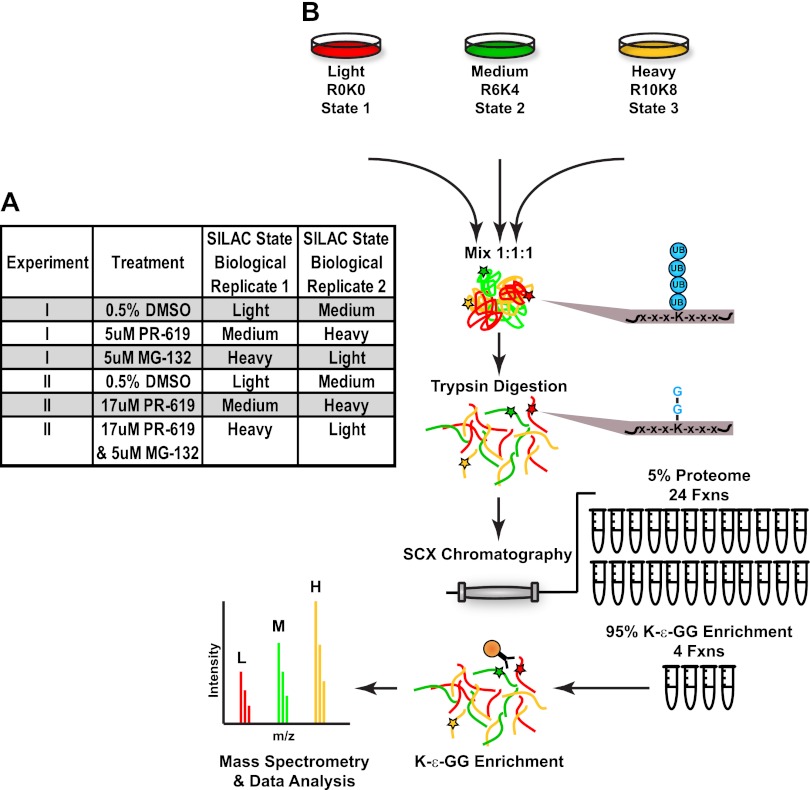
Outline of the SILAC experimental design and schematic of the workflow. Two SILAC triple-encoded experiments were completed in biological duplicates with label switching as outlined in (A). Our workflow is depicted in (B). SILAC labeled Jurkat cells were lysed, proteins reduced, alkylated, and digested with trypsin and subsequently fractionated off-line by SCX chromatography. A small percentage of each SCX fraction was combined to create 24 total pools for the proteome level analysis. The remaining SCX samples were combined to create four total pools for K-ε-GG enrichment. Peptide mixtures were enriched for K-ε-GG peptides and analyzed by LC-MS/MS.
Fig. 3.
Fig. 3.
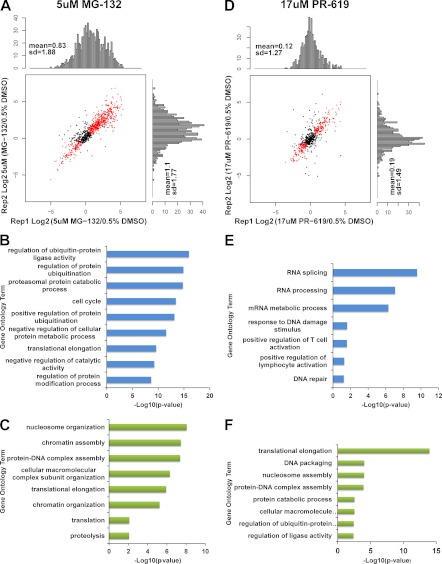
The effects of MG-132 and PR-619 on K-ε-GG peptides. Scatter plots and histograms of the SILAC ratios of biological replicate 1 versus 2 for (A) K-ε-GG peptides after 5 μm MG-132 treatment. Ratios deemed to be reproducibly regulated by the moderated t-statistic (Benjamini-Hochberg p value <0.1) are indicated in red. Enriched GOBP terms were derived using the DAVID bioinformatics resource. A selection of significantly enriched terms (Benjamini-Hochberg p value <0.05) were plotted for K-ε-GG modified proteins that were (B) up-regulated and (C) down-regulated by MG-132. Scatter plots and histograms of SILAC ratios of biological replicate 1 versus 2 for (D) K-ε-GG peptides after 17 μm PR-619 treatment. A selection of significantly enriched GOBP terms (p < 0.05) were plotted for K-ε-GG peptides ratios that were (E) up-regulated or (F) down-regulated by 17 μm PR-619 treatment.
Fig. 4.
Fig. 4.
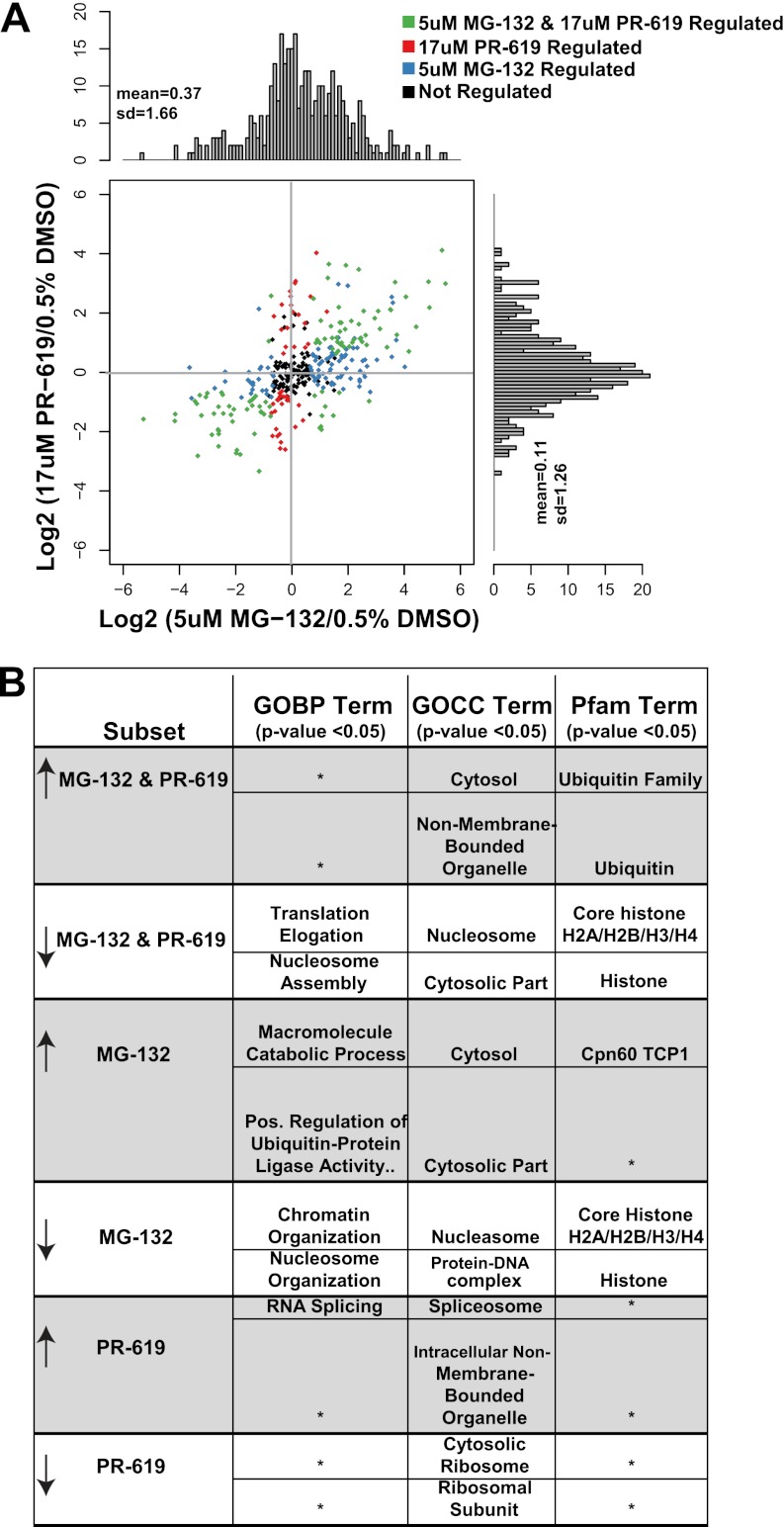
Comparison of effects induced by MG-132 and PR-619 on the same K-ε-GG peptide. Scatter plot and histograms of SILAC ratios for (A) K-ε-GG peptides after 5 μm MG-132 versus 17 μm PR-619 treatment. To generate this plot, the average log2 SILAC ratio between two biological replicates was calculated for each treatment condition. Regulation status was determined using the moderated t-statistic (Benjamini-Hochberg p value <0.1). Points colored in black were not deemed reproducibly regulated in either of the treatment conditions. Enriched GOBP, GOCC and Pfam terms were derived using the DAVID bioinformatics resource. The two most significantly enriched terms (Benjamini-Hochberg p value <0.05) are tabulated (B) for K-ε-GG modified proteins within each of the colored subsets. Asterisks indicate that no significantly enriched ontology term was identified.
Fig. 5.
Fig. 5.
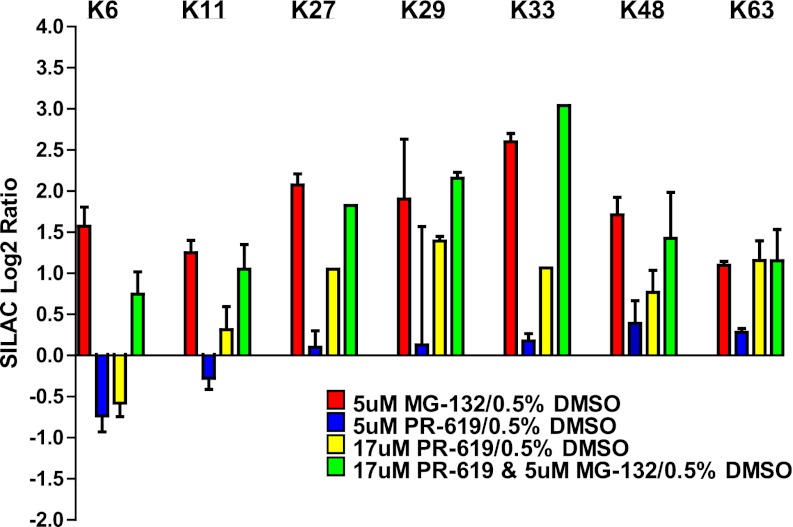
Effects of treatment on polyubiquitin linkages. SILAC log2 ratios are plotted for GlyGly modified lysine residues of ubiquitin. Ratios for all nondistinct K-ε-GG modified lysine residues of ubiquitin were used for this analysis.
Fig. 6.
Fig. 6.
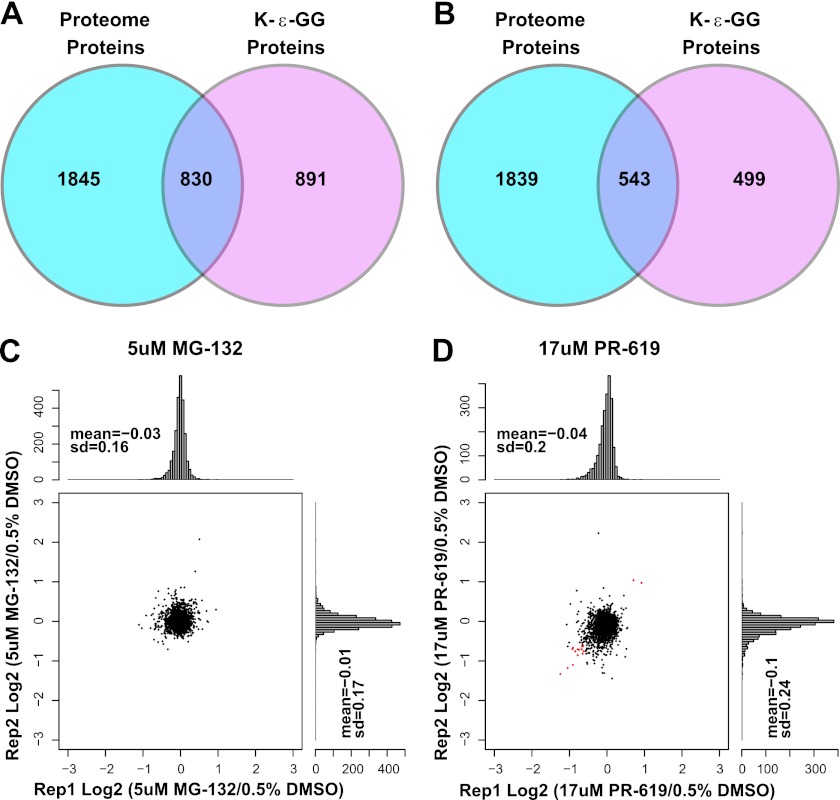
Results of Proteome Analysis. Overlap of proteins and K-ε-GG modified peptides identified in SILAC (A) Experiment I and (B) Experiment II. Scatter plots and histograms are shown for SILAC ratios of biological replicate 1 versus 2 for Proteome-level protein ratios after (C) 5 μm MG-132 treatment and (D) 17 μm PR-619 treatment.

References

    1. Myung J., Kim K. B., Crews C. M. (2001) The ubiquitin-proteasome pathway and proteasome inhibitors. Med. Res. Rev. 21, 245–273 - PMC - PubMed
    1. Dikic I., Wakatsuki S., Walters K. J. (2009) Ubiquitin-binding domains [mdash] from structures to functions. Nat. Rev. Mol. Cell Biol. 10, 659–671 - PMC - PubMed
    1. Cohen P., Tcherpakov M. (2010) Will the Ubiquitin System Furnish as Many Drug Targets as Protein Kinases? Cell 143, 686–693 - PubMed
    1. Sacco J. J., Coulson J. M., Clague M. J., Urbé S. (2010) Emerging roles of deubiquitinases in cancer-associated pathways. IUBMB Life 62, 140–157 - PMC - PubMed
    1. Komander D., Clague M. J., Urbé S. (2009) Breaking the chains: structure and function of the deubiquitinases. Nat. Rev. Mol. Cell Biol. 10, 550–563 - PubMed

Publication types

MeSH terms