. 2011 Jun 1;9(2):138-147.
doi: 10.1007/s12018-011-9098-2. Epub 2011 Jun 18.

Cysteine Protease Cathepsins in Atherosclerosis and Abdominal Aortic Aneurysm

Affiliations

Cysteine Protease Cathepsins in Atherosclerosis and Abdominal Aortic Aneurysm

Sara Sjöberg et al. Clin Rev Bone Miner Metab. .

Abstract

Extracellular matrix remodeling is an important mechanism in the initiation and progression of cardiovascular diseases. Cysteine protease cathepsins are among the important proteases that affect major events in the pathogenesis of atherosclerosis and abdominal aortic aneurysm, including smooth muscle cell transmigration through elastic lamina, macrophage foam cell formation, vascular cell and macrophage apoptosis, and plaque rupture. These events have been studied in cathepsin deficiencies and cathepsin inhibitor deficiencies in mice and have provided invaluable insights regarding the roles of cathepsins in cardiovascular diseases. Pharmacological inhibitions for cathepsins are under evaluation for other human diseases and may be used as clinical treatments for cardiovascular diseases in the near future. This article reviews different mechanisms for cathepsins in atherosclerosis and abdominal aortic aneurysm that could be targeted by selective cathepsin inhibitors.


Figures
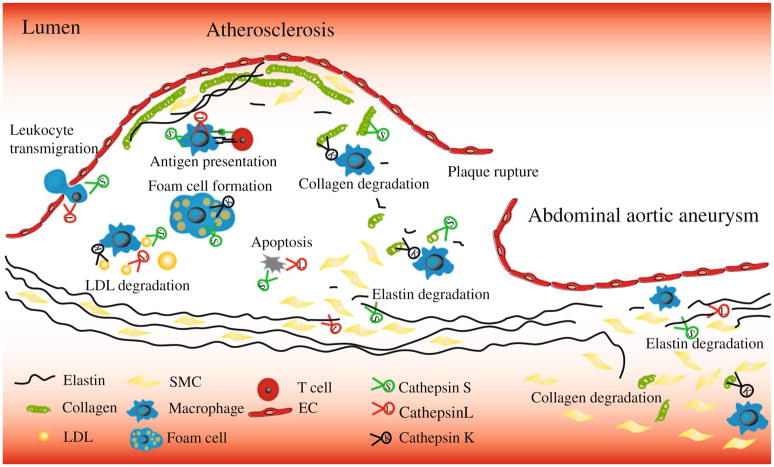
Fig. 1
Fig. 1
Overview of potential mechanisms for cathepsins in the pathogenesis of atherosclerosis and abdominal aortic aneurysms. Cathepsins expressed in inflammatory cells, vascular smooth muscle cells (SMC), and endothelial cells (EC) degrade elastin and collagen, which may affect lesion stability, SMC migration, and leukocyte transmigration. Cathepsins are involved in antigen presentation and may increase low-density lipoprotein (LDL) retention to extracellular matrix, foam cell formation, and vascular cell apoptosis

References

    1. Libby P, Lee RT. Matrix matters. Circulation. 2000;102(16):1874–6. - PubMed
    1. Robert L, Robert AM, Jacotot B. Elastin-elastase-atherosclerosis revisited. Atherosclerosis. 1998;140(2):281–95. - PubMed
    1. Reddy VY, Zhang QY, Weiss SJ. Pericellular mobilization of the tissue-destructive cysteine proteinases, cathepsins B, L, and S, by human monocyte-derived macrophages. Proc Natl Acad Sci USA. 1995;92(9):3849–53. - PMC - PubMed
    1. Sukhova GK, Shi GP, Simon DI, Chapman HA, Libby P. Expression of the elastolytic cathepsins S and K in human atheroma and regulation of their production in smooth muscle cells. J Clin Invest. 1998;102(3):576–83. - PMC - PubMed
    1. Kafienah W, Bromme D, Buttle DJ, Croucher LJ, Hollander AP. Human cathepsin K cleaves native type I and II collagens at the N-terminal end of the triple helix. Biochem J. 1998;331(Pt 3):727–32. - PMC - PubMed

LinkOut - more resources