Spousal involvement in CPAP: does pressure help?
- PMID: 22505859
- PMCID: PMC3311411
- DOI: 10.5664/jcsm.1766
Spousal involvement in CPAP: does pressure help?
Abstract
Study objectives: Continuous positive airway pressure (CPAP) improves sleep and quality of life for both patients with obstructive sleep apnea (OSA) and their spouses. However, few studies have investigated spousal involvement in treatment adherence. Aims of this observational study were to assess perceptions of spousal involvement and evaluate associations between involvement and adherence.
Methods: Spousal involvement in CPAP adherence was assessed in 23 married male OSA patients after the first week of treatment. At 3 months, 16 participants completed a second assessment of spousal involvement. Types of involvement assessed included positive (e.g., encouraging), negative (e.g., blaming), collaboration (e.g., working together), and one-sided (e.g., asking). An interpersonal measure of supportive behaviors was also administered at 3 months to evaluate the interpersonal qualities of spousal involvement types. Objective CPAP adherence data were available for 14 participants.
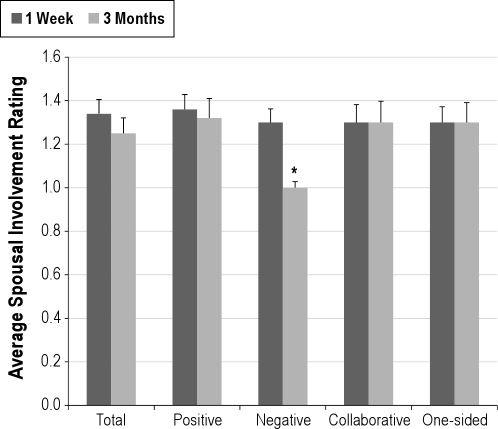
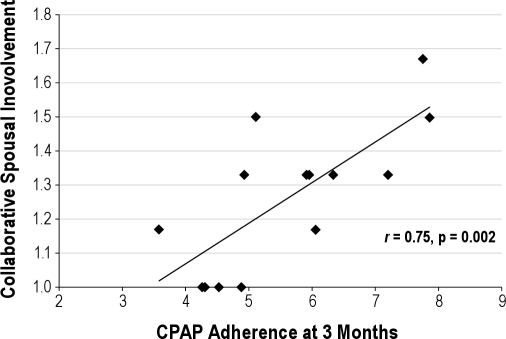
Results: Average frequency of spousal involvement ratings were low for each involvement type and only negative spousal involvement frequency decreased at 3 month follow-up (p = 0.003). Perceptions of collaborative spousal involvement were associated with higher CPAP adherence at 3 months (r = 0.75, p = 0.002). Positive, negative and one-sided involvement were not associated with adherence. Collaborative spousal involvement was associated with moderately warm and controlling interpersonal behaviors (affiliation, r = 0.55, p = 0.03, dominance r = 0.47, p = 0.07).
Conclusions: Patients reported low frequency but consistent and diverse perceptions of spousal involvement in CPAP over the first 3 months of treatment. Perceptions of collaborative spousal involvement were the only type associated with adherence and represent moderately warm and controlling interpersonal behavior. Interventions to increase spousal collaboration in CPAP may improve adherence.
Keywords: Obstructive sleep apnea; adherence; continuous positive airway pressure; relationship quality; social support.
Figures
References
-
- Young T, Evans L, Finn L, Palta M. Estimation of the clinically diagnosed proportion of sleep apnea syndrome in middle-aged men and women. Sleep. 1997;20:705–6. - PubMed
-
- Patel SR, White DP, Malhotra A, Stanchina ML, Ayas NT. Continuous positive airway pressure therapy for treating sleepiness in a diverse population with obstructive sleep apnea: results of a meta-analysis. Arch Intern Med. 2003;163:565–71. - PubMed
-
- Means MK, Lichstein KL, Edinger JD, et al. Changes in depressive symptoms after continuous positive airway pressure treatment for obstructive sleep apnea. Sleep Breath. 2003;7:31–42. - PubMed
-
- Marin JM, Carrizo SJ, Vicente E, Agusti AG. Long-term cardiovascular outcomes in men with obstructive sleep apnoea-hypopnoea with or without treatment with continuous positive airway pressure: an observational study. Lancet. 2005;365:1046–53. - PubMed
-
- Doherty LS, Kiely JL, Swan V, McNicholas WT. Long-term effects of nasal continuous positive airway pressure therapy on cardiovascular outcomes in sleep apnea syndrome. Chest. 2005;127:2076–84. - PubMed
Publication types
MeSH terms
Grants and funding
LinkOut - more resources
Full Text Sources
Other Literature Sources