. 2012 Dec;12(6):1210-21.
doi: 10.1037/a0027514. Epub 2012 Apr 16.

Out of sight but not out of mind: unseen affective faces influence evaluations and social impressions

Affiliations

Out of sight but not out of mind: unseen affective faces influence evaluations and social impressions

Eric Anderson et al. Emotion. 2012 Dec.

Abstract

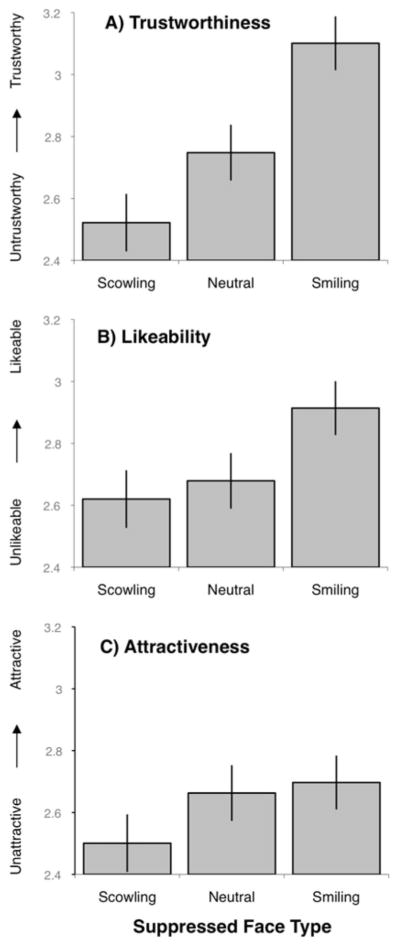
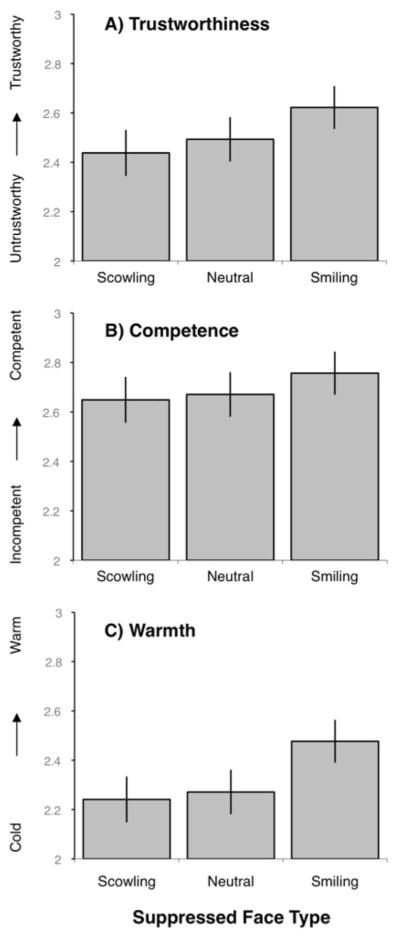
Using Continuous Flash Suppression (CFS), we demonstrated in four experiments that affective information extracted from unseen faces influences both affective and personality judgments of neutral faces. In four experiments, participants judged neutral faces as more pleasant or unpleasant (Studies 1 and 2) or as more or less trustworthy, likable, and attractive (Study 3) or as more or less competent or interpersonally warm (Study 4) when paired with unseen smiling or scowling faces compared to when paired with unseen neutral faces. These findings suggest that affective influences are a normal part of everyday experience and provide evidence for the affective foundations consciousness. Affective misattribution arises even when affective changes occur after a neutral stimulus is presented, demonstrating that these affective influences cannot be explained as a simple semantic priming effect. These findings have implications for understanding the constructive nature of experience, as well as the role of affect in social impressions.


Figures

Figure 1
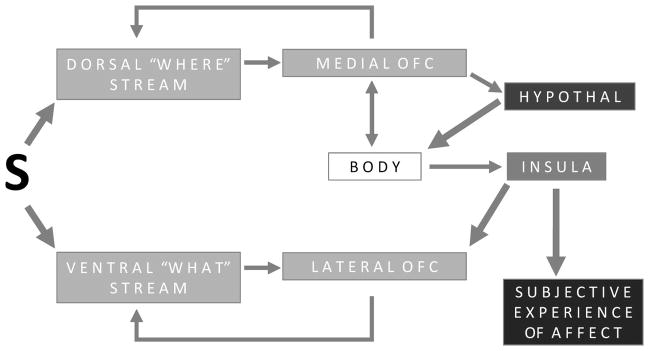
Figure 1. Neuroanatomical Depiction of Affective Vision
During perception, the brain, via magnocellular pathways in the dorsal visual stream (where is it and how do I act on it), makes an initial “gist” level prediction about the scene or object to which visual sensations refer. These areas project to the medial part of OFC, which regulates visceromotor control and has multiple cascading projections to striatum, hypothalamus, brainstem and spinal cord autonomic regulation centers, changing the perceiver’s body state. About 15–30 ms after the onset of this process the visual system begins to process more detailed visual input via parvocellular pathway in the ventral stream that is associated with visual consciousness. This information reaches lateral OFC quickly. With a lot of back and forth between visual cortex and the more lateral areas of prefrontal cortex (via the direct projections that connect them), a finer level of categorization is achieved until finally the object is precisely recognized. This 15–30 ms magnocelluar advantage is the window of affective projection where the body state is changed and helps shape visual perception. For ease of presentation, many other connections are not shown here (e.g., reciprocal connections between the ventral and dorsal visual streams, as well as reciprocal connections between the medial and lateral sections of the OFC). Medial OFC dorsal stream connections are similar to Barbas and Pandya’s (1989) “mediodorsal” system within the orbital sector of the prefrontal cortex, whereas the lateral OFC ventral stream connections are similar to their “basoventral” system.
Figure 2
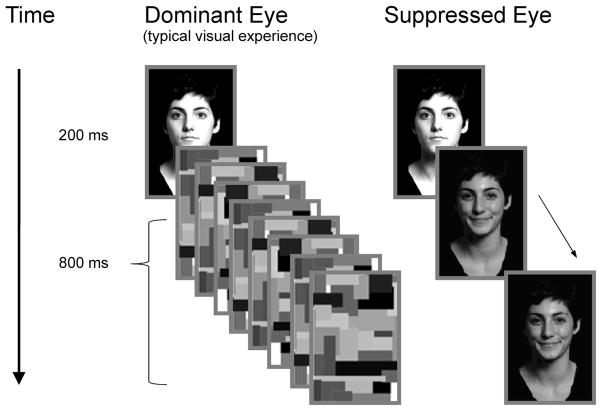
Figure 2. Study 1: Example of Trial Structure
Following a fixation dot, both eyes were presented with a face depicting a neutral expression for 200 ms. Immediately following, eight Mondrian images were presented, each for 100 ms. Concurrently, a low luminance face (depicting scowling, smiling, or neutral expressions) was presented to the suppressed eye for 800 ms.
Figure 3
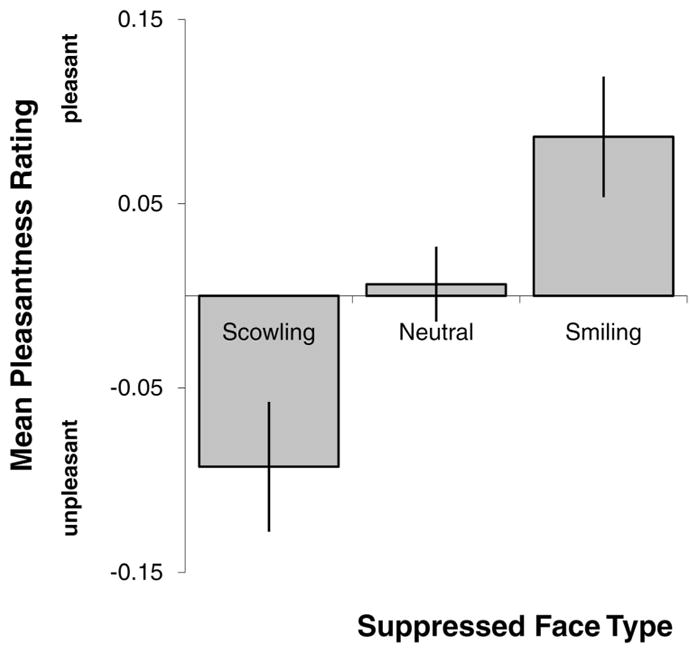
Figure 3. Study 1: Mean Ratings of Faces by Suppressed Face Type
Error bars represent standard errors. Ratings in graph were centered on individuals’ grand mean. All means were statistically different at p < .05, except the comparison between neutral and smiling face types, which only reached trend level significance ( p < .06).
Figure 4
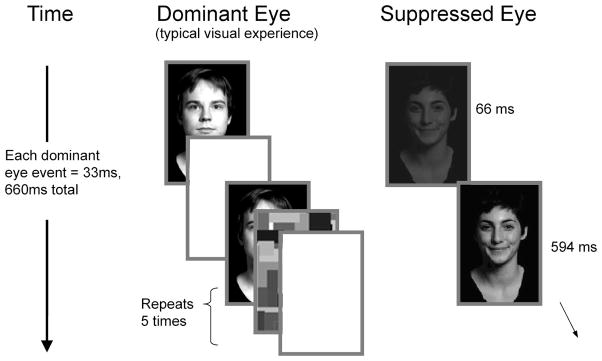
Figure 4. Study 3: Trial Structure
Following a fixation dot, the dominant eye was presented with a series of intermingled faces, white fields, and Mondrian images. Twenty images were presented, each for 33 ms for a total time of 660 ms. Concurrently, the suppressed eye was presented with a black field for the first 66 ms, followed by a low luminance face (either smiling, scowling, or neutral) presented for the remaining 594 ms of the trial.
Figure 5
Figure 5. Study 3: Mean social ratings by face type
Error bars represent standard errors. A) Trustworthiness; B) Likeability; C) Attractiveness.
Figure 6
Figure 6. Study 4: Mean social ratings by face type
Error bars represent standard errors. A) Trustworthiness; B) Competence; C) Warmth.

References

    1. Almeida J, Mahon BZ, Caramazza A. The role of the dorsal visual processing stream in tool identification. Psychological Science. 2010;21:772–778. doi: 10.1177/0956797610371343. - DOI - PMC - PubMed
    1. Almeida J, Mahon BZ, Nakayama K, Caramazza A. Unconscious processing dissociates along categorical lines. Proceedings of the National Academy of Sciences of the United States of America. 2008;105:15214– 8. doi: 10.1073/pnas.0805867105. - DOI - PMC - PubMed
    1. Alpers GW, Ruhleder M, Walz N, Mühlberger A, Pauli P. Binocular rivalry between emotional and neutral stimuli: A validation using fear conditioning and EEG. International Journal of Psychophysiology. 2005;57:25–32. doi: 10.1016/j.ijpsycho.2005.01.008. - DOI - PubMed
    1. Anderson E, Siegel EH, Barrett LF. What you feel influences what you see: The role of affective feelings in resolving binocular rivalry. Journal of Experimental Social Psychology. 2011;47:856–860. doi: 10.1016/j.jesp.2011.02.009. - DOI - PMC - PubMed
    1. Anderson E, Siegel EH, Bliss-Moreau E, Barrett LF. The visual impact of gossip. Science. 2011;332:1446–1448. doi: 10.1126/science.1201574. - DOI - PMC - PubMed

Publication types