. 2012;8(4):e1002631.
doi: 10.1371/journal.pgen.1002631. Epub 2012 Apr 5.

Fine-scale mapping of natural variation in fly fecundity identifies neuronal domain of expression and function of an aquaporin

Affiliations

Fine-scale mapping of natural variation in fly fecundity identifies neuronal domain of expression and function of an aquaporin

Alan O Bergland et al. PLoS Genet. 2012.

Abstract

To gain insight into the molecular genetic basis of standing variation in fitness related traits, we identify a novel factor that regulates the molecular and physiological basis of natural variation in female Drosophila melanogaster fecundity. Genetic variation in female fecundity in flies derived from a wild orchard population is heritable and largely independent of other measured life history traits. We map a portion of this variation to a single QTL and then use deficiency mapping to further refine this QTL to 5 candidate genes. Ubiquitous expression of RNAi against only one of these genes, an aquaporin encoded by Drip, reduces fecundity. Within our mapping population Drip mRNA level in the head, but not other tissues, is positively correlated with fecundity. We localize Drip expression to a small population of corazonin producing neurons located in the dorsolateral posterior compartments of the protocerebrum. Expression of Drip-RNAi using both the pan-neuronal ELAV-Gal4 and the Crz-Gal4 drivers reduces fecundity. Low-fecundity RILs have decreased Crz expression and increased expression of pale, the enzyme encoding the rate-limiting step in the production of dopamine, a modulator of insect life histories. Taken together these data suggest that natural variation in Drip expression in the corazonin producing neurons contributes to standing variation in fitness by altering the concentration of two neurohormones.


Conflict of interest statement

The authors have declared that no competing interests exist.

Figures
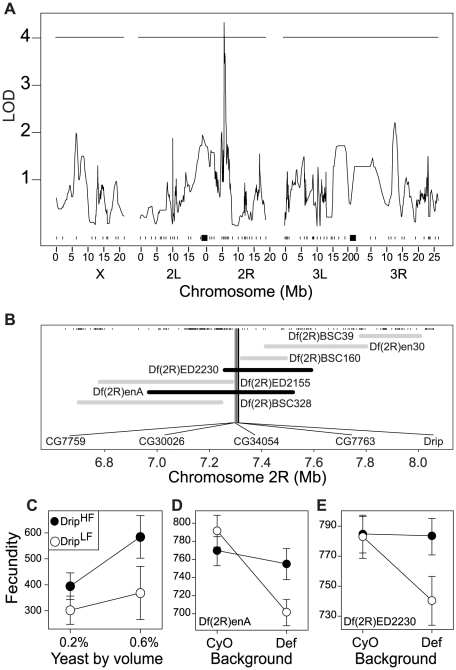
Figure 1
Figure 1. QTL and fine-scale mapping of female fecundity localizes to 5 positional candidate genes.
(A) QTL scan results for fecundity. The x-axis represents position along the three major D. melanogaster chromosomes in megabases (Mb). Tick marks represent location of polymorphic markers used for QTL mapping and black squares represent the approximate location of the centromeres. The y-axis represents the strength of association between a particular region and fecundity. The horizontal line represents the 95% permutation threshold. (B) Deficiency map of the QTL region on 2R. The x-axis represents position along chromosome 2R in megabases (Mb). Tick marks represent location of known genes and the horizontal bars represent the location (either molecularly defined or approximate) of deficiency break points. Grey bars represent deficiencies that complemented the RIL alleles, black bars represent deficiencies that failed to complement the RIL alleles. The five named genes are those genes identified by quantitative complementation as candidates genes affecting fecundity. (C) Estimated effect of the two RIL alleles at the QTL identified on chromosome 2R. Black and white circles represent high and low fecundity alleles, respectively. The x-axis represents larval rearing condition. The y-axis represents estimated fecundity. Error bars represent 95% CI calculated from amongst line variance. (D–E) Results from quantitative complementation tests with the two deficiencies that failed to complement the two alleles in the mapping population. The x-axis of each inset represents the tester chromosome (either “wild-type”- CyO, or deficiency – Def). Black vs. white circles represent the high and low fecundity RIL alleles, respectively. The y-axis of each inset represents estimated fecundity (see Materials and methods for more details). Error bars represent 95% CI based on non-parametric bootstrap resampling (5000 replicates), conditional on fly.
Figure 2
Figure 2. Effects of overexpression of RNAi constructs against positional candidate genes on female fecundity.
(A) Ubiquitous overexpression by the tub-Gal4 of RNAi constructs against driver for four of the five candidate genes. (B) Overexpression of Drip-RNAi with the pan-neuronal driver, Elav-Gal4, reduces female fecundity. (C) Overexpression of Drip-RNAi in corazonin producing neurons reduces female fecundity. Error bars represent 95% CI based on non-parametric bootstrap resampling (5000 replicates), conditional on fly. Asterisks represent significant difference from the control at p<0.05.
Figure 3
Figure 3. Tissue-specific expression of Drip, Crz, and pale between the different RIL alleles.
The y-axis represents fold change in Drip expression between low- and high-fecundity alleles, normalized to differences in Rpl32. Error bars represent 95% CI based on permutations; see text for details. The horizontal, dashed line represent the null hypothesis of no change in gene expression.
Figure 4
Figure 4. Drip is expressed in a neuropeptide corazonin (Crz) neurons located in protocerebrum of the brain.
(A) Confocal sections of the brain of Crz-GL4/UAS-mCD8-EGFP female stained with anti-GFP (green, A1) and anti-Drip (magenta; A2). White indicates the overlap of these colors. Images are oriented with dorsal up. Scale bar, 100 µm. (B) Higher magnification views of the dorsolateral protocerebrum of the brain (inset box of A). Scale bar, 20 µm.

References

    1. Fisher RA. The genetical theory of natural selection. New York: Dover Publications; 1958. 291
    1. Robertson A. The spectrum of genetic variation. In: Lewontin RC, editor. Population Biology and Evolution. Syracuse, N.Y., USA: Syracuse University Press; 1968.
    1. Lewontin RC. The Genetic Basis of Evolutionary Change. New York: Columbia University Press; 1974.
    1. Stearns SC. Life-history tactics: a review of the ideas. The Quarterly review of biology. 1976;51:3–47. - PubMed
    1. Levene H. Genetic Equilibrium When More Than One Ecological Niche Is Available. American Naturalist. 1953;87:331–333.

Publication types

MeSH terms
