


Associations of type 2 diabetes with common variants in PPARD and the modifying effect of vitamin D among middle-aged and elderly Chinese
- PMID: 22509365
- PMCID: PMC3324546
- DOI: 10.1371/journal.pone.0034895
Associations of type 2 diabetes with common variants in PPARD and the modifying effect of vitamin D among middle-aged and elderly Chinese
Abstract
Background: Previous studies have identified that variants in peroxisome proliferator-activated receptor PPAR-δ (PPARD), a target gene of vitamin D, were significantly associated with fasting glucose and insulin sensitivity in European populations. This current study sought to determine (1) whether the genetic associations of PPARD variants with type 2 diabetes and its related traits could be replicated in Chinese Han population, and (2) whether the associations would be modified by the effect of vitamin D status.
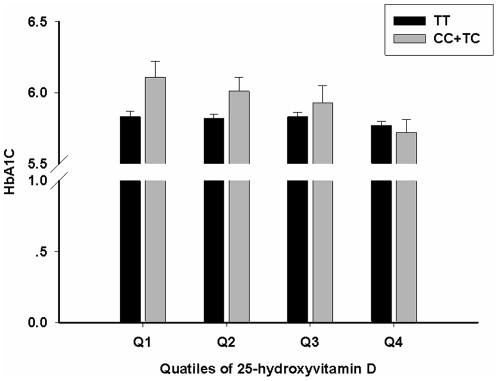
Methods and findings: We genotyped 9 tag single nucleotide polymorphisms (SNPs) that cover the gene of PPARD (rs2267664, rs6902123, rs3798343, rs2267665, rs2267668, rs2016520, rs2299869, rs1053049, and rs9658056) and tested their associations with type 2 diabetes risk and its related traits, including fasting glucose, insulin and HbA1c in 3,210 Chinese Hans. Among the 9 PPARD tag SNPs, rs6902123 was significantly associated with risk of type 2 diabetes (odds ratio 1.75 [95%CI 1.22-2.53]; P = 0.0025) and combined type 2 diabetes and impaired fasting glucose (IFG) (odds ratio 1.47 [95%CI 1.12-1.92]; P = 0.0054). The minor C allele of rs6902123 was associated with increased levels of fasting glucose (P = 0.0316) and HbA1c (P = 0.0180). In addition, we observed that vitamin D modified the effect of rs6902123 on HbA1c (P for interaction = 0.0347).
Conclusions/significance: Our findings demonstrate that common variants in PPARD contribute to the risk of type 2 diabetes in Chinese Hans, and provided suggestive evidence of interaction between 25(OH)D levels and PPARD-rs6902123 on HbA1c.
Conflict of interest statement
Figures
References
-
- Dunlop TW, Vaisanen S, Frank C, Molnar F, Sinkkonen L, et al. The human peroxisome proliferator-activated receptor delta gene is a primary target of 1alpha,25-dihydroxyvitamin D3 and its nuclear receptor. J Mol Biol. 2005;349:248–260. - PubMed
-
- Fritz T, Kramer DK, Karlsson HK, Galuska D, Engfeldt P, et al. Low-intensity exercise increases skeletal muscle protein expression of PPARdelta and UCP3 in type 2 diabetic patients. Diabetes Metab Res Rev. 2006;22:492–498. - PubMed
-
- Sigal RJ, Kenny GP, Wasserman DH, Castaneda-Sceppa C, White RD. Physical Activity/Exercise and Type 2 Diabetes. Diabetes Care. 2006;29:1433–1438. - PubMed
-
- Kramer DK, Al-Khalili L, Perrini S, Skogsberg J, Wretenberg P, et al. Direct activation of glucose transport in primary human myotubes after activation of peroxisome proliferator-activated receptor delta. Diabetes. 2005;54:1157–1163. - PubMed
Publication types
MeSH terms
Substances
LinkOut - more resources
Full Text Sources
Medical
