


The "House Calls" trial: a randomized controlled trial to reduce racial disparities in live donor kidney transplantation: rationale and design
- PMID: 22510472
- PMCID: PMC3361563
- DOI: 10.1016/j.cct.2012.03.015
The "House Calls" trial: a randomized controlled trial to reduce racial disparities in live donor kidney transplantation: rationale and design
Abstract
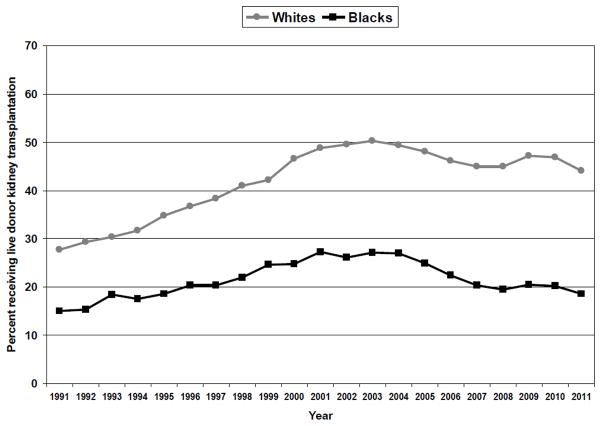
Despite a substantially lower rate of live donor kidney transplantation among Black Americans compared to White Americans, there are few systematic efforts to reduce this racial disparity. This paper describes the rationale and design of a randomized controlled trial evaluating the comparative effectiveness of three different educational interventions for increasing live donor kidney transplantation in Black Americans. This trial is a single-site, urn-randomized controlled trial with a planned enrollment of 180 Black Americans awaiting kidney transplantation. Patients are randomized to receive transplant education in one of three education conditions: through group education at their homes (e.g., House Calls), or through group (Group-Based) or individual education (Individual Counseling) in the transplant center. The primary outcome of the trial is the occurrence of a live donor kidney transplant, with secondary outcomes including living donor inquiries and evaluations as well as changes in patient live donor kidney transplantation readiness, willingness, knowledge, and concerns. Sex, age, dialysis status, and quality of life are evaluated as moderating factors. Findings from this clinical trial have the potential to inform strategies for reducing racial disparities in live donor kidney transplantation. Similar trials have been developed recently to broaden the evaluation of House Calls as an innovative disparity-reducing intervention in kidney transplantation.
Trial registration: ClinicalTrials.gov NCT00785265.
Copyright © 2012 Elsevier Inc. All rights reserved.
Conflict of interest statement
There are no conflicts of interest to report. Dr. Egbuna was a faculty member and transplant nephrologist at Beth Israel Deaconess Medical Center and Harvard Medical School during the development and initial implementation of the study. He is now employed as Clinical Research Medical Director for Amgen Inc., although Amgen has not been involved in any way with the study reported in this manuscript.
Figures
References
-
- Kovacs AZ, Molnar MZ, Szeifert L, Ambrus C, Molnar-Varga M, Szentkiralyi A, et al. Sleep disorders, depressive symptoms and health-related quality of life – a cross-sectional comparison between kidney transplant recipients and waitlisted patients on maintenance dialysis. Nephrol Dial Transplant. 2011;26:1058–65. - PubMed
-
- McDonald SP, Russ GR. Survival of recipients of cadaveric kidney transplants compared with those receiving dialysis treatment in Australia and New Zealand, 1991–2001. Nephrol Dial Transplant. 2002;17:2212–9. - PubMed
-
- Rabbat CG, Thorpe KE, Russell JD, Churchill DN. Comparison of mortality risk for dialysis patients and cadaveric first renal transplant recipients in Ontario, Canada. J Am Soc Nephrol. 2000;11:917–22. - PubMed
-
- Young CJ, Gaston RS. Renal transplantation in black Americans. N Engl J Med. 2000;343:1545–52. - PubMed
Publication types
MeSH terms
Associated data
Grants and funding
LinkOut - more resources
Full Text Sources
Medical
