. 2012 Jul;342(1):169-76.
doi: 10.1124/jpet.112.193847. Epub 2012 Apr 16.

Carnosol and carnosic acids from Salvia officinalis inhibit microsomal prostaglandin E2 synthase-1

Affiliations

Carnosol and carnosic acids from Salvia officinalis inhibit microsomal prostaglandin E2 synthase-1

Julia Bauer et al. J Pharmacol Exp Ther. 2012 Jul.

Abstract

Prostaglandin E(2) (PGE(2)), the most relevant eicosanoid promoting inflammation and tumorigenesis, is formed by cyclooxygenases (COXs) and PGE(2) synthases from free arachidonic acid. Preparations of the leaves of Salvia officinalis are commonly used in folk medicine as an effective antiseptic and anti-inflammatory remedy and possess anticancer activity. Here, we demonstrate that a standard ethyl acetate extract of S. officinalis efficiently suppresses the formation of PGE(2) in a cell-free assay by direct interference with microsomal PGE(2) synthase (mPGES)-1. Bioactivity-guided fractionation of the extract yielded closely related fractions that potently suppressed mPGES-1 with IC(50) values between 1.9 and 3.5 μg/ml. Component analysis of these fractions revealed the diterpenes carnosol and carnosic acid as potential bioactive principles inhibiting mPGES-1 activity with IC(50) values of 5.0 μM. Using a human whole-blood assay as a robust cell-based model, carnosic acid, but not carnosol, blocked PGE(2) generation upon stimulation with lipopolysaccharide (IC(50) = 9.3 μM). Carnosic acid neither inhibited the concomitant biosynthesis of other prostanoids [6-keto PGF(1α), 12(S)-hydroxy-5-cis-8,10-trans-heptadecatrienoic acid, and thromboxane B(2)] in human whole blood nor affected the activities of COX-1/2 in a cell-free assay. Together, S. officinalis extracts and its ingredients carnosol and carnosic acid inhibit PGE(2) formation by selectively targeting mPGES-1. We conclude that the inhibitory effect of carnosic acid on PGE(2) formation, observed in the physiologically relevant whole-blood model, may critically contribute to the anti-inflammatory and anticarcinogenic properties of S. officinalis.


Figures
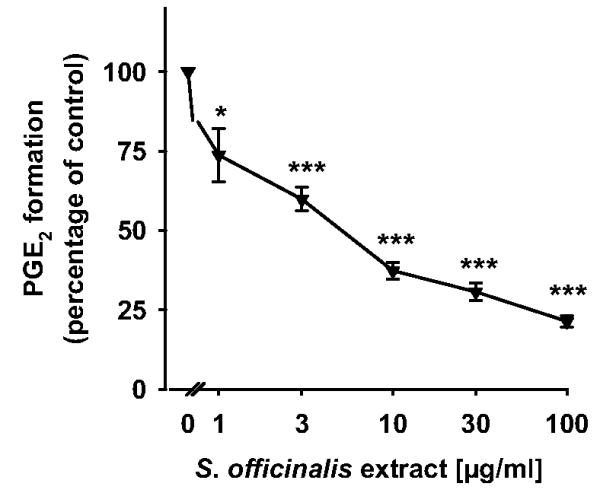
Fig. 1
Fig. 1
An ethyl acetate extract of S. officinalis inhibits mPGES-1 activity. Microsomal preparations of interleukin-1β-stimulated A549 cells were preincubated with an ethyl acetate extract of S. officinalis for 15 min at 4°C, and the reaction was started with 20 μM PGH2. After 1 min at 4°C, the reaction was terminated by using a stop solution containing FeCl2 and 11β-PGE2 (1 nmol) as internal standard. The concentration-response curve for the ethyl acetate extract of S. officinalis is shown. The 100% value corresponds to 246 ± 4 ng of PGE2. Data are given as mean + S.E. (n = 3-5). *, p < 0.05 or ***, p < 0.001 versus vehicle (DMSO) control, ANOVA + Tukey HSD post hoc tests.
Fig. 2
Fig. 2
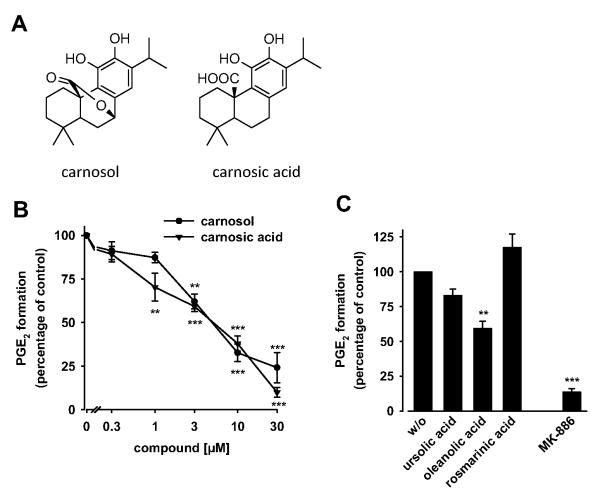
Carnosol and carnosic acid inhibit mPGES-1 activity. A, structures of carnosol (left) and carnosic acid (right). B, concentration-response curves for carnosol and carnosic acid. The effect of carnosol and carnosic acid on mPGES-1 activity was determined under the same conditions as described in the legend to Fig. 1. C, effect of vehicle (DMSO, w/o), ursolic acid, oleanolic acid, rosmarinic acid, and the mPGES-1 control inhibitor MK-886 (10 μM, each) on mPGES-1 activity. Values of 100% correspond to 306 ± 63 ng of PGE2. Data are given as mean + S.E. (n = 3-5). **, p < 0.01 or ***, p < 0.001 versus vehicle (DMSO) control, ANOVA + Tukey HSD post hoc tests.
Fig. 3
Fig. 3
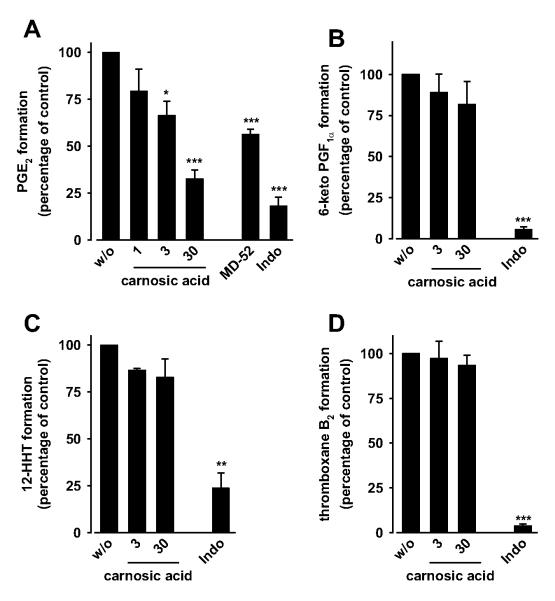
Effect of carnosol and carnosic acid on prostanoid formation in human whole blood. Aliquots of heparinized human whole blood (treated with 1 μM thromboxane synthase inhibitor and 50 μM aspirin for A and B) were preincubated with vehicle (DMSO, w/o) or carnosic acid for 5 min at room temperature, and prostanoid formation was induced by addition of 10 μg/ml LPS. Indomethacin (Indo, 10 μM) and MD52 (2 μM) were used as controls. A and C, PGE2 (A) and 12-HHT (C) were extracted from blood plasma by reversed-phase-18 solid-phase extraction, separated by reversed phase-HPLC, and quantified by ELISA (A) or UV detection (C). B and D, 6-keto PGF1α (B) and thromboxane B2 (D) were directly determined in the blood plasma by ELISA. Values of 100% correspond to 45.8 ± 5.2 ng/ml PGE2, 12.4 ± 1.6 ng/ml 6-keto PGF1α, 23.9 ± 3.2 ng/ml 12-HHT, and 67.8 ± 4.8 ng/ml thromboxane B2. Data are given as mean + S.E. (n = 1-4). *, p < 0.05; **, p < 0.01; or ***, p < 0.001 versus vehicle (DMSO) control, ANOVA + Tukey HSD post hoc tests.
Fig. 4
Fig. 4
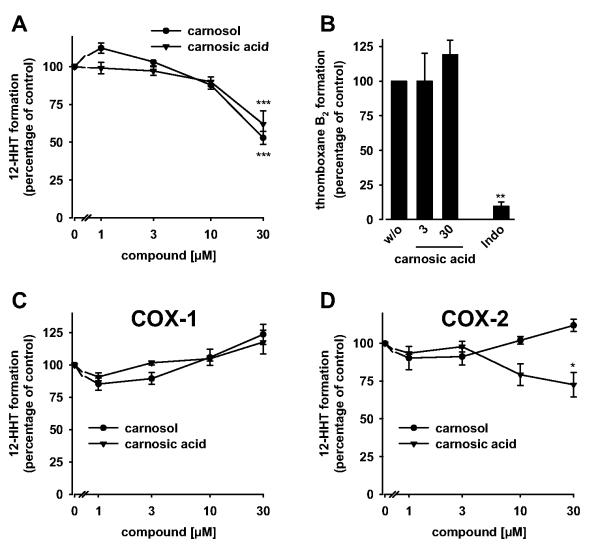
Effects of carnosol and carnosic acid on COX activity. Effects on 12-HHT (A) and thromboxane B2 formation (B) in intact platelets and on the activity of isolated bovine COX-1 (C) and human recombinant COX-2 (D). Platelets (108/ml) or COX isoenzymes were preincubated with carnosol or carnosic acid for 5 min, and 12-HHT (A, C, and D) or thromboxane B2 formation (B) was initiated with arachidonic acid. After 5 min at 37°C, 12-HHT was determined by reversed-phase-HPLC as described (A, C, and D); and thromboxane B2 was quantified by ELISA (B). Prostanoids formed in the absence of test compounds (100%, control) were: 92.2 ± 23.1 ng/ml 12-HHT (A) and 0.58 ± 0.03 μg/ml thromboxane B2 (B) for intact platelets, 201.7 ± 54.0 μg/ml 12-HHT for COX-1 (C), and 32.9 ± 5.7 μg/ml 12-HHT for COX-2 (D). Data are given as mean + S.E. (n = 3-5). *, p < 0.05; **, p < 0.01; or ***, p < 0.001 versus vehicle (DMSO) control, ANOVA + Tukey HSD post hoc tests.

References

    1. Albert D, Zündorf I, Dingermann T, Müller WE, Steinhilber D, Werz O. Hyperforin is a dual inhibitor of cyclooxygenase-1 and 5-lipoxygenase. Biochem Pharmacol. 2002;64:1767–1775. - PubMed
    1. Asano K, Lilly CM, Drazen JM. Prostaglandin G/H synthase-2 is the constitutive and dominant isoform in cultured human lung epithelial cells. Am J Physiol Lung Cell Mol Physiol. 1996;271:L126–L131. - PubMed
    1. Baricevic D, Sosa S, Della Loggia R, Tubaro A, Simonovska B, Krasna A, Zupancic A. Topical anti-inflammatory activity of Salvia officinalis L. leaves: the relevance of ursolic acid. J Ethnopharmacol. 2001;75:125–132. - PubMed
    1. Barni MV, Carlini MJ, Cafferata EG, Puricelli L, Moreno S. Carnosic acid inhibits the proliferation and migration capacity of human colorectal cancer cells. Oncol Rep. 2012;27:1041–1048. - PMC - PubMed
    1. Bauer J, Koeberle A, Dehm F, Pollastro F, Appendino G, Northoff H, Rossi A, Sautebin L, Werz O. Arzanol, a prenylated heterodimeric phloroglucinyl pyrone, inhibits eicosanoid biosynthesis and exhibits anti-inflammatory efficacy in vivo. Biochem Pharmacol. 2011;81:259–268. - PubMed

Publication types

MeSH terms