


High concentrations of AGE-LDL and oxidized LDL in circulating immune complexes are associated with progression of retinopathy in type 1 diabetes
- PMID: 22511260
- PMCID: PMC3357232
- DOI: 10.2337/dc11-2040
High concentrations of AGE-LDL and oxidized LDL in circulating immune complexes are associated with progression of retinopathy in type 1 diabetes
Abstract
Objective: To determine whether immunocomplexes (ICs) containing advanced glycation end product (AGE)-LDL (AGE-LDL) and oxidized LDL (oxLDL) contribute to the development of retinopathy over a 16-year period in subjects with type 1 diabetes.
Research design and methods: Levels of AGE-LDL and oxLDL in ICs were measured in 517 patients of the Diabetes Control and Complications Trial/Epidemiology of Diabetes Interventions and Complications (DCCT/EDIC) cohort. Retinopathy was assessed by stereoscopic fundus photography. Cox proportional hazards models were used to assess the effect of AGE-LDL-ICs and oxLDL-ICs on retinopathy progression.
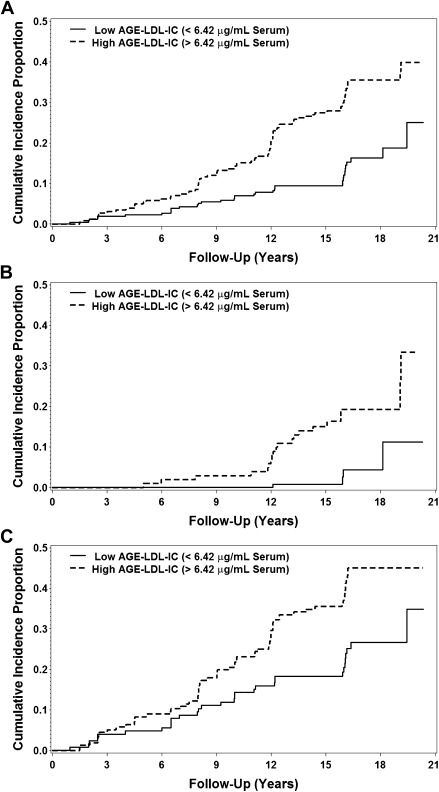
Results: In unadjusted models, higher baseline levels of AGE-LDL-ICs and oxLDL-ICs significantly predicted progression of diabetic retinopathy outcomes. After adjustment by study-design variables (treatment group, retinopathy cohort, duration of type 1 diabetes, and baseline albumin excretion rate [AER], hemoglobin A(1c) (HbA(1c)), and Early Treatment Diabetic Retinopathy Study [ETDRS] score), one SD increase in IC levels was associated with 47% (hazard ratio [HR] 1.47 [95% CI 1.19-1.81]; AGE-LDL-IC) and 45% (1.45 [1.17-1.80]; oxLDL-IC) increased risk of developing proliferative diabetic retinopathy (PDR) and 37% (1.37 [1.12-1.66]; to both ICs) increased risk of progressing to severe nonproliferative retinopathy. Analyses were stratified by retinopathy cohort because results differed between primary and secondary cohorts. For AGE-LDL-ICs, HR for progression to PDR was 2.38 (95% CI 1.30-4.34) in the primary cohort and attenuated in the secondary cohort (1.29 [1.03-1.62]). Similar results were observed for oxLDL-ICs.
Conclusions: Increased levels of AGE-LDL and oxLDL in ICs are associated with increased risk for progression to advanced retinopathy in patients with type 1 diabetes, indicating that the antibody response to modified LDL plays a significant role in retinopathy progression.
Figures
Comment in
-
Diabetes: modified LDLs linked to progression of retinopathy in T1DM.Nat Rev Endocrinol. 2012 May 8;8(7):380. doi: 10.1038/nrendo.2012.71. Nat Rev Endocrinol. 2012. PMID: 22565025 No abstract available.
References
-
- Centers for Disease Control and Prevention National Diabetes Fact Sheet: General Information and National Estimates on Diabetes in the United States, 2007. Atlanta, GA, U.S. Department of Health and Human Services, 2008
-
- Klein R. The epidemiology of diabetic retinopathy: findings from the Wisconsin Epidemiologic Study of Diabetic Retinopathy. Int Ophthalmol Clin 1987;27:230–238 - PubMed
-
- Orchard TJ, Dorman JS, Maser RE, et al. Factors associated with avoidance of severe complications after 25 yr of IDDM. Pittsburgh Epidemiology of Diabetes Complications Study I. Diabetes Care 1990;13:741–747 - PubMed
-
- Nathan DM, Zinman B, Cleary PA, et al. Diabetes Control and Complications Trial/Epidemiology of Diabetes Interventions and Complications (DCCT/EDIC) Research Group Modern-day clinical course of type 1 diabetes mellitus after 30 years’ duration: the Diabetes Control and Complications Trial/Epidemiology of Diabetes Interventions and Complications and Pittsburgh Epidemiology of Diabetes Complications Experience (1983-2005). Arch Intern Med 2009;169:1307–1316 - PMC - PubMed
-
- Gotto AM., Jr Evolving concepts of dyslipidemia, atherosclerosis, and cardiovascular disease: the Louis F. Bishop Lecture. J Am Coll Cardiol 2005;46:1219–1224 - PubMed
Publication types
MeSH terms
Substances
Grants and funding
LinkOut - more resources
Full Text Sources
Medical
Miscellaneous
