


DICER-LIKE3 activity in Physcomitrella patens DICER-LIKE4 mutants causes severe developmental dysfunction and sterility
- PMID: 22511605
- PMCID: PMC3506028
- DOI: 10.1093/mp/sss036
DICER-LIKE3 activity in Physcomitrella patens DICER-LIKE4 mutants causes severe developmental dysfunction and sterility
Abstract
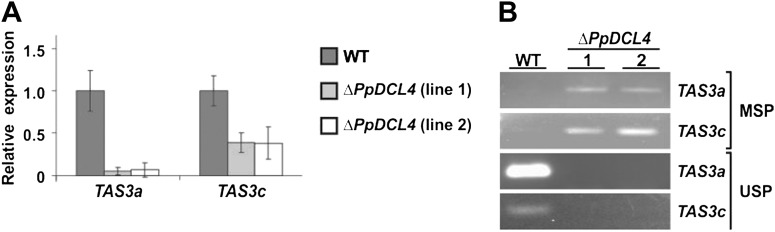
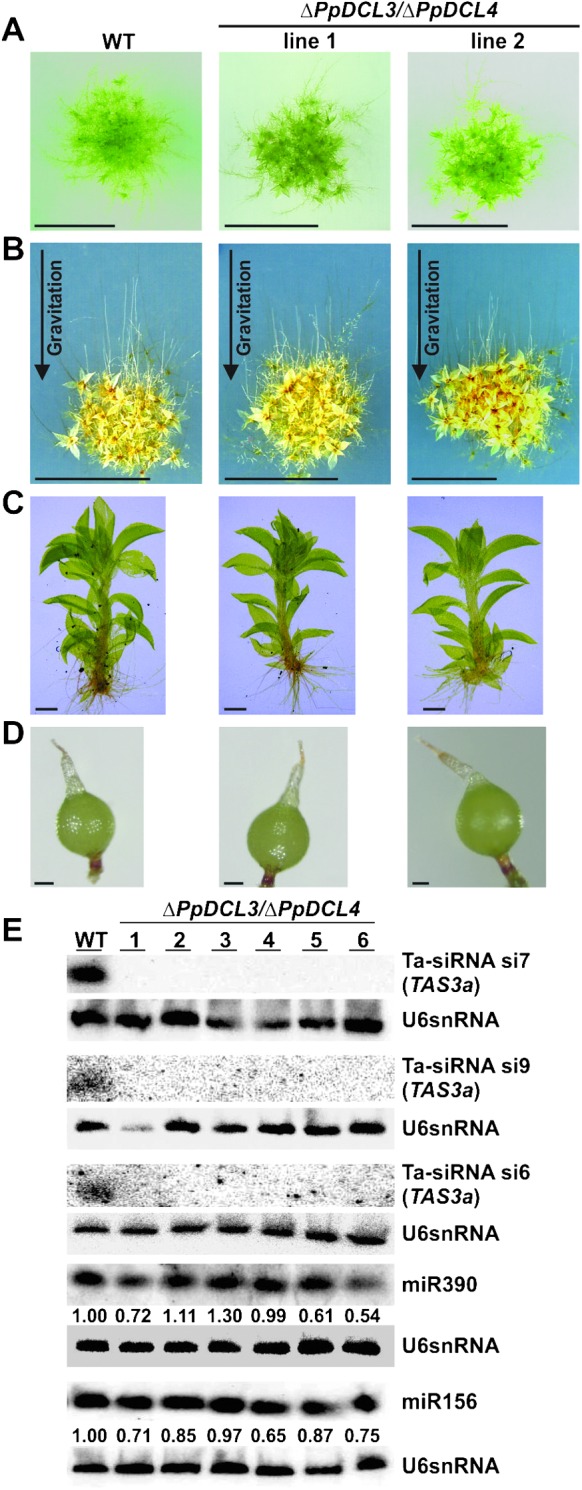
Trans-acting small interfering RNAs (ta-siRNAs) are plant-specific siRNAs released from TAS precursor transcripts after microRNA-dependent cleavage, conversion into double-stranded RNA, and Dicer-dependent phased processing. Like microRNAs (miRNAs), ta-siRNAs direct site-specific cleavage of target RNAs at sites of extensive complementarity. Here, we show that the DICER-LIKE 4 protein of Physcomitrella patens (PpDCL4) is essential for the biogenesis of 21 nucleotide (nt) ta-siRNAs. In ΔPpDCL4 mutants, off-sized 23 and 24-nt ta-siRNAs accumulated as the result of PpDCL3 activity. ΔPpDCL4 mutants display severe abnormalities throughout Physcomitrella development, including sterility, that were fully reversed in ΔPpDCL3/ΔPpDCL4 double-mutant plants. Therefore, PpDCL3 activity, not loss of PpDCL4 function per se, is the cause of the ΔPpDCL4 phenotypes. Additionally, we describe several new Physcomitrella trans-acting siRNA loci, three of which belong to a new family, TAS6. TAS6 loci are typified by sliced miR156 and miR529 target sites and are in close proximity to PpTAS3 loci.
Figures



References
-
- Adenot X, et al. DRB4-dependent TAS3 trans-acting siRNAs control leaf morphology through AGO7. Curr. Biol. 2006;16:927–932. - PubMed
-
- Allen E, Xie Z, Gustafson AM, Carrington JC. microRNA-directed phasing during trans-acting siRNA biogenesis in plants. Cell. 2005;121:207–221. - PubMed
-
- Axtell MJ, Jan C, Rajagopalan R, Bartel DP. A two-hit trigger for siRNA biogenesis in plants. Cell. 2006;127:565–577. - PubMed
Publication types
MeSH terms
Substances
Grants and funding
LinkOut - more resources
Full Text Sources
Other Literature Sources
Molecular Biology Databases
Research Materials
