


Longitudinal analysis of the temporal evolution of Acinetobacter baumannii strains in Ohio, USA, by using rapid automated typing methods
- PMID: 22511922
- PMCID: PMC3325217
- DOI: 10.1371/journal.pone.0033443
Longitudinal analysis of the temporal evolution of Acinetobacter baumannii strains in Ohio, USA, by using rapid automated typing methods
Abstract
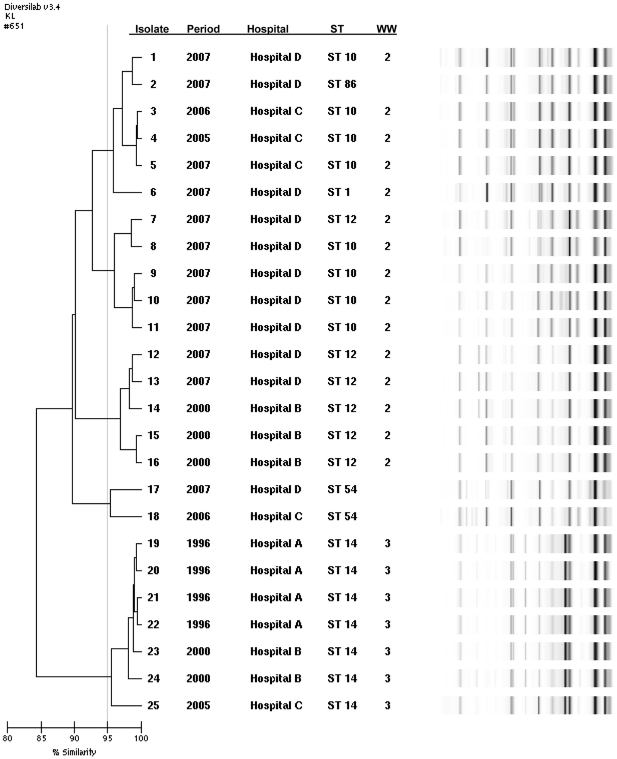
Genotyping methods are essential to understand the transmission dynamics of Acinetobacter baumannii. We examined the representative genotypes of A. baumannii at different time periods in select locations in Ohio, using two rapid automated typing methods: PCR coupled with electrospray ionization mass spectrometry (PCR/ESI-MS), a form of multi-locus sequence typing (MLST), and repetitive-sequence-based-PCR (rep-PCR). Our analysis included 122 isolates from 4 referral hospital systems, in 2 urban areas of Ohio. These isolates were associated with outbreaks at 3 different time periods (1996, 2000 and 2005-2007). Type assignments of PCR/ESI-MS and rep-PCR were compared to each other and to worldwide (WW) clone types. The discriminatory power of each method was determined using the Simpson's index of diversity (DI). We observed that PCR/ESI-MS sequence type (ST) 14, corresponding to WW clone 3, predominated in 1996, whereas ST 12 and 14 co-existed in the intermediate period (2000) and ST 10 and 12, belonging to WW clone 2, predominated more recently in 2007. The shift from WW clone 3 to WW clone 2 was accompanied by an increase in carbapenem resistance. The DI was approximately 0.74 for PCR/ESI-MS, 0.88 for rep-PCR and 0.90 for the combination of both typing methods. We conclude that combining rapid automated typing methods such as PCR/ESI-MS and rep-PCR serves to optimally characterize the regional molecular epidemiology of A. baumannii. Our data also sheds light on the changing sequence types in an 11 year period in Northeast Ohio.
Conflict of interest statement
Figures

References
-
- Munoz-Price LS, Weinstein RA. Acinetobacter infection. N Engl J Med. 2008;358:1271–1281. - PubMed
-
- Maragakis LL, Perl TM. Acinetobacter baumannii: epidemiology, antimicrobial resistance, and treatment options. Clin Infect Dis. 2008;46:1254–1263. - PubMed
-
- Centers for Disease Control and Prevention (CDC) Acinetobacter baumannii infections among patients at military medical facilities treating injured U.S. service members, 2002–2004. MMWR Morb Mortal Wkly Rep. 2004;53:1063–1066. - PubMed
-
- Scott P, Deye G, Srinivasan A, Murray C, Moran K, et al. An outbreak of multidrug-resistant Acinetobacter baumannii-calcoaceticus complex infection in the US military health care system associated with military operations in Iraq. Clin Infect Dis. 2007;44:1577–1584. - PubMed
Publication types
MeSH terms
Grants and funding
LinkOut - more resources
Full Text Sources
