


Obesity susceptibility loci and dietary intake in the Look AHEAD Trial
- PMID: 22513296
- PMCID: PMC3349457
- DOI: 10.3945/ajcn.111.026955
Obesity susceptibility loci and dietary intake in the Look AHEAD Trial
Abstract
Background: Genome-wide association studies (GWAS) have identified consistent associations with obesity. However, the mechanisms remain unclear.
Objective: The objective was to determine the association between obesity susceptibility loci and dietary intake.
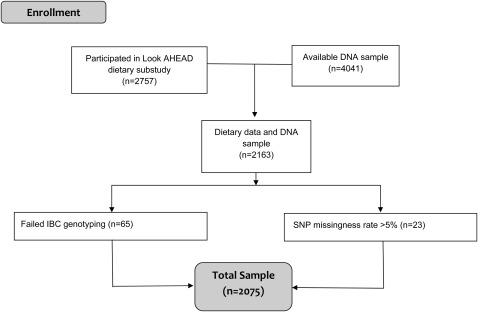
Design: The association of GWAS-identified obesity risk alleles (FTO, MC4R, SH2B1, BDNF, INSIG2, TNNI3K, NISCH-STAB1, MTIF3, MAP2K5, QPCTL/GIPR, and PPARG) with dietary intake, measured through food-frequency questionnaires, was investigated in 2075 participants from the Look AHEAD (Action for Health in Diabetes) clinical trial. We adjusted for age, sex, population stratification, and study site.
Results: Obesity risk alleles at FTO rs1421085 significantly predicted more eating episodes per day (P = 0.001)-an effect that persisted after adjustment for body weight (P = 0.004). Risk variants within BDNF were significantly associated with more servings from the dairy product and the meat, eggs, nuts, and beans food groups (P ≤ 0.004). The risk allele at SH2B1 rs4788099 was significantly associated with more servings of dairy products (P = 0.001), whereas the risk allele at TNNI3K rs1514176 was significantly associated with a lower percentage of energy from protein (P = 0.002).
Conclusion: These findings suggest that obesity risk loci may affect the pattern and content of food consumption among overweight or obese individuals with type 2 diabetes. The Look AHEAD Genetic Ancillary Study was registered at clinicaltrials.gov as NCT01270763 and the Look AHEAD study as NCT00017953.
Figures
References
-
- Cannon CP. Obesity-related cardiometabolic complications. Clin Cornerstone 2008;9:11–19. - PubMed
Publication types
MeSH terms
Substances
Associated data
Grants and funding
- DK57151/DK/NIDDK NIH HHS/United States
- DK57149/DK/NIDDK NIH HHS/United States
- U01DK056992-11S1/DK/NIDDK NIH HHS/United States
- P20 MD006899/MD/NIMHD NIH HHS/United States
- DK57008/DK/NIDDK NIH HHS/United States
- M01RR000056 44/RR/NCRR NIH HHS/United States
- DK56990/DK/NIDDK NIH HHS/United States
- DK57135/DK/NIDDK NIH HHS/United States
- DK57078/DK/NIDDK NIH HHS/United States
- DK072497/DK/NIDDK NIH HHS/United States
- DK57171/DK/NIDDK NIH HHS/United States
- DK57131/DK/NIDDK NIH HHS/United States
- M01RR01066/RR/NCRR NIH HHS/United States
- DK57182/DK/NIDDK NIH HHS/United States
- DK57002/DK/NIDDK NIH HHS/United States
- M01RR01346/RR/NCRR NIH HHS/United States
- DK57178/DK/NIDDK NIH HHS/United States
- P30 DK48520/DK/NIDDK NIH HHS/United States
- DK57136/DK/NIDDK NIH HHS/United States
- DK57154/DK/NIDDK NIH HHS/United States
- DK57219/DK/NIDDK NIH HHS/United States
- DK57177/DK/NIDDK NIH HHS/United States
- M01RR0021140/RR/NCRR NIH HHS/United States
- DK 046204/DK/NIDDK NIH HHS/United States
- M01RR02719/RR/NCRR NIH HHS/United States
- DK56992/DK/NIDDK NIH HHS/United States
- P30 DK017047/DK/NIDDK NIH HHS/United States
- M01RR00051/RR/NCRR NIH HHS/United States
LinkOut - more resources
Full Text Sources
Other Literature Sources
Medical
Miscellaneous
