


Anticholinergic therapy for acute asthma in children
- PMID: 22513916
- PMCID: PMC11329281
- DOI: 10.1002/14651858.CD003797.pub2
Anticholinergic therapy for acute asthma in children
Abstract
Background: Inhaled anticholinergics as single agent bronchodilators (or in combination with beta(2)-agonists) are one of the several medications available for the treatment of acute asthma in children.
Objectives: To determine the effectiveness of only inhaled anticholinergic drugs (i.e. administered alone), compared to a control in children over the age of two years with acute asthma.
Search methods: The Cochrane Register of Controlled Trials (CENTRAL), and the Cochrane Airways Group Register of trials were searched by the Cochrane Airways Group. The latest search was performed in April 2011.
Selection criteria: We included only randomised controlled trials (RCTs) in which inhaled anticholinergics were given as single therapy and compared with placebo or any other drug or drug combinations for children over the age of two years with acute asthma.
Data collection and analysis: Two authors independently selected trials, extracted data and assessed trial quality.
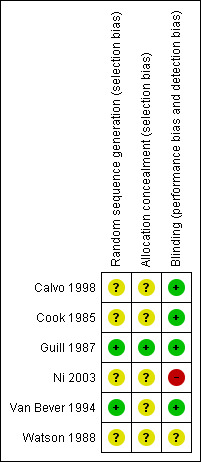
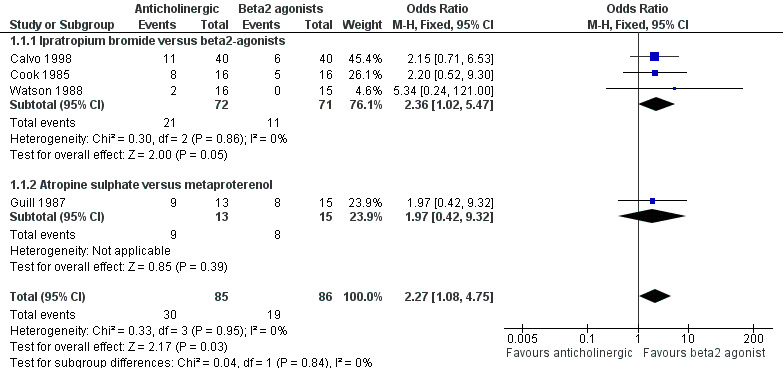
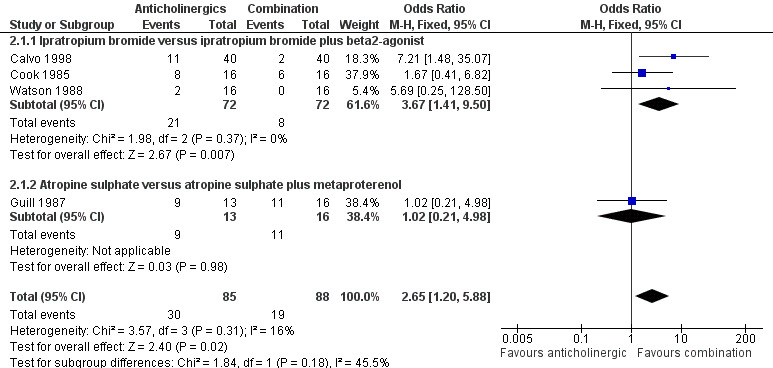
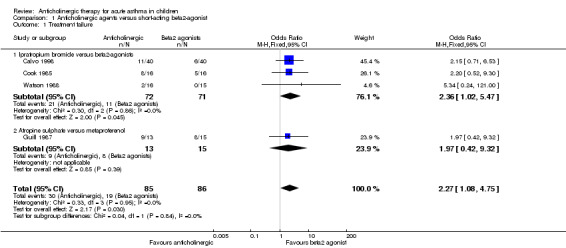
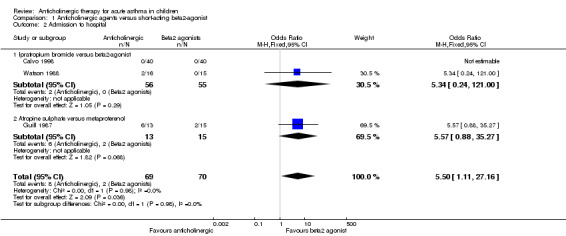
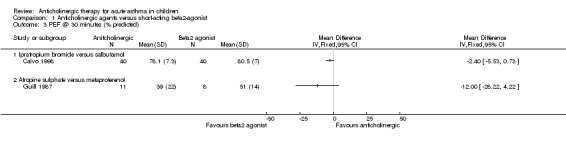
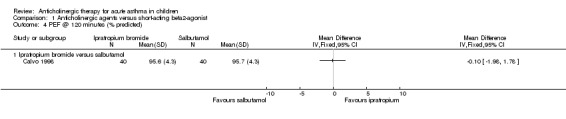
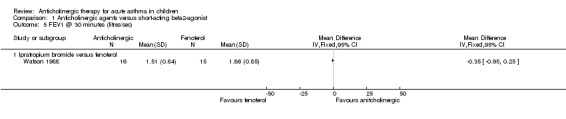
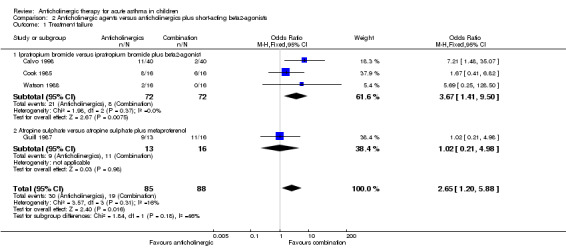
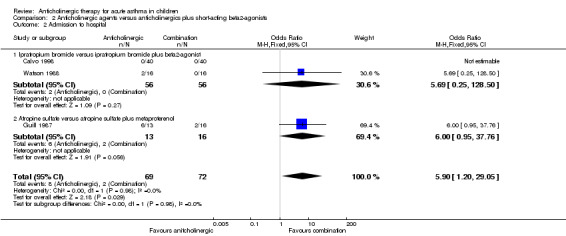
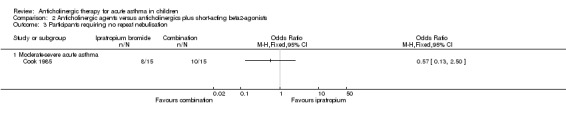
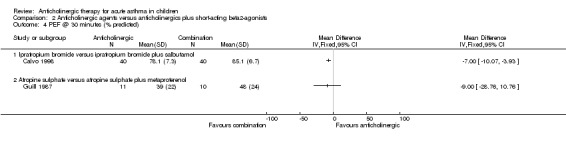
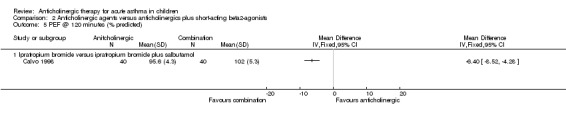
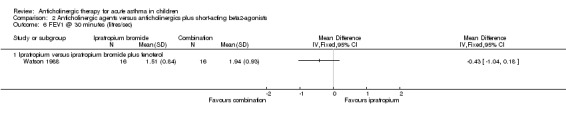
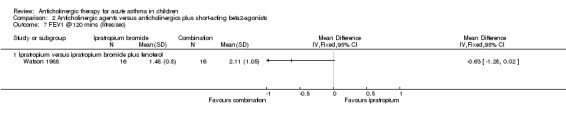
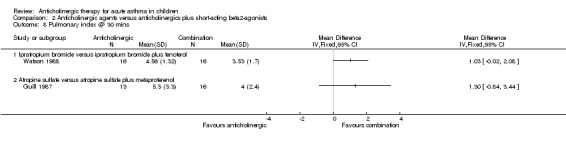
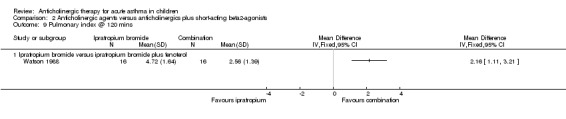
Main results: Six studies met the inclusion criteria but were limited by small sample sizes, various treatment regimes used and outcomes assessed. The studies were overall of unclear quality. Data could only be pooled for the outcomes of treatment failure and hospitalisation. Other data could not be combined due to divergent outcome measurements. Meta-analysis revealed that children who received anticholinergics alone were significantly more likely to have treatment failure compared to those who received beta(2)-agonists from four trials on 171 children (odds ratio (OR) 2.27; 95% CI 1.08 to 4.75). Also, treatment failure on anticholinergics alone was more likely than when anticholinergics were combined with beta(2)-agonists from four trials on 173 children (OR 2.65; 95% CI 1.2 to 5.88). Data on clinical scores/symptoms that were measured on different scales were conflicting. Individual trials reported that lung function was superior in the combination group when compared with anticholinergic agents used alone. The use of anticholinergics was not found to be associated with significant side effects.
Authors' conclusions: In children over the age of two years with acute asthma exacerbations, inhaled anticholinergics as single agent bronchodilators were less efficacious than beta(2)-agonists. Inhaled anticholinergics were also less efficacious than inhaled anticholinergics combined with beta(2)-agonists. Inhaled anticholinergic drugs alone are not appropriate for use as a single agent in children with acute asthma exacerbations.
Conflict of interest statement
None known.
Figures
Update of
References
References to studies included in this review
Calvo 1998 {published data only}
-
- Calvo GM, Calvo AM, Marin HF, Moya GJ. Is it useful to add an anticholinergic treatment to ß2‐adrenergic medication in acute asthma attack?. Journal of Investigational Allergology and Clinical Immunology 1998;8(1):30‐4. - PubMed
Cook 1985 {published data only}
-
- Cook JJ, Ferguson DM, Dawson KP. Ipratropium and fenoterol in the treatment of acute asthma. Pharmatherapeutica 1985;4(6):383‐6. - PubMed
Guill 1987 {published data only}
-
- Guill MF, Maloney MJ, DuRant RH. Comparison of inhaled metaproterenol, inhaled atropine sulfate, and their combination in treatment of children with acute asthma. Annals of Allergy 1987;59:367‐71. - PubMed
Ni 2003 {published data only}
-
- Ni SF, Yao WJ. Combined application of salbutamol and ipratropium bromide in the treatment of bronchial asthma in children. Herald of Medicine 2003;22(2):96‐7.
Van Bever 1994 {published data only}
-
- Bever HP, Desager KN, Pauwels JH, Vermeire PA. Comparison of the bronchodilating effect of oxitropium bromide and fenoterol in asthmatic children. European Journal of Pediatrics 1994;153:604‐6. - PubMed
Watson 1988 {published data only}
-
- Wade TA, Watson MD, Becker AB, Simons FER. Comparison of ipratropium solution, fenoterol solution, and their combination administered by nebulizer and face mask to children with acute asthma. Journal of Allergy and Clinical Immunology 1988;82:1012‐8. - PubMed
References to studies excluded from this review
Beck 1985 {published data only}
-
- Beck R, Robertson C, Galdes‐Sebaldt M, Levison H. Combined salbutamol and ipratropium bromide by inhalation in the treatment of severe acute asthma. Journal of Pediatrics 1985;107(4):605‐8. - PubMed
BenitoFernandez 2000 {published data only}
-
- Benito Fernandez J, Mintegui Raso S, Sanchez Echaniz J, Vazquez Ronco MA, Pijoan Zubizarreta JI. Efficacy of early administration of nebulised ipratropium bromide in children with acute asthma attack [Eficacia de la administracion precoz de bromuro de ipratropio nebulizado en ninos con crisis asmatica]. Anales Espanoles De Pediatria Sept 2000;53(3):217‐22. - PubMed
Bratteby 1986 {published data only}
-
- Bratteby LE, Foucard T, Lӧnnerholm G. Combined treatment with ipratropium bromide and beta‐2‐adrenoceptor agonists in childhood asthma. European Journal of Respiratory Disease 1986;68(4):239‐47. - PubMed
Browne 2002 {published data only}
-
- Browne GJ, Trieu L, Asperen P. Randomized, double‐blind, placebo‐controlled trial of intravenous salbutamol and nebulized ipratropium bromide in early management of severe acute asthma in children presenting to an emergency department. Critical Care Medicine 2002;30(2):448‐53. - PubMed
Craven 2001 {published data only}
-
- Craven D, Kercsmar CM, Meyers TR, O'Riordan MA, Golonka G, Moore S. Ipratropium bromide plus nebulized albuterol for the treatment of hospitalized children with acute asthma. Journal of Pediatrics 2001;138(1):51‐8. - PubMed
De Stefano 1990 {published data only}
-
- DeStefano G, Bonetti S, Bonizzatto C, Valletta EA, Piacentini GL, Boner AL. Additive effect of albuterol and ipratropium bromide in the treatment of bronchospasm in children. Annals of Allergy 1990;65(4):260‐2. - PubMed
Ducharme 1998 {published data only}
-
- Ducharme FM, Davis GM. Randomized controlled trial of ipratropium bromide and frequent low doses of Salbutamol in the management of mild and moderate acute pediatric asthma. Journal of Pediatrics 1998;133(4):479‐85. - PubMed
Ferres 1988 {published data only}
-
- Ferres J, Guinovart G, Carreras G, Julia A, Mangues MA, Farre R. Inhaled salbutamol versus combined fenoterol and ipratropium bromide treatment in childhood acute asthma. 7th Congress of the European Society of Pneumology; 1988 September 5‐9; Budapest. 1988; Vol. 1 Suppl:2336s.
Goggin 2001 {published data only}
-
- Goggin N, Macarthur C, Parkin PC. Randomized trial of the addition of ipratropium bromide to albuterol and corticosteroid therapy in children hospitalized because of an acute asthma exacerbation. Archives of Pediatrics and Adolescent Medicine 2001;155(12):1329‐34. - PubMed
Hayday 2002 {published data only}
-
- Hayday K, Stevermer JJ. In children hospitalized for asthma exacerbation, does adding ipratropium bromide to albuterol and corticosteroids improve outcome?. Journal of Family Pracitice 2002;51(3):280. - PubMed
Iramain 2011 {published data only}
-
- Iramain R, Lopez‐Herce J, Coronel J, Spitters C, Guggiari J, Bogado N. Inhaled salbutamol plus ipratropium in moderate and severe asthma crises in children. Journal of Asthma 2011;48(3):298‐303. - PubMed
Lew 1990 {published data only}
-
- Lew DB, Herrod HG, Crawford LV. Combination of atropine and isoetharine aerosol therapy in pediatric acute asthma. Annals of Allergy 1990;64(2):195‐200. - PubMed
Lin 1978 {published data only}
-
- Lin MT, Lee‐Hong E, Collins‐Williams C. A clinical trial of the bronchodilator effect of SCH 1000 aerosol in asthmatic children. Annals of Allergy May 1978;40:326‐32. - PubMed
Mallol 1987 {published data only}
-
- Mallol J, Barrueto L, Girardi G, Toro O. Bronchodilator effect of fenoterol and ipratropium bromide in infants with acute wheezing: use of MDI with a spacer device. Pediatric Pulmonology 1987;3(5):352‐6. - PubMed
Mirsadraee 2009 {published data only}
-
- Mirsadraee M, Kabolie M, Boskabady MH. Best drugs for avoiding paradoxical bronchospasm during spirometry. Tanaffos 2009;8(3):58‐64.
Monge 2000 {published data only}
-
- Sienra Monge JJ, Bermejo Guevara MA, Rio Navarro BE, Rosas Vargas MA, Reyes Ruiz NI. Degree and duration of Bronchodilatation with a beta 2‐agonist administered alone versus a beta 2‐ agonist administered with ipratropium bromide in children with acute asthma [Grado y duracion de la bronchodilatatacion mediante la administracion de un agonista beta 2 solo vs un agonista beta 2 mas bromuro de ipratropio en ninos con asma aguda.]. Revista Alergia Mexico 2000;47(1):26‐9. - PubMed
Pulejo 1986 {published data only}
-
- Pulejo R, Romano L, Noto M. Double‐blind study with duovent and placebo in 20 asthmatic children. Respiration 1986;50(2):236‐9. - PubMed
Qureshi 1997 {published data only}
-
- Qureshi F, Zaritsky A, Lakkis H. Efficacy of nebulized ipratropium in severely asthmatic children. Annals of Emergency Medicine 1997;29(2):205‐11. - PubMed
Qureshi 1998 {published data only}
-
- Quereshi F, Pestian J, Davis P, Zaritsky A. Effect of nebulized ipratropium on the hospitalization rates of children with asthma. New England Journal of Medicine 1998;339:1030‐5. - PubMed
Rayner 1987 {published data only}
Reisman 1988 {published data only}
-
- Reisman J, Galdes‐Sebalt M, Kazim F, Canny G, Levison H. Frequent administration by inhalation of salbutamol and ipratropium bromide in the initial management of severe acute asthma in children. Journal of Allergy and Clinical Immunology 1988;81(1):16‐20. - PubMed
Schuh 1995 {published data only}
-
- Schuh S, Johnson DW, Callahan S, Canny G, Levison‐H. Efficacy of frequent nebulized ipratropium bromide added to frequent high‐dose albuterol therapy in severe childhood asthma. Journal of Pediatrics 1995;126(4):639‐45. - PubMed
Storms 1986 {published data only}
-
- Storms WW, Bodman SF, Nathan RA, Busse WW, Bush RK, Falliers CJ, et al. Use of ipratropium bromide in asthma. Results of a multi‐clinic study. American Journal of Medicine 1986;81(5A):61‐6. - PubMed
Storr 1986 {published data only}
Timsit 2002 {published data only}
-
- Timsit S, Sannier N, Bocquet N, Cojocaru B, Wille C, Boursiquot C, et al. Benefit of ipratropium bromide for the treatment of childhood asthma in the emergency department [Apport du bromure d'ipratropium dans la prise en charge des crises d'asthme aux urgences]. Archives de Pediatrie 2002;9(2):117‐24. - PubMed
Ulrik 1992 {published data only}
-
- Ulrik CS, Backer V, Bach‐Mortensen N. Bronchodilating effect of ipratropium bromide inhalation powder and aerosol in children and adolescents with stable bronchial asthma. Allergy 1992;47(2):133‐7. - PubMed
Ward 1981 {published data only}
Ward 1985 {published data only}
-
- Ward MJ, MacFarlane JT, Davies D. A place for ipratropium bromide in the treatment of severe acute asthma. British Journal of Diseases of the Chest 1985;79(4):374‐8. - PubMed
Yeung 1980 {published data only}
-
- Yeung R, Nolan GM, Levison H. Comparison of the effect of inhaled SCH 1000 and fenoterol on excercise‐induced bronchospasm in children. Pediatrics 1980;66(1):109‐14. - PubMed
Youngchaiyud 1989 {published data only}
-
- Youngchaiyud P, Charoenratanakul S, Suthamsmai T, Sriwatanakul K. Comparison of fenoterol, ipratropium bromide and their combination in asthma. Siriraj Hospital Gazette 1989;41(4):197‐201.
Zimmerman 1984 {published data only}
-
- Zimmerman T, Drexel W. Bronchial asthma in childhood. Therapy with fenoterol and ipratropium bromide powder [Asthma bronchiale im Kindersalter‐ Therapie mit Fenoterol und Ipratropiumbromid‐Pulver]. Monatsschr‐Kinderheilkd 1984;132(12):915‐7. - PubMed
Zorc 1999 {published data only}
-
- Zorc JJ, Pusic MX, Ogborn CJ, Lebet R, Duggan AK. Ipratropium bromide added to asthma treatment in pediatric emergency department. Pediatrics 1999;103(4 Pt 1):748‐52. - PubMed
Additional references
Beakes 1997
-
- Beakes DE. The use of anticholinergics in Asthma. Journal of Asthma 1997;34(5):357‐68. - PubMed
Brown 2001
-
- Brown JH, Taylor P. Muscarinic receptor agonists and antagonists. In: Hardman JG, Limbird LE editor(s). Goodman and Gilman's: The Pharmacological Basis of Therapeutics. 10th Edition. McGraw‐Hill, 2001:155‐73.
BTS 2009
-
- British Thoracic Society. British Thoracic Society guideline on the management of asthma. Thorax 2009;June:1‐125.
Cugell 1986
-
- Cugell DW. Clinical pharmacology and toxicology of ipratropium bromide. American Journal of Medicine 1986;81:18‐22. - PubMed
Everard 2005
Gross 1988
-
- Gross NJ. The use of anticholinergic agents in the treatment of airways disease. Clinics in Chest Medicine 1988;9(4):591‐8. - PubMed
Higgins 2011
-
- Higgins JPT, Green S (editors). Cochrane Handbook for Systematic Reviews of Interventions. Version 5.1.0 [updated March 2011]. The Cochrane Collaboration, 2011. Available from www.cochrane‐handbook.org.
McDonald 2010
NAC 2006
-
- National Asthma Council Australia. Asthma Management Handbook. National Asthma Council Australia, 2006.
NHLBI 2007
-
- National Heart, Lung, and Blood Institute. Guidelines for the Diagnosis and Management of Asthma. Maryland: National Heart, Lung, and Blood Institute, 2007.
Plotnick 2008
RevMan 2011 [Computer program]
-
- The Nordic Cochrane Centre, The Cochrane Collaboration. Review Manager (RevMan). Version 5.1. Copenhagen: The Nordic Cochrane Centre, The Cochrane Collaboration, 2011.
Rodrigo 2002
-
- Rodrigo GJ, Rodrigo C. The role of anticholinergics in acute asthma treatment. An evidence‐based evaluation. Chest 2002;121:1977‐87. - PubMed
Tal 1983
-
- Tal A, Bavilski C, Yohai D, Bearman JE, Gorodischer R, Moses SW. Dexamethasone and salbutamol in the treatment of acute wheezing in infants. Pediatrics 1983;71(1):13‐8. - PubMed
Undem 2001
-
- Undem BJ, Lichtenstein LM. Drugs used in the treatment of asthma. In: Hardman JG, Limbird LE editor(s). Goodman and Gilman's: The Pharmacological Basis of Therapeutics. 10th Edition. McGraw‐Hill, 2001:733‐54.
Publication types
MeSH terms
Substances
LinkOut - more resources
Full Text Sources
Medical
Miscellaneous
