Tandem duplication of chromosomal segments is common in ovarian and breast cancer genomes
- PMID: 22514011
- PMCID: PMC3428857
- DOI: 10.1002/path.4042
Tandem duplication of chromosomal segments is common in ovarian and breast cancer genomes
Abstract
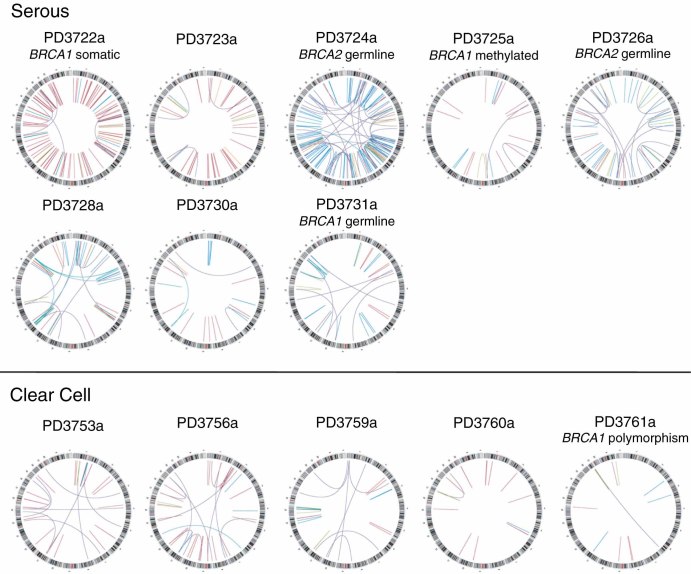
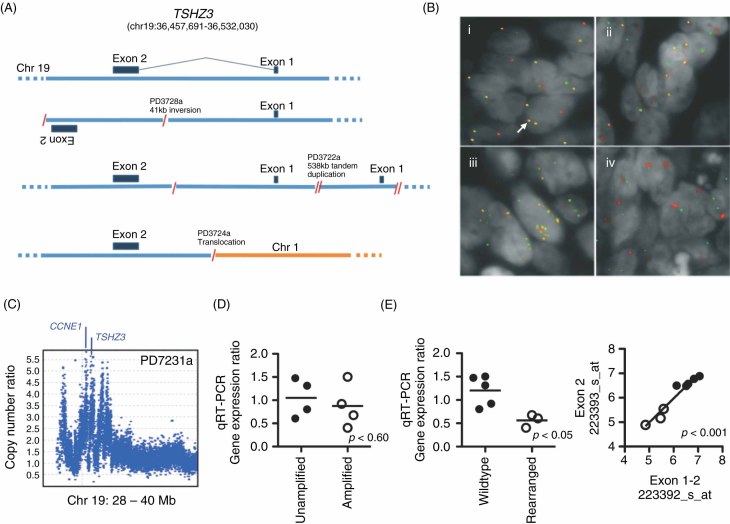
The application of paired-end next generation sequencing approaches has made it possible to systematically characterize rearrangements of the cancer genome to base-pair level. Utilizing this approach, we report the first detailed analysis of ovarian cancer rearrangements, comparing high-grade serous and clear cell cancers, and these histotypes with other solid cancers. Somatic rearrangements were systematically characterized in eight high-grade serous and five clear cell ovarian cancer genomes and we report here the identification of > 600 somatic rearrangements. Recurrent rearrangements of the transcriptional regulator gene, TSHZ3, were found in three of eight serous cases. Comparison to breast, pancreatic and prostate cancer genomes revealed that a subset of ovarian cancers share a marked tandem duplication phenotype with triple-negative breast cancers. The tandem duplication phenotype was not linked to BRCA1/2 mutation, suggesting that other common mechanisms or carcinogenic exposures are operative. High-grade serous cancers arising in women with germline BRCA1 or BRCA2 mutation showed a high frequency of small chromosomal deletions. These findings indicate that BRCA1/2 germline mutation may contribute to widespread structural change and that other undefined mechanism(s), which are potentially shared with triple-negative breast cancer, promote tandem chromosomal duplications that sculpt the ovarian cancer genome.
Copyright © 2012 Pathological Society of Great Britain and Ireland. Published by John Wiley & Sons, Ltd.
Figures
References
-
- TCGA. Integrated genomic analyses of ovarian carcinoma. Nature. 2011;474:609–615. DOI: 10.1038/nature10166. - DOI - PMC - PubMed
-
- Vaughan S, Coward JI, Bast RC, Jr, et al. Rethinking ovarian cancer: recommendations for improving outcomes. Nat Rev Cancer. 2011;11:719–725. DOI: nrc3144 [pii] 10.1038/nrc3144. - DOI - PMC - PubMed
-
- Tothill RW, Tinker AV, George J, et al. Novel molecular subtypes of serous and endometrioid ovarian cancer linked to clinical outcome. Clin Cancer Res. 2008;14:5198–5208. DOI: 10.1158/1078-0432.CCR-08-0196. - DOI - PubMed
-
- Helland A, Anglesio MS, George J, et al. Deregulation of MYCN, LIN28B and LET7 in a molecular subtype of aggressive high-grade serous ovarian cancers. PloS One. 2011;6:e18064. DOI: 10.1371/journal.pone.0018064. - DOI - PMC - PubMed
-
- Gorringe KL, George J, Anglesio MS, et al. Copy number analysis identifies novel interactions between genomic loci in ovarian cancer. PloS One. 2010;5 DOI: 10.1371/journal.pone.0011408. - DOI - PMC - PubMed
Publication types
MeSH terms
Substances
Grants and funding
LinkOut - more resources
Full Text Sources
Other Literature Sources
Medical
Miscellaneous