. 2012 Apr 10:6:78.
doi: 10.3389/fnhum.2012.00078. eCollection 2012.

Is there a critical lesion site for unilateral spatial neglect? A meta-analysis using activation likelihood estimation

Affiliations

Is there a critical lesion site for unilateral spatial neglect? A meta-analysis using activation likelihood estimation

Pascal Molenberghs et al. Front Hum Neurosci. .

Abstract

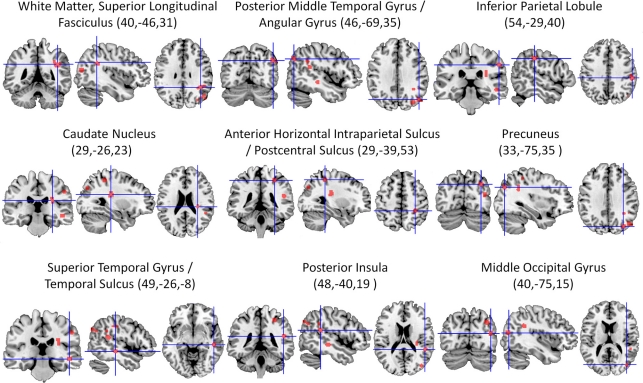
The critical lesion site responsible for the syndrome of unilateral spatial neglect has been debated for more than a decade. Here we performed an activation likelihood estimation (ALE) to provide for the first time an objective quantitative index of the consistency of lesion sites across anatomical group studies of spatial neglect. The analysis revealed several distinct regions in which damage has consistently been associated with spatial neglect symptoms. Lesioned clusters were located in several cortical and subcortical regions of the right hemisphere, including the middle and superior temporal gyrus, inferior parietal lobule, intraparietal sulcus, precuneus, middle occipital gyrus, caudate nucleus, and posterior insula, as well as in the white matter pathway corresponding to the posterior part of the superior longitudinal fasciculus. Further analyses suggested that separate lesion sites are associated with impairments in different behavioral tests, such as line bisection and target cancellation. Similarly, specific subcomponents of the heterogeneous neglect syndrome, such as extinction and allocentric and personal neglect, are associated with distinct lesion sites. Future progress in delineating the neuropathological correlates of spatial neglect will depend upon the development of more refined measures of perceptual and cognitive functions than those currently available in the clinical setting.

Keywords: ALE meta-analysis; cancellation task; extinction; lesion mapping; line bisection; unilateral spatial neglect.


Figures
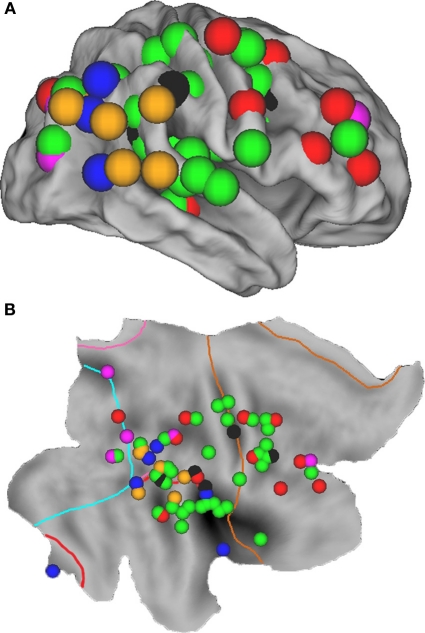
Figure 1
Figure 1
Overview of all regions associated with unilateral spatial neglect, based upon 20 lesion mapping studies (see Table 1), superimposed on the cortical surface of the right hemisphere using CARET software (v5.64 http://brainmap.wustl.edu/caret.html). (A) Fiducial map. Purple spheres = neglect tested with line bisection tasks; red spheres = neglect tested with cancellation tasks; green spheres = neglect tested with a combination of tasks; blue spheres = allocentric neglect; black spheres = personal neglect; orange spheres = spatial extinction. (B) Flat map with identical spheres as in A. Cyan line indicates the occipital lobe border; pink line = parietal lobe; red line = temporal lobe; brown line = frontal lobe; regions outside borders = limbic lobe.
Figure 2
Figure 2
Overview of all significant clusters (FDR, p < 0.05) derived from the ALE analysis of 20 lesion mapping studies (listed in Table 1), superimposed on a ch2better template using MRIcron. Numbers in parentheses are x, y, and z coordinates of the center of the cluster in MNI space. All lesion clusters are in the right cerebral hemisphere.
Figure 3
Figure 3
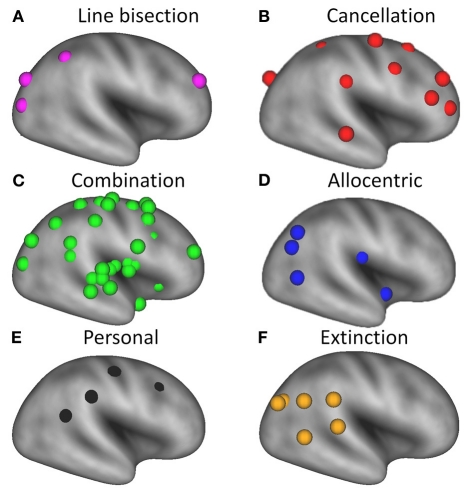
Overview of brain regions associated with different deficits in patients with unilateral spatial neglect, superimposed on a very inflated template brain using CARET software (v5.64 http://brainmap.wustl.edu/caret.html). Purple spheres = neglect tested with line bisection tasks; red spheres = neglect tested with cancellation tasks; green spheres = neglect tested with a combination of tasks; blue spheres = allocentric neglect; black spheres = personal neglect; orange spheres = spatial extinction.

References

    1. Albert M. L. (1973). A simple test of visual neglect. Neurology 23, 658–664 - PubMed
    1. Baas U., de Haan B., Graessli T., Karnath H.-O., Mueri R., Perrig W. J., Wurtz P., Gutbrod K. (2011). Personal neglect-a disorder of body representation? Neuropsychologia 49, 898–905 10.1016/j.neuropsychologia.2011.01.043 - DOI - PubMed
    1. Bartolomeo P., Thiebaut de Schotten M., Doricchi F. (2007). Left unilateral neglect as a disconnection syndrome. Cereb. Cortex 17, 2479–2490 10.1093/cercor/bhl181 - DOI - PubMed
    1. Bates E., Wilson S. M., Saygin A. P., Dick F., Sereno M. I., Knight R. T., Dronkers N. F. (2003). Voxel-based lesion-symptom mapping. Nat. Neurosci. 6, 448–450 10.1038/nn1050 - DOI - PubMed
    1. Bays P. M., Singh-Curry V., Gorgoraptis N., Driver J., Husain M. (2010). Integration of goal- and stimulus-related visual signals revealed by damage to human parietal cortex. J. Neurosci. 30, 5968–5978 10.1523/JNEUROSCI.0997-10.2010 - DOI - PMC - PubMed

LinkOut - more resources