. 2012 Apr 10:3:89.
doi: 10.3389/fphys.2012.00089. eCollection 2012.

Testosterone and vascular function in aging

Affiliations

Testosterone and vascular function in aging

Rhéure A M Lopes et al. Front Physiol. .

Abstract

Androgen receptors are widely distributed in several tissues, including vascular endothelial and smooth muscle cells. Through classic cytosolic androgen receptors or membrane receptors, testosterone induces genomic and non-genomic effects, respectively. Testosterone interferes with the vascular function by increasing the production of pro-inflammatory cytokines and arterial thickness. Experimental evidence indicates that sex steroid hormones, such as testosterone modulate the synthesis and bioavailability of NO and, consequently, endothelial function, which is key for a healthy vasculature. Of interest, aging itself is accompanied by endothelial and vascular smooth muscle dysfunction. Aging-associated decline of testosterone levels is accompanied by age-related diseases, such as metabolic and cardiovascular diseases, indicating that very low levels of androgens may contribute to cardiovascular dysfunction observed in these age-related disorders or, in other words, that testosterone may have beneficial effects in the cardiovascular system. However, testosterone seems to play a negative role in the severity of renal disease. In this mini-review, we briefly comment on the interplay between aging and testosterone levels, the vascular actions of testosterone and its implications for vascular aging. Renal effects of testosterone and the use of testosterone to prevent vascular dysfunction in elderly are also addressed.

Keywords: aging; cardiovascular disease; testosterone; vascular function.


Figures
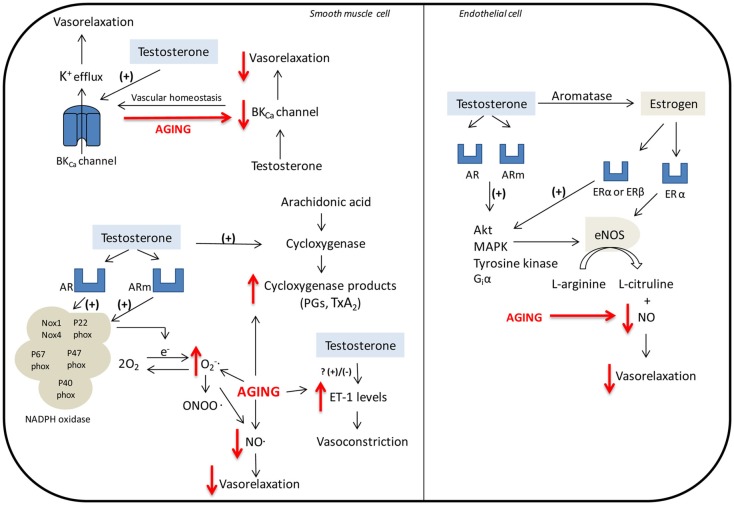
Figure 1
Figure 1
Mechanisms involved in the regulation of vascular function by testosterone. Smooth muscle cell: The relaxation induced by testosterone is dependent on large conductance Ca2+-activated K+ channels (BKCa). Aging decreases the expression of BKCa, which can determine the reduced vasodilator response to testosterone in elderly. Testosterone induces NADPH oxidase-dependent ROS generation. NO can react with O2- forming peroxynitrite (ONOO). This decreases NO availability and consequently reduces vasodilator responses. Testosterone also stimulates COX-1/COX-2 and ET-1 pathways. Endothelial cell: Through the P450 aromatase, testosterone can be converted to estrogen. Activation of estrogen and androgen receptors modulates endothelial function by mechanisms involving release of NO via NO synthase. Abbreviations: AR, androgen receptor; ER estrogen receptor; Akt, serine/threonine kinase; BKCa, large conductance Ca2+-activated K+ channels; ERKs, extracellular-signal-regulated kinases; eNOS, endothelial NO synthase; Giα, guanine nucleotide regulator protein subunit that inhibits guanylate cyclase; MAPK, mitogen-activated protein kinase; O2-, superoxide anion; ONOO, peroxynitrite; PGs, prostaglandins; TxA2, thromboxane A2. Aging-associated decline in testosterone levels, as well as mechanisms that contribute to aging-associated endothelial dysfunction are depicted in red.

References

    1. Akishita M., Hashimoto M., Ohike Y., Ogawa S., Iijima K., Eto M., Ouchi Y. (2007). Low testosterone level is an independent determinant of endothelial dysfunction in men. Hypertens. Res. 30, 1029–103410.1291/hypres.30.1029 - DOI - PubMed
    1. Amar E., Grivel T., Hamidi K., Lemaire A., Giuliano F. (2005). Ageing men’s sexual functions decline and the erectile dysfunction (ED) increase. Prog. Urol. 15, 6–9 - PubMed
    1. Araujo A. B., Wittert G. A. (2011). Endocrinology of the aging male. Best Pract. Res. Clin. Endocrinol. Metab. 25, 303–31910.1016/j.beem.2010.11.004 - DOI - PMC - PubMed
    1. Askew E. B., Gampe R. T., Jr., Stanley T. B., Faggart J. L., Wilson E. M. (2007). Modulation of androgen receptor activation function 2 by testosterone and dihydrotestosterone. J. Biol. Chem. 282, 25801–2581610.1074/jbc.M703268200 - DOI - PMC - PubMed
    1. Bagatell C. J., Bremner W. J. (1996). Androgens in men – uses and abuses. N. Engl. J. Med. 334, 707–71410.1056/NEJM199603143341107 - DOI - PubMed

LinkOut - more resources
