


Prevalence of Neoehrlichia mikurensis in ticks and rodents from North-west Europe
- PMID: 22515314
- PMCID: PMC3395572
- DOI: 10.1186/1756-3305-5-74
Prevalence of Neoehrlichia mikurensis in ticks and rodents from North-west Europe
Abstract
Background: Neoehrlichia mikurensis s an emerging and vector-borne zoonosis: The first human disease cases were reported in 2010. Limited information is available about the prevalence and distribution of Neoehrlichia mikurensis in Europe, its natural life cycle and reservoir hosts. An Ehrlichia-like schotti variant has been described in questing Ixodes ricinus ticks, which could be identical to Neoehrlichia mikurensis.
Methods: Three genetic markers, 16S rDNA, gltA and GroEL, of Ehrlichia schotti-positive tick lysates were amplified, sequenced and compared to sequences from Neoehrlichia mikurensis. Based on these DNA sequences, a multiplex real-time PCR was developed to specifically detect Neoehrlichia mikurensis in combination with Anaplasma phagocytophilum in tick lysates. Various tick species from different life-stages, particularly Ixodes ricinus nymphs, were collected from the vegetation or wildlife. Tick lysates and DNA derived from organs of wild rodents were tested by PCR-based methods for the presence of Neoehrlichia mikurensis. Prevalence of Neoehrlichia mikurensis was calculated together with confidence intervals using Fisher's exact test.
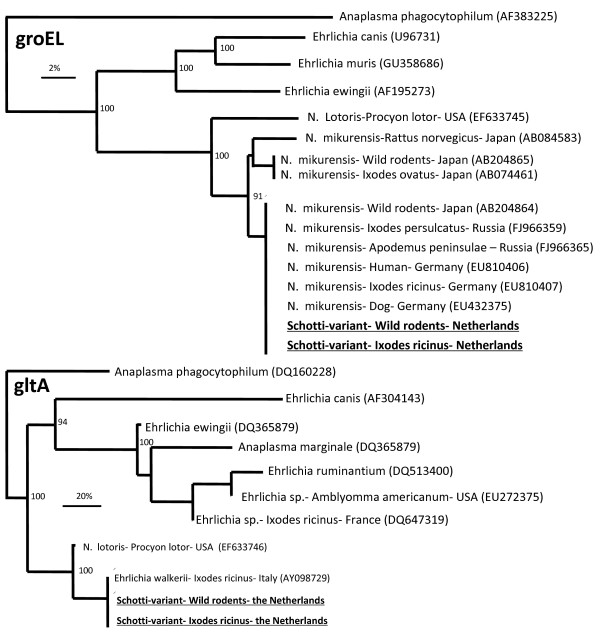
Results: The three genetic markers of Ehrlichia schotti-positive field isolates were similar or identical to Neoehrlichia mikurensis. Neoehrlichia mikurensis was found to be ubiquitously spread in the Netherlands and Belgium, but was not detected in the 401 tick samples from the UK. Neoehrlichia mikurensis was found in nymphs and adult Ixodes ricinus ticks, but neither in their larvae, nor in any other tick species tested. Neoehrlichia mikurensis was detected in diverse organs of some rodent species. Engorging ticks from red deer, European mouflon, wild boar and sheep were found positive for Neoehrlichia mikurensis.
Conclusions: Ehrlichia schotti is similar, if not identical, to Neoehrlichia mikurensis. Neoehrlichia mikurensis is present in questing Ixodes ricinus ticks throughout the Netherlands and Belgium. We propose that Ixodes ricinus can transstadially, but not transovarially, transmit this microorganism, and that different rodent species may act as reservoir hosts. These data further imply that wildlife and humans are frequently exposed to Neoehrlichia mikurensis-infected ticks through tick bites. Future studies should aim to investigate to what extent Neoehrlichia mikurensis poses a risk to public health.
Figures
References
-
- Hubalek Z. Epidemiology of lyme borreliosis. Curr Probl Dermatol. 2009;37:31–50. - PubMed
-
- Hofhuis A, van der Giessen JW, Borgsteede FH, Wielinga PR, Notermans DW, van Pelt W. Lyme borreliosis in the Netherlands: strong increase in GP consultations and hospital admissions in past 10 years. Euro Surveill. 2006;11(6):E060622 060622. - PubMed
-
- van Dobbenburgh A, van Dam AP, Fikrig E. Human granulocytic ehrlichiosis in western Europe. N Engl J Med. 1999;340(15):1214–1216. - PubMed
Publication types
MeSH terms
Substances
LinkOut - more resources
Full Text Sources
Research Materials
