


Screening Togolese medicinal plants for few pharmacological properties
- PMID: 22518084
- PMCID: PMC3326758
- DOI: 10.4103/0974-8490.94737
Screening Togolese medicinal plants for few pharmacological properties
Abstract
Background: Terminalia macroptera Guill. et Perr. (Combretaceae), Sida alba L. (Malvaceae), Prosopis africana Guill et Perr. Taub. (Mimosaceae), Bridelia ferruginea Benth. (Euphorbiaceae), and Vetiveria nigritana Stapf. (Asteraceae) are traditionally used in Togolese folk medicine to treat several diseases including microbial infections.
Objective: This study aimed to investigate the antimicrobial, antioxidant, and hemolytic properties of the crude extracts of the above-mentioned plants.
Materials and methods: The antimicrobial and the antioxidant activities were assayed using the NCCLS microdilution method and the DPPH free radical scavenging, respectively. Human A+ red blood cells were used to perform the hemolytic assay. Phenolics were further quantified in the extracts using spectrophotometric methods.
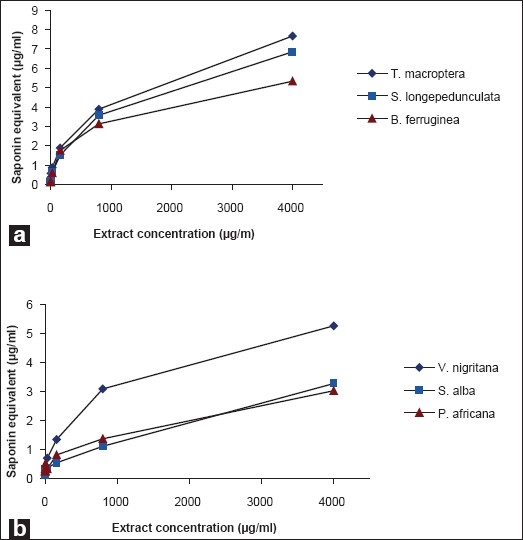
Results: Minimal inhibitory concentrations in the range of 230-1800 μg/ml were recorded in the NCCLS broth microdilution for both bacterial and fungal strains with methanol extracts. The DPPH radical scavenging assay yielded interesting antioxidant activities of the extracts of P. africana and T. macroptera (IC(50) values of 0.003 ± 0.00 μg/ml and 0.05 ± 0.03 μg/ml, respectively). These activities were positively correlated with the total phenolic contents and negatively correlated with the proanthocyanidin content of the extracts. The hemolytic assay revealed that great hemolysis occurred with the methanol extracts of T. macroptera, S. longepedunculata, and B. ferruginea.
Conclusion: These results support in part the use of the selected plants in the treatment of microbial infections. In addition, the plant showed an interesting antioxidant activity that could be useful in the management of oxidative stress.
Keywords: Antimicrobial; antioxidant; hemolytic; phenolics.
Conflict of interest statement
Figures
Similar articles
-
Antimicrobial, antiplasmodial, haemolytic and antioxidant activities of crude extracts from three selected Togolese medicinal plants.Asian Pac J Trop Med. 2011 Oct;4(10):808-13. doi: 10.1016/S1995-7645(11)60199-5. Asian Pac J Trop Med. 2011. PMID: 22014738
-
Enzyme inhibition, antioxidant and immunomodulatory activities, and brine shrimp toxicity of extracts from the root bark, stem bark and leaves of Terminalia macroptera.J Ethnopharmacol. 2014 Sep 11;155(2):1219-26. doi: 10.1016/j.jep.2014.07.004. Epub 2014 Jul 10. J Ethnopharmacol. 2014. PMID: 25017373
-
Effects of hydroethanolic extracts of Balanites aegyptiaca (L.) Delile (Balanitaceae) on some resistant pathogens bacteria isolated from wounds.J Ethnopharmacol. 2015 Apr 22;164:16-21. doi: 10.1016/j.jep.2015.01.051. Epub 2015 Feb 7. J Ethnopharmacol. 2015. PMID: 25666430
-
Biopharmaceutical potentials of Prosopis spp. (Mimosaceae, Leguminosa).J Food Drug Anal. 2017 Jan;25(1):187-196. doi: 10.1016/j.jfda.2016.11.001. Epub 2016 Dec 10. J Food Drug Anal. 2017. PMID: 28911536 Free PMC article. Review.
-
The phytochemical and pharmacological actions of Entada africana Guill. & Perr.Heliyon. 2019 Sep 5;5(9):e02332. doi: 10.1016/j.heliyon.2019.e02332. eCollection 2019 Sep. Heliyon. 2019. PMID: 31517111 Free PMC article. Review.
Cited by
-
Ethnopharmacology, Chemistry and Biological Properties of Four Malian Medicinal Plants.Plants (Basel). 2017 Feb 21;6(1):11. doi: 10.3390/plants6010011. Plants (Basel). 2017. PMID: 28230801 Free PMC article. Review.
-
Ethnobotanical Study of Latex Plants in the Maritime Region of Togo.Pharmacognosy Res. 2016 Apr-Jun;8(2):128-34. doi: 10.4103/0974-8490.175613. Pharmacognosy Res. 2016. PMID: 27034604 Free PMC article.
References
-
- Mokaddas E, Rotimi VO, Sanyal SC. In vitro activity of Piperacillin/tazobactom versus other broad antibiotics against nosocomial Gram negative pathogens isolated from burn patients. J Chemother. 1998;19:208–14. - PubMed
-
- Karou D, Nadembega WM, Ouattara L, Ilboudo D, Canini A, Nikiéma JB, et al. African ethnopharmacology and new drug discovery. Med Plant Sci Biotechnol. 2007;1:61–9.
LinkOut - more resources
Full Text Sources
Molecular Biology Databases
Miscellaneous