. 2012 Jul;22(7):1327-33.
doi: 10.1101/gr.138792.112. Epub 2012 Apr 20.

Precision genome engineering with programmable DNA-nicking enzymes

Affiliations

Precision genome engineering with programmable DNA-nicking enzymes

Eunji Kim et al. Genome Res. 2012 Jul.

Abstract

Zinc finger nucleases (ZFNs) are powerful tools of genome engineering but are limited by their inevitable reliance on error-prone nonhomologous end-joining (NHEJ) repair of DNA double-strand breaks (DSBs), which gives rise to randomly generated, unwanted small insertions or deletions (indels) at both on-target and off-target sites. Here, we present programmable DNA-nicking enzymes (nickases) that produce single-strand breaks (SSBs) or nicks, instead of DSBs, which are repaired by error-free homologous recombination (HR) rather than mutagenic NHEJ. Unlike their corresponding nucleases, zinc finger nickases allow site-specific genome modifications only at the on-target site, without the induction of unwanted indels. We propose that programmable nickases will be of broad utility in research, medicine, and biotechnology, enabling precision genome engineering in any cell or organism.


Figures
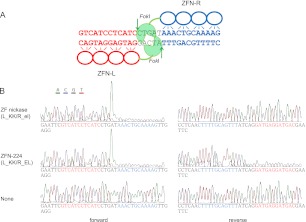
Figure 1.
Figure 1.
DNA cleavage by ZFNs and ZF nickases. (A) ZFN-224 and its target sequence. ZFN-224 consists of two subunits, L (left, red) and R (right, blue). The two half-site sequences are shown (red and blue) and the 5-bp spacer is shown (black). (Arrows) Cleaved phosphodiester bonds. (B) Run-off DNA sequencing analysis to detect DNA cleavage by ZFN-224 and ZF nickases. A plasmid containing the ZFN-224 target site was incubated with the nuclease pair or the nickase pair and subjected to run-off sequencing. Note that an additional adenine is added at the end by the template-independent terminal transferase activity of AmpliTaq DNA polymerase used for the sequencing reaction.
Figure 2.
Figure 2.
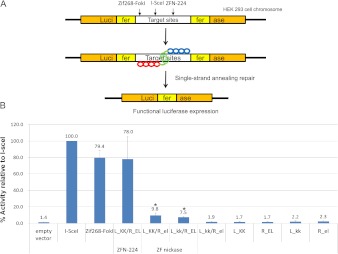
Comparison of activities of ZFNs and ZF nickases using a cell-based reporter system. (A) Schematic overview of a single-strand annealing (SSA) system. (B) Measurement of nuclease and nickase activities using the cell-based SSA system. Means and standard deviations (error bars) from at least three independent experiments are shown. P-values were calculated with the Student's t-test; (*) P < 0.05 (empty vector vs. nickase).
Figure 3.
Figure 3.
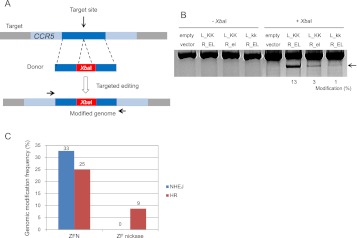
Targeted genome editing via HR in human cells with ZF nickases. (A) Schematic overview of HR-mediated genome editing. HR donor DNA consists of two 800-bp homology arms (left and right) and an XbaI site. K562 cells were transfected with plasmids encoding nucleases or ZF nickases plus HR donor plasmid. After 4 d of incubation, genomic DNA was isolated, and the target locus was amplified with primers (arrows) that bind outside of the homology arm sequences. PCR amplicons were digested with XbaI. (B) XbaI-treated and untreated DNA samples were analyzed on a 1% agarose gel. (Arrow) The expected position of XbaI-digested PCR products. Modification frequencies (percentages) were calculated by measuring the band intensity. (C) Comparison of patterns of genomic modifications induced by ZFNs and ZF nickases. PCR products corresponding to genomic modifications were cloned, sequenced, and classified according to their mutation patterns. The DNA sequence of each clone is shown in Supplemental Figure 1.
Figure 4.
Figure 4.
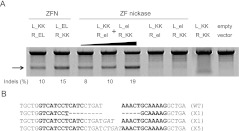
Two pairs of ZF nickases produce a DSB in the genome. (A) Nuclease or nickase-driven indels detected by T7E1 assay. PCR products amplified using genomic DNA from cells transfected with plasmids (4 μg/monomer) encoding nickases or nucleases were subjected to T7E1 digestion and analyzed by agarose gel electrophoresis. (Arrow) The expected position of the resulting DNA band. (The black triangle above the gel picture) The increase of the transfected plasmid (4, 8, and 10 μg/each monomer). (B) DNA sequences of the CCR5 wild-type and mutant clones. The two half-sites are shown in boldface letters. Microhomologies are underlined, and inserted bases are shown in italics. Dashes indicate deleted bases. The number of occurrences is shown in parentheses; X1 and X5 are the number of each clone. (WT) Wild type.
Figure 5.
Figure 5.
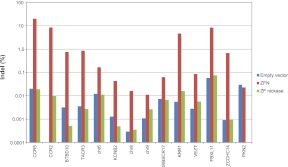
Mutagenic NHEJ frequencies at on-target and off-target sites. K562 cells were transfected with plasmids encoding ZFN-224, the ZF nickase (L_KK/R_el), or an empty vector used as a negative control. PCR amplicons corresponding to the CCR5 on-target site and 13 off-target sites were subjected to high-throughput sequencing. Sequences that contained indels within the spacer region were considered to be NHEJ-mediated modifications.
Figure 6.
Figure 6.
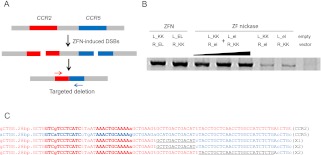
Nickase-mediated genomic deletions in human cells. (A) Schematic representation of ZFN-mediated genomic deletions. (B) PCR products corresponding to the 15-kb genomic deletions in cells transfected with plasmids (4 μg/monomer) encoding nucleases or nickases. (The black triangle above the gel picture) The increase of the transfected plasmid (4, 8, and 10 μg/each monomer). (C) DNA sequences of deletion PCR products that were amplified from genomic DNA isolated from cells transfected with a single nickase pair. Nuclease target sites are shown in boldface letters. Mismatched bases between the CCR2 and CCR5 loci are indicated as lowercase letters. Mutated bases are shown in italics. The regions in which recombination between the CCR2 and CCR5 loci occurred are underlined.

Comment in

References

    1. Bae KH, Kwon YD, Shin HC, Hwang MS, Ryu EH, Park KS, Yang HY, Lee DK, Lee Y, Park J, et al. 2003. Human zinc fingers as building blocks in the construction of artificial transcription factors. Nat Biotechnol 21: 275–280 - PubMed
    1. Bibikova M, Golic M, Golic KG, Carroll D 2002. Targeted chromosomal cleavage and mutagenesis in Drosophila using zinc-finger nucleases. Genetics 161: 1169–1175 - PMC - PubMed
    1. Bitinaite J, Wah DA, Aggarwal AK, Schildkraut I 1998. FokI dimerization is required for DNA cleavage. Proc Natl Acad Sci 95: 10570–10575 - PMC - PubMed
    1. Boch J, Scholze H, Schornack S, Landgraf A, Hahn S, Kay S, Lahaye T, Nickstadt A, Bonas U 2009. Breaking the code of DNA binding specificity of TAL-type III effectors. Science 326: 1509–1512 - PubMed
    1. Brunet E, Simsek D, Tomishima M, DeKelver R, Choi VM, Gregory P, Urnov F, Weinstock DM, Jasin M 2009. Chromosomal translocations induced at specified loci in human stem cells. Proc Natl Acad Sci 106: 10620–10625 - PMC - PubMed

Publication types

Substances

LinkOut - more resources