


Nutrition of children and women in Bangladesh: trends and directions for the future
- PMID: 22524113
- PMCID: PMC3312353
- DOI: 10.3329/jhpn.v30i1.11268
Nutrition of children and women in Bangladesh: trends and directions for the future
Abstract
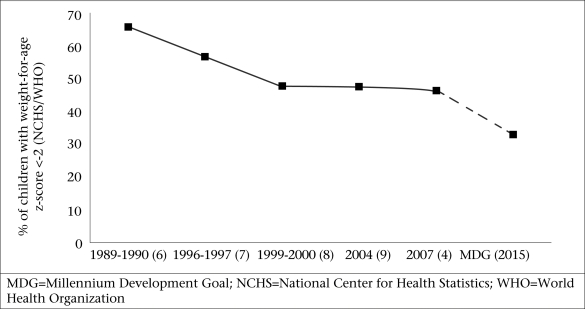
Although child and maternal malnutrition has been reduced in Bangladesh, the prevalence of underweight (weight-for-age z-score <-2) among children aged less than five years is still high (41%). Nearly one-third of women are undernourished with body mass index of <18.5 kg/m2. The prevalence of anaemia among young infants, adolescent girls, and pregnant women is still at unacceptable levels. Despite the successes in specific programmes, such as the Expanded Programme on Immunization and vitamin A supplementation, programmes for nutrition interventions are yet to be implemented at scale for reaching the entire population. Given the low annual rate of reduction in child undernutrition of 1.27 percentage points per year, it is unlikely that Bangladesh would be able to achieve the United Nations' Millennium Development Goal to address undernutrition. This warrants that the policy-makers and programme managers think urgently about the ways to accelerate the progress. The Government, development partners, non-government organizations, and the academia have to work in concert to improve the coverage of basic and effective nutrition interventions, including exclusive breastfeeding, appropriate complementary feeding, supplementation of micronutrients to children, adolescent girls, pregnant and lactating women, management of severe acute malnutrition and deworming, and hygiene interventions, coupled with those that address more structural causes and indirectly improve nutrition. The entire health system needs to be revitalized to overcome the constraints that exist at the levels of policy, governance, and service-delivery, and also for the creation of demand for the services at the household level. In addition, management of nutrition in the aftermath of natural disasters and stabilization of prices of foods should also be prioritized.
Figures

References
-
- Black RE, Allen LH, Bhutta ZA, Caulfield LE, de Onis M, Ezzati M, et al. Maternal and child undernutrition: global and regional exposures and health consequences. Lancet. 2008;371:243–60. - PubMed
-
- Bryce J, Coitinho D, Darnton-Hill I, Pelletier D, Pinstrup-Andersen P, Maternal and Child Undernutrition Study Group Maternal and child undernutrition: effective action at national level. Lancet. 2008;371:510–26. - PubMed
-
- World Health Organization . WHO global database on child growth and malnutrition. Geneva: World Health Organization; 2010. p. 12. ( http://www.who.int/nutgrowthdb/database/countries/who_standards/ind_ref.pdf, accessed on 29 May 2011)
-
- National Institute of Population Research and Training . Bangladesh demographic and health survey 2007. Dhaka: National Institute of Population Research and Training; 2009. p. 346.
-
- Balarajan Y, Villamor E. Nationally representative surveys show recent increases in the prevalence of overweight and obesity among women of reproductive age in Bangladesh, Nepal, and India. J Nutr. 2009;139:2139–44. - PubMed
Publication types
MeSH terms
LinkOut - more resources
Full Text Sources
Other Literature Sources
Medical