


Prominence of an O75 clonal group (clonal complex 14) among non-ST131 fluoroquinolone-resistant Escherichia coli causing extraintestinal infections in humans and dogs in Australia
- PMID: 22526317
- PMCID: PMC3393427
- DOI: 10.1128/AAC.06120-11
Prominence of an O75 clonal group (clonal complex 14) among non-ST131 fluoroquinolone-resistant Escherichia coli causing extraintestinal infections in humans and dogs in Australia
Abstract
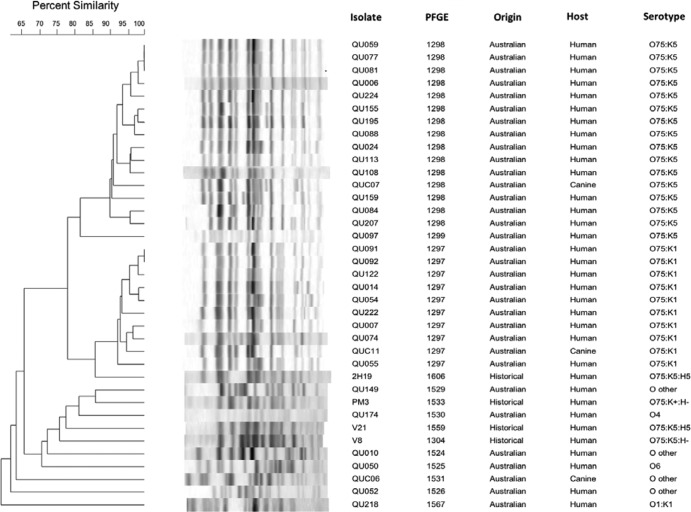
Fluoroquinolone (FQ)-resistant extraintestinal pathogenic Escherichia coli (FQ(r) ExPEC) strains from phylogenetic group B2 are undergoing epidemic spread. Isolates belonging to phylogenetic group B2 are generally more virulent than other E. coli isolates; therefore, resistance to FQs among group B2 isolates is concerning. Although clonal expansion of sequence type 131 (ST131) is a major factor, the contribution of additional clonal groups has not been quantified. Group B2 FQ(r) ExPEC isolates from humans (n = 250) and dogs (n = 12) in Australia were screened for ST131, a recently recognized and rapidly emerging multidrug-resistant and virulent clonal group that is important in both human and companion animal medicine. Non-ST131 isolates underwent virulence genotyping, PCR-based O typing, partial multilocus sequence typing (MLST), pulsed-field gel electrophoresis (PFGE), and FQ resistance mechanism analysis. Of 49 non-ST131 isolates (45 human, 4 canine), 49% (24 human, 2 canine) represented O-type O75 and exhibited conserved virulence genotypes (F10 papA allele, iha, fimH, sat, vat, fyuA, iutA, kpsMII, usp, ompT, malX, K1/K5 capsule) and MLST allele profiles corresponding with clonal complex CC14. Two clusters, each containing canine and human isolates, were identified by PFGE (differentiated by K1 and K5 capsules). Australian FQ(r) O75 isolates exhibited commonality with an historical FQ-susceptible O75 urosepsis isolate (also CC14). The isolation from humans and dogs of highly similar FQ(r) derivatives of the classic O75:K1/K5 (CC14) ExPEC lineage suggests recent acquisition of FQ resistance and potential cross-host-species transfer. This lineage should be targeted with ST131 in future epidemiological investigations of FQ(r) ExPEC.
Figures
References
-
- Blanco J, et al. 2011. National survey of Escherichia coli causing extraintestinal infections reveals the spread of drug-resistant clonal groups O25b:H4-B2-ST131, O15:H1-D-ST393 and CGA-D-ST69 with high virulence gene content in Spain. J. Antimicrob. Chemother. 66:2011–2021 - PubMed
-
- Clermont O, et al. 2009. Rapid detection of the O25b-ST131 clone of Escherichia coli encompassing the CTX-M-15-producing strains. J. Antimicrob. Chemother. 64:274–277 - PubMed
-
- Clermont O, Johnson JR, Menard M, Denamur E. 2007. Determination of Escherichia coli O types by allele-specific polymerase chain reaction: application to the O types involved in human septicemia. Diagn. Microbiol. Infect. Dis. 57:129–136 - PubMed
-
- Clinical and Laboratory Standards Institute 2010. Performance standards for antimicrobial susceptibility testing: twentieth informational supplement M100-S20. Clinical and Laboratory Standards Institute, Wayne, PA
Publication types
MeSH terms
Substances
LinkOut - more resources
Full Text Sources
Other Literature Sources
Medical
Research Materials
Miscellaneous
