


Score to identify the severity of adult patients with influenza A (H1N1) 2009 virus infection at hospital admission
- PMID: 22526871
- PMCID: PMC7101595
- DOI: 10.1007/s10096-012-1616-8
Score to identify the severity of adult patients with influenza A (H1N1) 2009 virus infection at hospital admission
Abstract
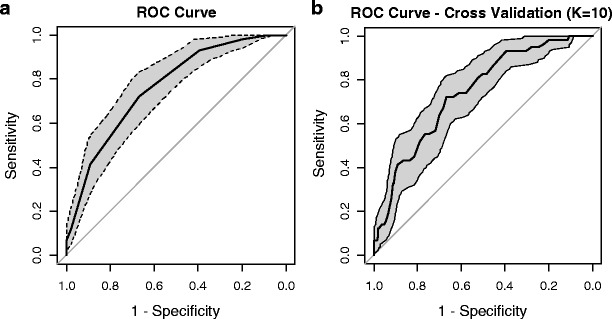
The objective of this paper was to develop a prognostic index for severe complications among hospitalized patients with influenza A (H1N1) 2009 virus infection. We conducted a prospective observational cohort study of 618 inpatients with 2009 H1N1 virus infection admitted to 36 Spanish hospitals between July 2009 and February 2010. Risk factors evaluated included host-related factors and clinical data at admission. We developed a composite index of severe in-hospital complications (SIHC), which included: mortality, mechanical ventilation, septic shock, acute respiratory distress syndrome, and requirement for resuscitation maneuvers. Six factors were independently associated with SIHC: age >45 years, male sex, number of comorbidities, pneumonia, dyspnea, and confusion. From the β parameter obtained in the multivariate model, a weight was assigned to each factor to compute the individual influenza risk score. The score shows an area under the receiver operating characteristic (ROC) curve of 0.77. The SIHC rate was 1.9 % in the low-risk group, 10.3 % in the intermediate-risk group, and 29.6 % in the high-risk group. The odds ratio for complications was 21.8 for the high-risk group compared with the low-risk group. This easy-to-score influenza A (H1N1) 2009 virus infection risk index accurately stratifies patients hospitalized for H1N1 virus infection into low-, intermediate-, and high-risk groups for SIHC.
Figures
References
Publication types
MeSH terms
LinkOut - more resources
Full Text Sources
Medical
