


The iceberg of health care utilization in women with urinary incontinence
- PMID: 22527544
- PMCID: PMC3905313
- DOI: 10.1007/s00192-012-1743-x
The iceberg of health care utilization in women with urinary incontinence
Abstract
Introduction and hypothesis: The objective of the study was to estimate prevalence of urinary incontinence (UI) health care utilization in women from the population up to specialty care.
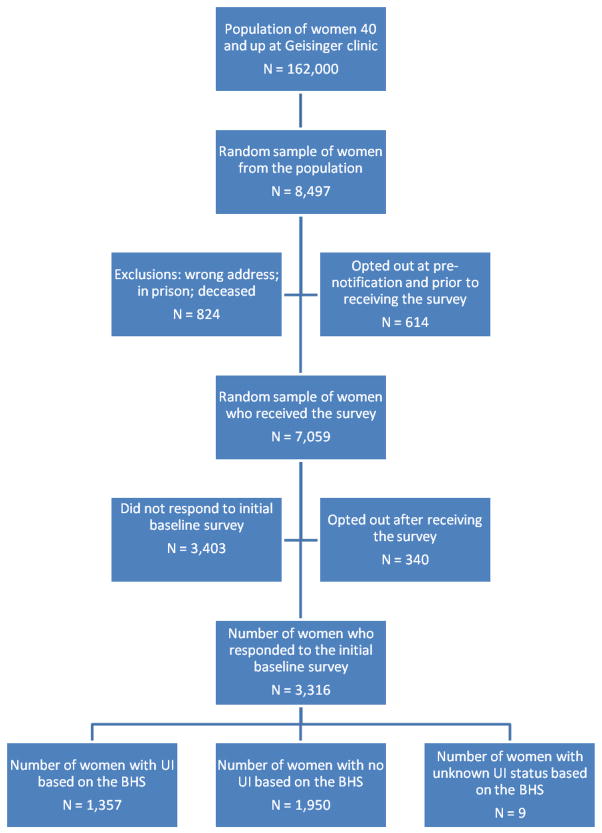
Methods: The General Longitudinal Overactive Bladder Evaluation-UI (GLOBE-UI) is a population-based study on the natural history of UI in women ≥ 40 years of age. Prevalence of UI was estimated by using the Bladder Health Survey (BHS). Survey data were linked with electronic health records to build the different steps of the iceberg of disease. Descriptive statistics were used to estimate the prevalence estimates at all levels of the iceberg.
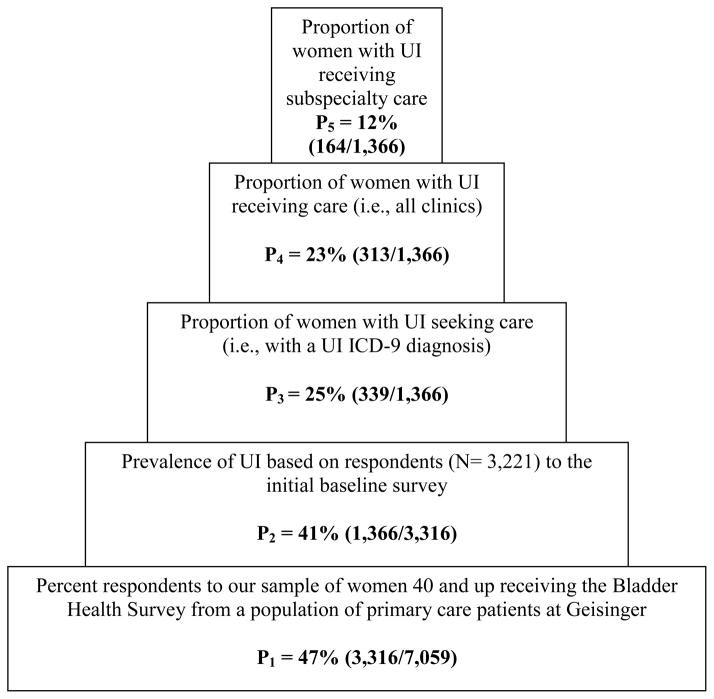
Results: A total sample of 7,059 women received the BHS. Of those, 3,316 (47 %) responded. Prevalence of UI was 1,366 (41 %). Women with or without UI did not differ by age or marital status. However, women with versus without UI were more parous (91 vs 87 %), significantly more overweight or obese (74 vs 61 %), and more likely to have a college education or higher (54 vs 46 %), P < 0.01. Nine hundred fifty-eight (73 %) women with UI reported duration of more than 2 years and 72 % reported moderate to severe UI symptoms. Of all 1,366 women with BHS UI diagnosis, only 339 (25 %) sought care, 313 (23 %) received some care, and 164 (12 %) received subspecialty care.
Conclusions: UI is a highly prevalent disease. Only a minority with UI appears to seek care and a fraction sees a pelvic floor specialist. It is important not only to educate women, but also primary care providers about this highly prevalent yet treatable condition.
Conflict of interest statement
This research was funded by National Institute of Health/ National Institute of Diabetes and Digestive and Kidney Diseases, grant # RO1 DK082551. No author on this paper has a conflict of interest.
Figures
References
-
- Abrams P, Kelleher CJ, Kerr LA, Rogers RG. Overactive bladder significantly affects quality of life. Am J Manag Care. 2000;6:S580–90. - PubMed
-
- Simeonova Z, Milsom I, Kullendorff AM, Molander U, Bengtsson C. The prevalence of urinary incontinence and its influence on the quality of life in women from an urban Swedish population. Acta Obstet Gynecol Scand. 1999;78:546–51. - PubMed
-
- Melville JL, Fan MY, Rau H, Nygaard IE, Katon WJ. Major depression and urinary incontinence in women: temporal associations in an epidemiologic sample. Am J Obstet Gynecol. 2009;201:490.e1, 490.e7. - PubMed
-
- Hannestad YS, Rortveit G, Sandvik H, Hunskaar S Norwegian EPINCONT study. A community-based epidemiological survey of female urinary incontinence: the Norwegian EPINCONT study. Epidemiology of Incontinence in the County of Nord-Trondelag. J Clin Epidemiol. 2000;53:1150–7. - PubMed
-
- Thom D. Variation in estimates of urinary incontinence prevalence in the community: effects of differences in definition, population characteristics, and study type. J Am Geriatr Soc. 1998;46:473–80. - PubMed
Publication types
MeSH terms
Grants and funding
LinkOut - more resources
Full Text Sources
Medical
