. 2013 Feb;9(1):32-43.
doi: 10.1007/s12015-012-9365-8.

Human stromal (mesenchymal) stem cells from bone marrow, adipose tissue and skin exhibit differences in molecular phenotype and differentiation potential

Affiliations

Human stromal (mesenchymal) stem cells from bone marrow, adipose tissue and skin exhibit differences in molecular phenotype and differentiation potential

May Al-Nbaheen et al. Stem Cell Rev Rep. 2013 Feb.

Abstract

Human stromal (mesenchymal) stem cells (hMSCs) are multipotent stem cells with ability to differentiate into mesoderm-type cells e.g. osteoblasts and adipocytes and thus they are being introduced into clinical trials for tissue regeneration. Traditionally, hMSCs have been isolated from bone marrow, but the number of cells obtained is limited. Here, we compared the MSC-like cell populations, obtained from alternative sources for MSC: adipose tissue and skin, with the standard phenotype of human bone marrow MSC (BM-MSCs). MSC from human adipose tissue (human adipose stromal cells (hATSCs)) and human skin (human adult skin stromal cells, (hASSCs) and human new-born skin stromal cells (hNSSCs)) grew readily in culture and the growth rate was highest in hNSSCs and lowest in hATSCs. Compared with phenotype of hBM-MSC, all cell populations were CD34(-), CD45(-), CD14(-), CD31(-), HLA-DR(-), CD13(+), CD29(+), CD44(+), CD73(+), CD90(+),and CD105(+). When exposed to in vitro differentiation, hATSCs, hASSCs and hNSSCs exhibited quantitative differences in their ability to differentiate into adipocytes and to osteoblastic cells. Using a microarray-based approach we have unveiled a common MSC molecular signature composed of 33 CD markers including known MSC markers and several novel markers e.g. CD165, CD276, and CD82. However, significant differences in the molecular phenotype between these different stromal cell populations were observed suggesting ontological and functional differences. In conclusion, MSC populations obtained from different tissues exhibit significant differences in their proliferation, differentiation and molecular phenotype, which should be taken into consideration when planning their use in clinical protocols.


Figures
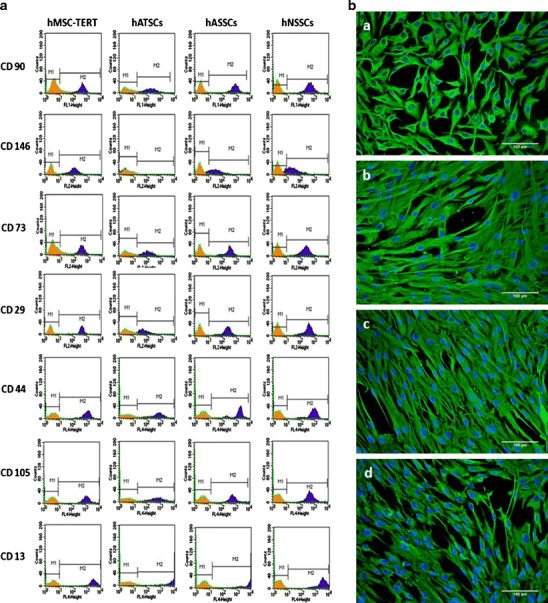
Fig. 1
Fig. 1
Phenotypic analysis hMSC-TERT, hATSCs, hASSCs and hNSSCs. The human bone marrow stromal (mesenchymal) stem cell (hMSC) immortalized with human telomerase reverse transcriptase gene (hMSC-TERT) and stromal cells derived from adipose tissue (hATSCs), adult dermal skin (hASSCs) and neonatal foreskin (hNSSCs) cells were cultured using plastic adherence. a Flow cytometry analysis of CD cell surface proteins. Filled histograms represent cells stained with the corresponding isotype control antibody. Five thousand events were collected and analyzed. b Immunofluorescence based detection of Vimentin expression and visualization of nuclei using DAPI
Fig. 2
Fig. 2
Proliferation potential of hATSCs, hASSCs and hNSSCs. Stromal cells derived from adipose tissue (hATSCs), adult dermal skin (hASSCs) and neonatal foreskin (hNSSCs) cells were cultured using plastic adherence. a hATSCs (n = 7), hASSCs (n = 5) and hNSSCs (n = 6) cumulative population doublings (PD) during long-term culture. b PD rate of hATSCs, hASSCs and hNSSCs. *p < 0.05
Fig. 3
Fig. 3
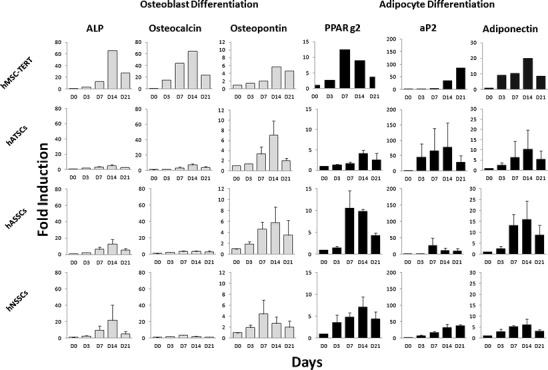
Gene expression of osteoblast and adipocyte markers during in vitro differentiation of hMSC-TERT, hATSCs, hASSCs and hNSSCs. The human bone marrow stromal (mesenchymal) stem cells (hMSC) immortalized with human telomerase reverse transcriptase gene (hMSC-TERT) and stromal cells derived from adipose tissue (hATSCs), adult dermal skin (hASSCs) and neonatal foreskin (hNSSCs) cells were cultured using plastic adherence and exposed to either osteoblast or adipocyte differentiation medium over a 21 day (D) period. Gene expression was normalized to beta-ACTIN and was represented as fold-change of non-induced D0 control cells. hMSC-TERT, hATSCs, hASSCs and hNSSCs data are shown as mean ± SD of three donor biological samples from at least two independent experiments. ALP = alkaline phosphatase, PPARg2 = Peroxisome proliferator-activated receptor gamma2, aP2 = adipocyte protein 2
Fig. 4
Fig. 4
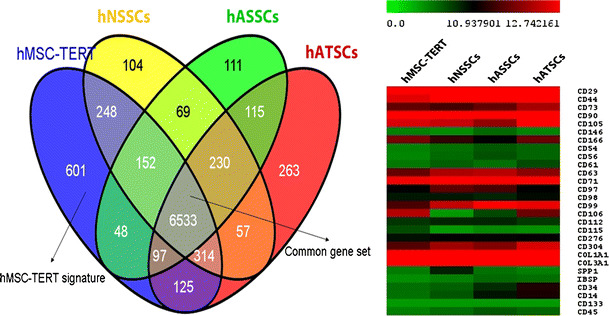
Microarray-based gene expression analysis of hMSC-TERT, hATSCs, hASSCs and hNSSCs. The human bone marrow stromal (mesenchymal) stem cells (hMSC) immortalized with human telomerase reverse transcriptase gene (hMSC-TERT) and stromal cells isolated from adipose tissue (hATSCs), adult dermal skin (hASSCs) and neonatal foreskin (hNSSCs) cells were cultured using plastic adherence. Total RNA was isolated and microarray analysis was carried out. a Venn diagram representing distinct and overlapping gene expression patterns between these cell populations. b Heat-map of a number of CD markers representing a common MSC molecular signature

References

    1. Kassem, M., Al-Nbaheen, M., Ali, D., & Aldahmash, A. (2010). Human Mesenchymal (skeletal) stem cells and clinical applications for bone tissue regeneration. In A. Bongso & E. H. Lee (Eds.), Stem Cells: From bench to bedside, 2nd edn (pp. 457–475). Singapore: World Scientific publishing co. pte. Ltd.
    1. Abdallah BM, Kassem M. Human mesenchymal stem cells: from basic biology to clinical applications. Gene Therapy. 2008;15:109–116. doi: 10.1038/sj.gt.3303067. - DOI - PubMed
    1. Le Blanc K, Frassoni F, Ball L, Locatelli F, Roelofs H, Lewis I, et al. Mesenchymal stem cells for treatment of steroid-resistant, severe, acute graft-versus-host disease: a phase II study. Lancet. 2008;371:1579–1586. doi: 10.1016/S0140-6736(08)60690-X. - DOI - PubMed
    1. Sacchetti B, Funari A, Michienzi S, Di Cesare S, Piersanti S, Saggio I, et al. Self-renewing osteoprogenitors in bone marrow sinusoids can organize a hematopoietic microenvironment. Cell. 2007;131:324–336. doi: 10.1016/j.cell.2007.08.025. - DOI - PubMed
    1. Stenderup K, Justesen J, Clausen C, Kassem M. Aging is associated with decreased maximal life span and accelerated senescence of bone marrow stromal cells. Bone. 2003;33:919–926. doi: 10.1016/j.bone.2003.07.005. - DOI - PubMed

Publication types