Review
. 2012 Apr 24;78(17):1354-62.
doi: 10.1212/WNL.0b013e3182518375.

Contextual social cognition and the behavioral variant of frontotemporal dementia

Affiliations
Review

Contextual social cognition and the behavioral variant of frontotemporal dementia

Agustin Ibañez et al. Neurology. .

Abstract

The significance of social situations is commonly context-embedded. Although the role of context has been extensively studied in basic sensory processing or simple stimulus-response settings, its relevance for social cognition is unknown. We propose the social context network model (SCNM), a fronto-insular-temporal network responsible for processing social contextual effects. The SCNM may 1) update the context and use it to make predictions, 2) coordinate internal and external milieus, and 3) consolidate context-target associative learning. We suggest the behavioral variant of frontotemporal dementia (bvFTD) as a specific disorder in which the reported deficits in social cognition (e.g., facial recognition, empathy, decision-making, figurative language, theory of mind) can be described as context impairments due to deficits in the SCNM. Disruption of orbitofrontal-amygdala circuit, as well as the frontal, temporal, and insular atrophy in bVFTD, suggests a relationship between context-sensitive social cognition and SCNM. In considering context as an intrinsic part of social cognition, we highlight the need for a situated cognition approach in social cognition research as opposed to an abstract, universal, and decontextualized approach. The assessment of context-dependent social cognition paradigms, the SCNM, and their possible application to neuropsychiatric disorders may provide new insight into bvFTD and other related frontal disorders.


Figures
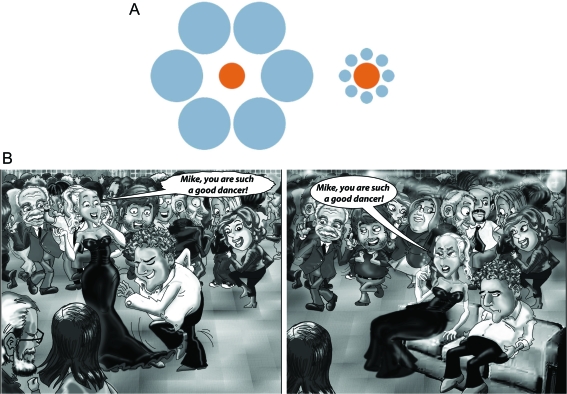
Figure 1
Figure 1. Context-dependent effects from visual perception to social cognition
(A) The Ebbinghaus illusion. (B) The role of social context in semantic and situational meaning. Two different social contexts (in this case, indexed by the emotional expression, the dancing situation, and the other's actions) dramatically alter the meaning of the same sentence: “Mike, you are such a good dancer!” This figure makes a comparison between visual perception and social cognition by pointing out that they can both generate instances where the same stimulus is differentially experienced as a function of context. But there is also a difference. The perceptual illusion is obligatory (i.e., intrinsic to the hard-wiring of the visual system) whereas the utterance and interpretation of the comments in B are conditional. The femme fatale has the choice not to utter the comment and the young man has the option of interpreting the comment as wistful/friendly or sarcastic/cruel. The critical input of our brain (mainly prefrontal cortex) is probably based on its ability to coordinate conditional behaviors and interpretations in social situations. Illustration by Carlos Becerra (B).
Figure 2
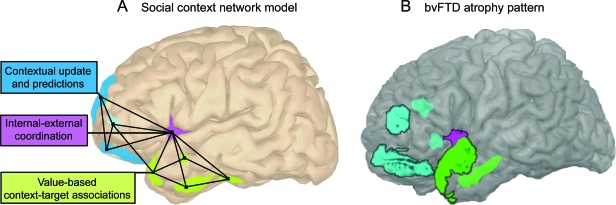
Figure 2. The social context network model (SCNM) and behavioral variant of frontotemporal dementia (bvFTD)
(A) The SCNM. Lateral view of the left hemisphere showing the proposed fronto-insular-temporal network (light blue, violet, and green regions of interest, respectively). In this context network, prefrontal areas (PFC) such as frontopolar and dorsolateral-prefrontal cortices would be involved in the generation of focused predictions via the update of associative activation of representations in the specific context. The insular cortex would provide the convergence point for emotional and cognitive states related to the coordination between external and internal milieus, facilitating the fronto-temporal interaction in social context processing. Finally, target-context associations stored in the temporal regions would be integrated with feature-based information processed in frontal regions. Connected nodes represent the fronto-insular-temporal interactions. (B) bvFTD atrophy pattern. Lateral view of earliest regions thought to be damaged in bvFTD, in the frontal, insular, and temporal areas (light blue, violet, and green regions of interest, respectively). Note the partial overlap with the nodes of the SCNM. Highlighted regions correspond to the following Brodmann areas: frontal (BA46, B10, BA11, BA24); temporal (BA20, BA21, BA38); and insula (BA48).

References

    1. Bar M. Visual objects in context. Nat Rev Neurosci 2004; 5: 617– 629 - PubMed
    1. Zhang NR, von der Heydt R. Analysis of the context integration mechanisms underlying figure-ground organization in the visual cortex. J Neurosci 2010; 30: 6482– 6496 - PMC - PubMed
    1. Schwartz O, Hsu A, Dayan P. Space and time in visual context. Nat Rev Neurosci 2007; 8: 522– 535 - PubMed
    1. Barrett LF, Bar M. See it with feeling: affective predictions during object perception. Philos Trans R Soc Lond B Biol Sci 2009; 364: 1325– 1334 - PMC - PubMed
    1. de Gelder B. Towards the neurobiology of emotional body language. Nat Rev Neurosci 2006; 7: 242– 249 - PubMed

Publication types

MeSH terms