


Individual participant data meta-analysis of prognostic factor studies: state of the art?
- PMID: 22530717
- PMCID: PMC3413577
- DOI: 10.1186/1471-2288-12-56
Individual participant data meta-analysis of prognostic factor studies: state of the art?
Abstract
Background: Prognostic factors are associated with the risk of a subsequent outcome in people with a given disease or health condition. Meta-analysis using individual participant data (IPD), where the raw data are synthesised from multiple studies, has been championed as the gold-standard for synthesising prognostic factor studies. We assessed the feasibility and conduct of this approach.
Methods: A systematic review to identify published IPD meta-analyses of prognostic factors studies, followed by detailed assessment of a random sample of 20 articles published from 2006. Six of these 20 articles were from the IMPACT (International Mission for Prognosis and Analysis of Clinical Trials in traumatic brain injury) collaboration, for which additional information was also used from simultaneously published companion papers.
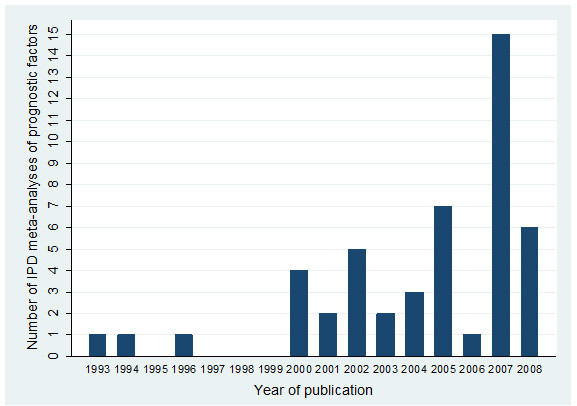
Results: Forty-eight published IPD meta-analyses of prognostic factors were identified up to March 2009. Only three were published before 2000 but thereafter a median of four articles exist per year, with traumatic brain injury the most active research field. Availability of IPD offered many advantages, such as checking modelling assumptions; analysing variables on their continuous scale with the possibility of assessing for non-linear relationships; and obtaining results adjusted for other variables. However, researchers also faced many challenges, such as large cost and time required to obtain and clean IPD; unavailable IPD for some studies; different sets of prognostic factors in each study; and variability in study methods of measurement. The IMPACT initiative is a leading example, and had generally strong design, methodological and statistical standards. Elsewhere, standards are not always as high and improvements in the conduct of IPD meta-analyses of prognostic factor studies are often needed; in particular, continuous variables are often categorised without reason; publication bias and availability bias are rarely examined; and important methodological details and summary results are often inadequately reported.
Conclusions: IPD meta-analyses of prognostic factors are achievable and offer many advantages, as displayed most expertly by the IMPACT initiative. However such projects face numerous logistical and methodological obstacles, and their conduct and reporting can often be substantially improved.
Figures
References
-
- Steyerberg EW, Mushkudiani N, Perel P, Butcher I, Lu J, McHugh GS, Murray GD, Marmarou A, Roberts I, Habbema JDF. et al.Predicting outcome after traumatic brain injury: Development and international validation of prognostic scores based on admission characteristics. PLoS Med. 2008;5(8):1251–1261. - PMC - PubMed
-
- Look MP, van Putten WL, Duffy MJ, Harbeck N, Christensen IJ, Thomssen C, Kates R, Spyratos F, Ferno M, Eppenberger-Castori S. et al.Pooled analysis of prognostic impact of urokinase-type plasminogen activator and its inhibitor PAI-1 in 8377 breast cancer patients. J Natl Cancer Inst. 2002;94(2):116–128. doi: 10.1093/jnci/94.2.116. - DOI - PubMed
-
- Sauerbrei W. Covariates. Wiley Encyclopedia of Clinical Trials. 2007. pp. 1–13.
Publication types
MeSH terms
Grants and funding
LinkOut - more resources
Full Text Sources
