Association between age-related decline of kidney function and plasma malondialdehyde
- PMID: 22530729
- PMCID: PMC3388493
- DOI: 10.1089/rej.2011.1259
Association between age-related decline of kidney function and plasma malondialdehyde
Abstract
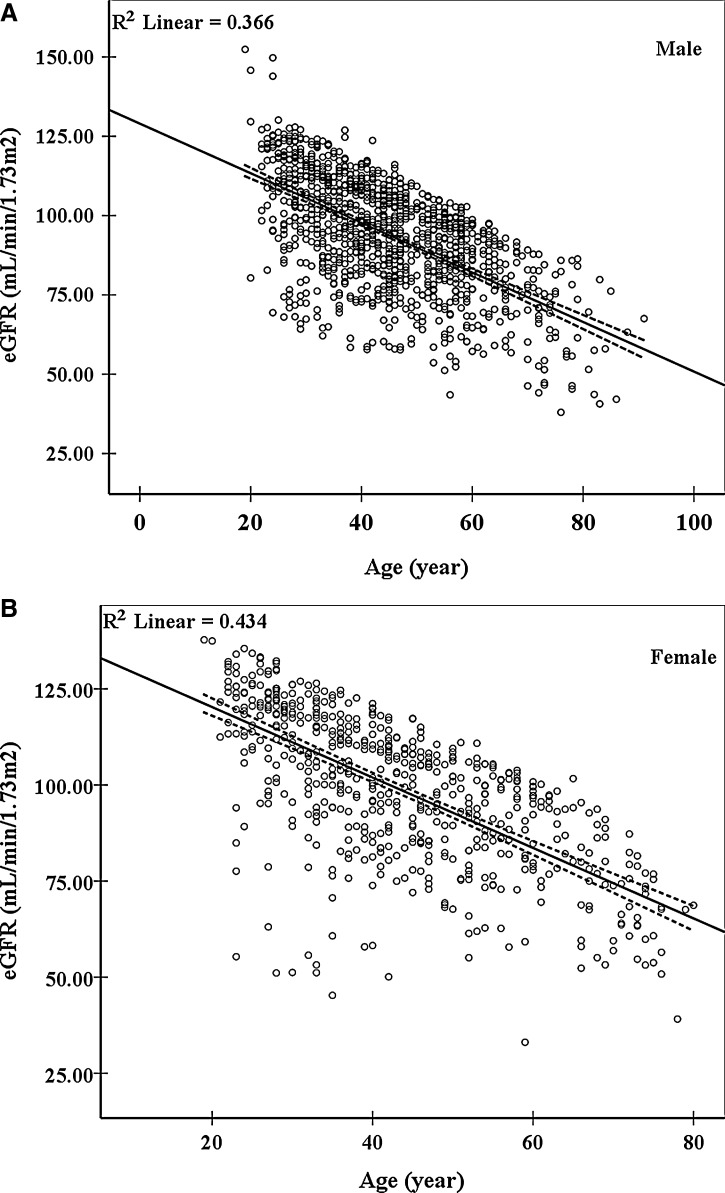
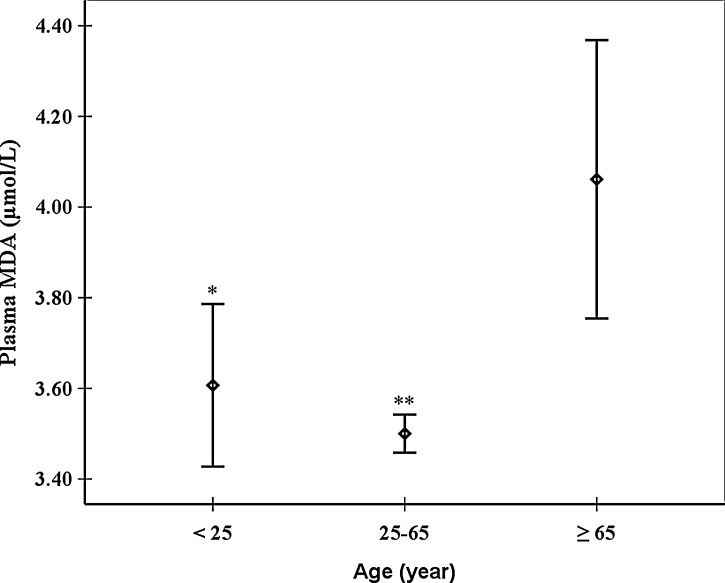
Oxidative stress is a key factor linked renal function decline with age. However, there is still no large cohort study exploring the potential role of oxidative stress in mild insufficiency of kidney function (MIKF) and chronic kidney disease (CKD) after adjusting for confounding factors. This study tested the hypothesis that oxidative stress, indicated by plasma malondialdehyde (MDA), is associated with the prevalence of MIKF and CKD after controlling the effects of confounding factors. Plasma levels of MDA and serum levels of fasting glucose, cholesterol, triglycerides, creatinine, alanine aminotransferase, and aspartate aminotransferase were analyzed from 2,169 Chinese Han adults. A questionnaire and physical examination were performed to identify and suspect risk factors of renal function decline with age. Kidney function, as indicated by estimated glomerular filtration rate, showed a significant decline with age in both male and female. Although the association between age and plasma MDA levels was nonlinear, MDA was negatively related to kidney function. The multivariate-adjusted odds ratios showed that plasma MDA had a significantly graded relation to the prevalence of MIKF and CKD with or without adjustment for covariates. By comparison with the lowest quartile, individuals with the highest quartile of MDA level had a 99% and 223% increased risk of developing MIKF and CKD, respectively. Further results from multiinteraction analysis demonstrated that plasma MDA may be the mediator linking different covariates with renal function decline. The most striking finding of this study was that oxidative stress, as indicated by plasma MDA levels, is associated with the prevalence of MIKF and/or CKD. Although imposing an increasing burden on the kidney and/or promoting a cyclical process of oxidative stress in the body, high levels of MDA in plasma may link the decline of kidney function with age.
Figures
References
-
- Yin DZ. Chen KJ. The essential mechanisms of aging: Irreparable damage accumulation of biochemical side-reactions. Exp Gerontol. 2005;40:455–465. - PubMed
-
- Gourtsoyiannis N. Prassopoulos P. Cavouras D. Pantelidis N. The thickness of the renal parenchyma decreases with age: A CT study of 360 patients. AJR. Am J Roentgenol. 1990;155:541–544. - PubMed
-
- Rowe JW. Andres R. Tobin JD. Norris AH. Shock NW. The effect of age on creatinine clearance in men: A cross-sectional and longitudinal study. J Gerontol. 1976;31:155–163. - PubMed
-
- Fehrman-Ekholm I. Skeppholm L. Renal function in the elderly (>70 years old) measured by means of iohexol clearance, serum creatinine, serum urea and estimated clearance. Scand J Urol Nephro. 2004;38:73–77. - PubMed
-
- Coresh J. Selvin E. Stevens LA. Manzi J. Kusek JW. Eggers P. Van Lente F. Levery AS. Prevalence of chronic kidney disease in the United States. JAMA. 2007;298:2038–2047. - PubMed
Publication types
MeSH terms
Substances
LinkOut - more resources
Full Text Sources
Medical