


Rule-governed behavior: teaching a preliminary repertoire of rule-following to children with autism
- PMID: 22532759
- PMCID: PMC3139547
- DOI: 10.1007/BF03393096
Rule-governed behavior: teaching a preliminary repertoire of rule-following to children with autism
Abstract
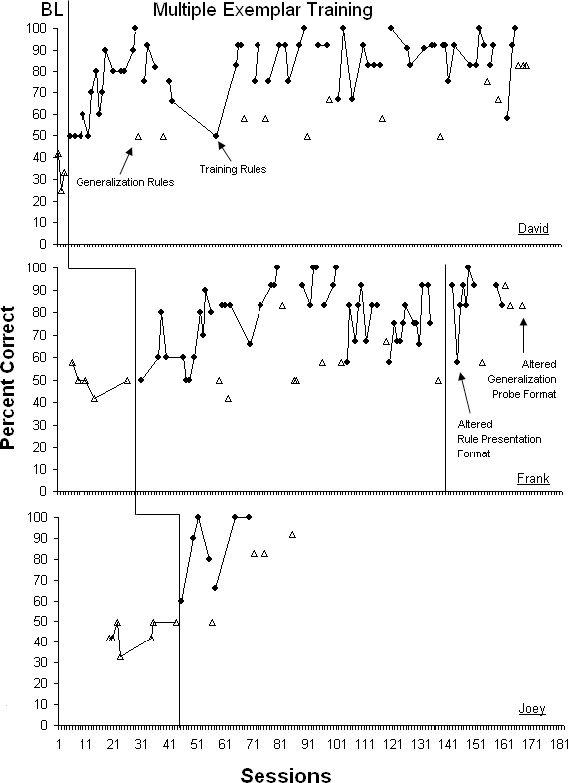
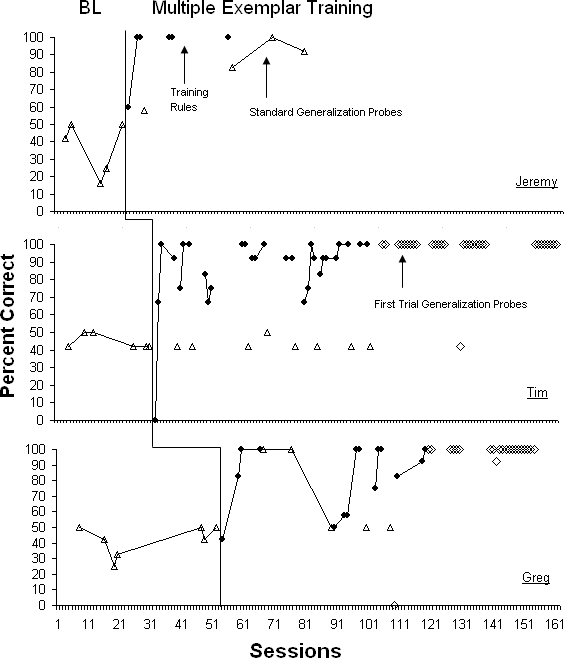
Rule-governed behavior is generally considered an integral component of complex verbal repertoires but has rarely been the subject of empirical research. In particular, little or no previous research has attempted to establish rule-governed behavior in individuals who do not already display the repertoire. This study consists of two experiments that evaluated multiple exemplar training procedures for teaching a simple component skill, which may be necessary for developing a repertoire of rule-governed behavior. In both experiments, children with autism were taught to respond to simple rules that specified antecedents and the behaviors that should occur in their presence. In the first study, participants were taught to respond to rules containing "if/then" statements, where the antecedent was specified before the behavior. The second experiment was a replication and extension of the first. It involved a variation on the manner in which rules were presented. Both experiments eventually demonstrated generalization to novel rules for all participants; however variations to the standard procedure were required for several participants. Results suggest that rule-following can be analyzed and taught as generalized operant behavior and implications for future research are discussed.
Keywords: autism; conditionality; instructional control; relational frame theory; rule-following; rule-governed behavior.
Figures
References
-
- Barnes-Holmes D, O'Hora D, Roche B, Hayes S.C, Bisset R.T, Liddy F. Understanding and verbal regulation. In: Hayes S.C, Barnes-Holmes D, Roche B, editors. Relational Frame Theory: A Post-Skinnerian Account of Human Language and Cognition. New York, NY: Kluwer; 2001. pp. 103–118. (Eds.)
-
- Barnes-Holmes Y, Barnes-Holmes D, Roche B, Smeets P. Exemplar training and a derived transformation of function in accordance with symmetry: II. The Psychological Record. 2001;51:589–604.
-
- Cooper J.O, Heron T.E, B Heward W.L. Applied behavior analysis. (2nd ed.) Upper Saddle River, NJ: Pearson Education; 2007.
LinkOut - more resources
Full Text Sources
