


Age-related treatment strategy and long-term outcome in acute myocardial infarction patients in the PCI era
- PMID: 22533539
- PMCID: PMC3407529
- DOI: 10.1186/1471-2261-12-31
Age-related treatment strategy and long-term outcome in acute myocardial infarction patients in the PCI era
Abstract
Background: Older age, as a factor we cannot affect, is consistently one of the main negative prognostic values in patients with acute myocardial infarction. One of the most powerful factors that improves outcomes in patients with acute coronary syndromes is the revascularization preferably performed by percutaneous coronary intervention. No data is currently available for the role of age in large groups of consecutive patients with PCI as the nearly sole method of revascularization in AMI patients. The aim of this study was to analyze age-related differences in treatment strategies, results of PCI procedures and both in-hospital and long-term outcomes of consecutive patients with acute myocardial infarction.
Methods: Retrospective multicenter analysis of 3814 consecutive acute myocardial infarction patients divided into two groups according to age (1800 patients ≤ 65 years and 2014 patients > 65 years). Significantly more older patients had a history of diabetes mellitus and previous myocardial infarctions.
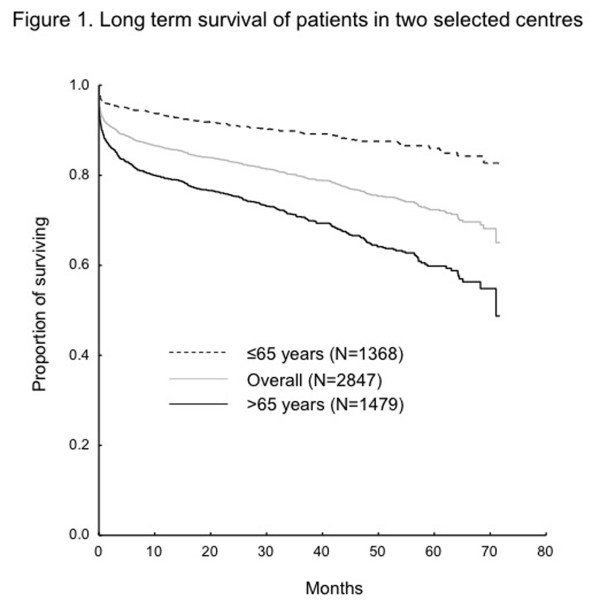
Results: The older population had a significantly lower rate of coronary angiographies (1726; 95.9% vs. 1860; 92.4%, p < 0.0001), PCI (1541; 85.6% vs. 1505; 74.7%, p < 0.001), achievement of optimal final TIMI flow 3 (1434; 79.7% vs. 1343; 66.7%, p < 0.001) and higher rate of unsuccessful reperfusion with final TIMI flow 0-1 (46; 2.6% vs. 78; 3.9%, p = 0.022). A total of 217 patients (5.7%) died during hospitalization, significantly more often in the older population (46; 2.6% vs. 171; 8.5%, p < 0.001). The long-term mortality (data for 2847 patients from 2 centers) was higher in the older population as well (5 years survival: 86.1% vs. 59.8%). Though not significantly different and in contrast with PCI, the presence of diabetes mellitus, previous MI, final TIMI flow and LAD, as the infarct-related artery, had relatively lower impact on the older patients. Severe heart failure on admission (Killip III-IV) was associated with the worst prognosis in the whole group of patients, though its significance was higher in the youngers (HR 6.04 vs. 3.14, p = 0.051 for Killip III and 12.24 vs. 5.65, p = 0.030 for Killip IV). We clearly demonstrated age as a strong discriminator for the whole population of AMI patients.
Conclusions: In a consecutive AMI population, the older group (>65 years) was associated with a less pronounced impact of risk factors on long-term outcome. To ascertain the coronary anatomy by coronary angiography and proceed to PCI if suitable regardless of age is crucial in all patients, though the primary success rate of PCI in the older age is lower. Age, when viewed as a risk factor, was a dominant discriminating factor in all patients.
Figures
References
-
- Danchin N, Puymirat E, Aissaoui N, Adavane S, Durand E. Epidemiology of acute coronary syndromes in France and in Europe. Ann Cardiol Angeiol (Paris) 2010;59(Suppl 2):S37–S41. - PubMed
-
- Yusuf S, Hawken S, Ounpuu S, Dans T, Avezum A, Lanas F, McQueen M, Budaj A, Pais P, Varigos J, Lisheng L. Effect of potentially modifiable risk factors associated with myocardial infarction in 52 countries (the INTERHEART study): case-control study. Lancet. 2004;364:937–952. doi: 10.1016/S0140-6736(04)17018-9. - DOI - PubMed
-
- Gharacholou SM, Lopes RD, Alexander KP, Mehta RH, Stebbins AL, Pieper KS, James SK, Armstrong PW, Granger CB. Age and Outcomes in ST-Segment Elevation Myocardial Infarction Treated With Primary Percutaneous Coronary Intervention: Findings From the APEX-AMI Trial. Arch Intern Med. 2011;171:559–567. doi: 10.1001/archinternmed.2011.36. - DOI - PubMed
Publication types
MeSH terms
LinkOut - more resources
Full Text Sources
Medical
Miscellaneous
