


Evaluating alert fatigue over time to EHR-based clinical trial alerts: findings from a randomized controlled study
- PMID: 22534081
- PMCID: PMC3392862
- DOI: 10.1136/amiajnl-2011-000743
Evaluating alert fatigue over time to EHR-based clinical trial alerts: findings from a randomized controlled study
Abstract
Objective: Inadequate participant recruitment is a major problem facing clinical research. Recent studies have demonstrated that electronic health record (EHR)-based, point-of-care, clinical trial alerts (CTA) can improve participant recruitment to certain clinical research studies. Despite their promise, much remains to be learned about the use of CTAs. Our objective was to study whether repeated exposure to such alerts leads to declining user responsiveness and to characterize its extent if present to better inform future CTA deployments.
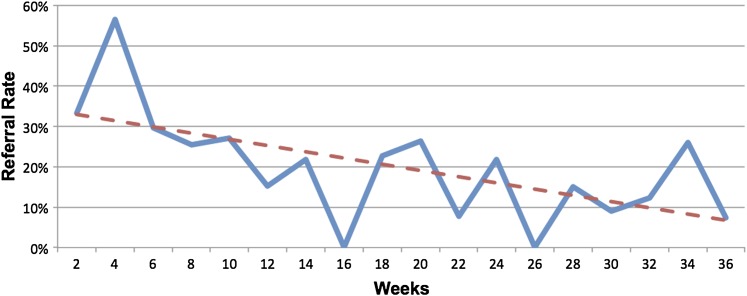
Methods: During a 36-week study period, we systematically documented the response patterns of 178 physician users randomized to receive CTAs for an ongoing clinical trial. Data were collected on: (1) response rates to the CTA; and (2) referral rates per physician, per time unit. Variables of interest were offset by the log of the total number of alerts received by that physician during that time period, in a Poisson regression.
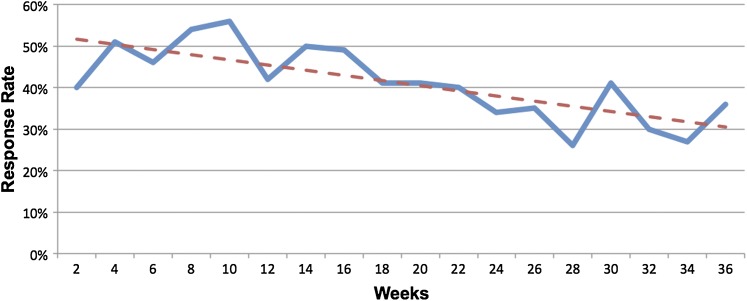
Results: Response rates demonstrated a significant downward trend across time, with response rates decreasing by 2.7% for each advancing time period, significantly different from zero (flat) (p<0.0001). Even after 36 weeks, response rates remained in the 30%-40% range. Subgroup analyses revealed differences between community-based versus university-based physicians (p=0.0489).
Discussion: CTA responsiveness declined gradually over prolonged exposure, although it remained reasonably high even after 36 weeks of exposure. There were also notable differences between community-based versus university-based users.
Conclusions: These findings add to the limited literature on this form of EHR-based alert fatigue and should help inform future tailoring, deployment, and further study of CTAs.
Conflict of interest statement
Figures
References
-
- Nathan DG, Wilson JD. Clinical research and the NIH: a report card. N Engl J Med 2003;349:1860–5 - PubMed
-
- Campbell EG, Weissman JS, Moy E, et al. Status of clinical research in academic health centers: views from the research leadership. JAMA 2001;286:800–6 - PubMed
-
- Mansour EG. Barriers to clinical trials. Part III: knowledge and attitudes of health care providers. Cancer 1994;74(9 Suppl):2672–5 - PubMed
-
- Siminoff LA, Zhang A, Colabianchi N, et al. Factors that predict the referral of breast cancer patients onto clinical trials by their surgeons and medical oncologists. J Clin Oncol 2000;18:1203–11 - PubMed
-
- Somkin CP, Altschuler A, Ackerson L, et al. Organizational barriers to physician participation in cancer clinical trials. Am J Manag Care 2005;11:413–21 - PubMed
Publication types
MeSH terms
Grants and funding
LinkOut - more resources
Full Text Sources
Medical
